|

Is EUR a 'growth currency' vulnerable to risk aversion?

EUR - a growth currency in the pre-crisis period, took over the role of the funding currency after the European Central Bank (ECB) hit the zero lower bound in 2014 and later adopted QE with negative rate policy. 

Being a funding currency, the EUR responded positively to risk aversion and vice versa. For example - in August 2015, the PBOC shocked markets with Yuan devaluation, The rsulting broad based risk aversion saw EUR/USD rally to a high of 1.1713. As of today, the level is unchallenged. 

On similar lines, the currency pair rallied to 1.1376 in the first quarter of 2016, tracking the oil-led risk-off in the global markets. 

2017 - EUR a risk currency?

Trump trade and the US reflation story fizzled out in Feb 2017. Thus, US dollar started losing ground. At the same time, the Eurozone turned the corner… courtesy of ‘peak populism’ and strong economic data. 
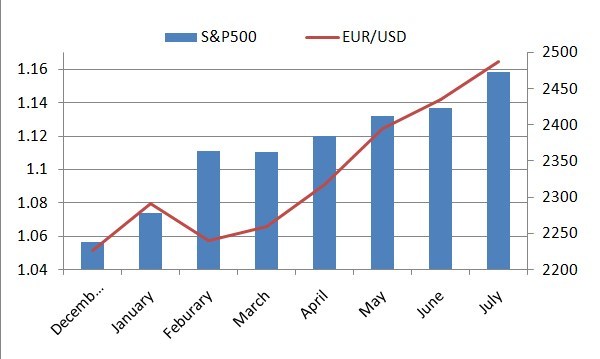
  • The chart above shows, the rally in the S&P 500 index has been followed closely by the EUR/USD pair. 
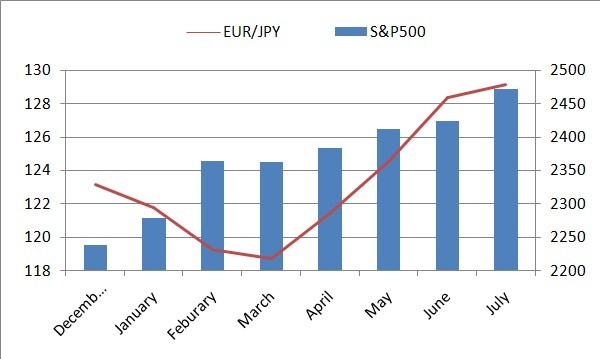
  • The EUR/JPY cross also seems to have regained its status global risk barometer. The chart above shows the cross has closely tracked the uptick in the S&P 500 this year. 

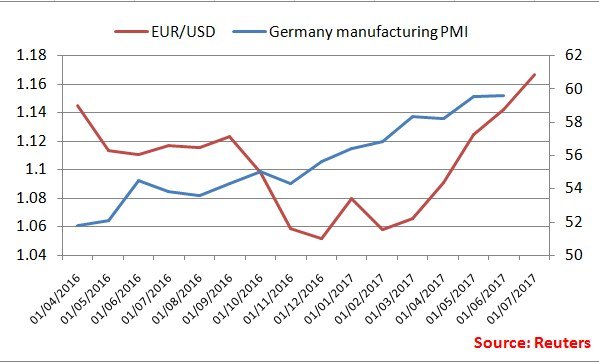
The fact that the EUR has also been responding positively to the stellar German and Eurozone PMI run also adds credence to the argument that it has been treated as a growth currency this year… PMIs had lost their charm (failed to move the EUR pairs) during 2015-2016. The chart below shows EUR has been closely following the German PMI. 
Finally, the fact that the ECB is moving closer to QE taper also strengthens the EUR’s appeal as a risk/growth currency. 

There is enough evidence that the common currency has been treated as a growth/risk-on currency this year, which means it is vulnerable to technical correction. EUR/USD looks set to test 1.18 and 1.20 this year unless we have a major correction in the stock markets. 

Author

Omkar Godbole

Omkar Godbole

FXStreet Contributor

Omkar Godbole, editor and analyst, joined FXStreet after four years as a research analyst at several Indian brokerage companies.


More from Omkar Godbole
Share:

Editor's Picks

GBP/USD off highs, back to 1.3620

GBP/USD remains slightly on the defensive at the end of the week, receding to the low 1.3600s after hitting fresh tops past 1.3670 earlier in the day. Cable’s correction comes after two daily gains in a row and amid a tepid advance in the Greenback, while poor UK data also accompany the downside.

EUR/USD treads water below 1.1700

EUR/USD now trades with modest losses around 1.1670 following another unsuccessful atempt to advance past 1.1700 the figure in a convincing fashion. The pair’s decline follows a maginal rebound in the US Dollar as market participants continue to assess recent US data as well as developments from the US bond market.

Gold trims gains, recedes to the sub-$4,600 area

Gold rapidly leaves behind Thursday’s inconclusive price action and advances markedly on Friday, briefly surpassing the $4,600 mark per troy ounce to hit three-month peaks. Meanwhile, the precious metal’s solid performance comes despite marginal gains in the buck coupled with another day of rising US Treasury yields across the curve.

Crypto Today: Bitcoin, Ethereum, XRP bulls accelerate rally amid rising ETF inflows

The cryptocurrency market remains bullish on Friday, led by Bitcoin’s surge above $77,000. Altcoins, including Ethereum and Ripple, mirror BTC’s positive outlook, trading near $2,400 and $1.35, respectively.

Week ahead – Fed’s Jackson Hole and Nvidia earnings to dictate markets

Kevin Warsh to make his Jackson Hole debut amid confusing messaging. But a major hawkish surprise unlikely after bond market intervention. Nvidia earnings to also determine market direction as stock rally cools.

$20 billion offered, $2 billion taken: Why Treasury doubled its buyback cap

The US Treasury moved off its own calendar on Wednesday, and that is the part worth sitting with. At 12:32 GMT, the department said it would at least double the size of liquidity support buyback operations in the 10-year to 20-year and 20-year to 30-year sectors, lifting the maximum from $2 billion per operation to at least $4 billion, effective September 9 and running to November 4.