|

International trade: From shortage to surplus?

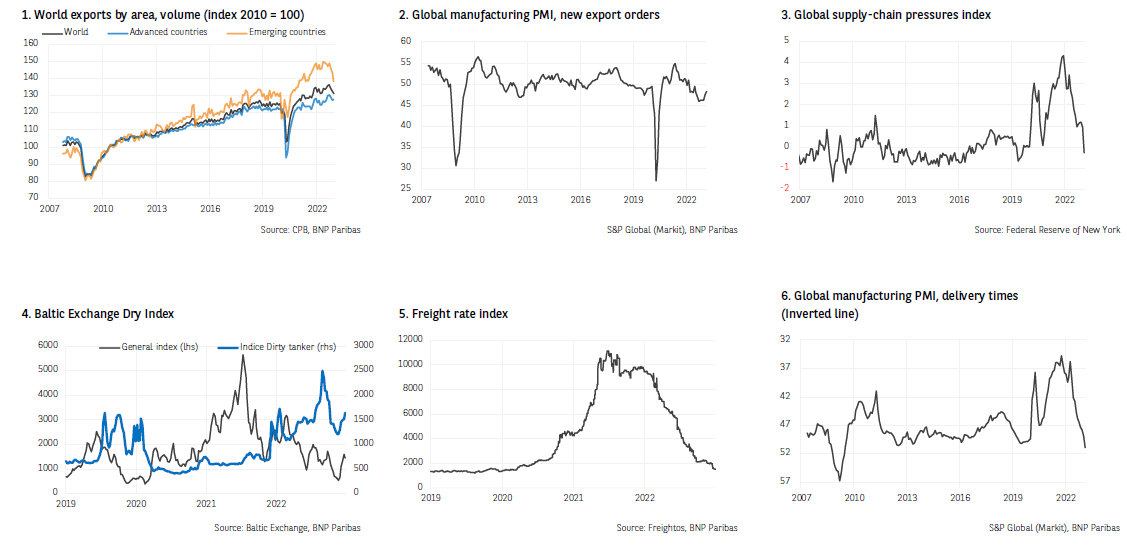
International trade data show quite clearly that the slowing of activity has been accentuated over recent months. Global export volumes (Chart 1), have continued to fall, according to the latest figures (December 2022). Health restrictions in China, which were only relaxed in mid-December, weighed on this dynamic. Nevertheless, global exports saw a 2.6% increase over the whole of 2022, relative to 2021.

The semiconductor sector, considered a good barometer of global activity, has seen falls in production levels and exports, which were amplified at the beginning of the year. This can be seen in particular in South Korea’s export figures, which are viewed as leading indicators: over the first 20 days of February exports, smoothed over three months, fell to their lowest level since October 2017. Although the risk of semiconductor shortages seems to have eased overall, supply in certain sectors, particularly the automotive industry, remains limited.

The slowdown in demand has eased further global production chains, in which bottlenecks had already largely cleared in the second half of 2022. The aggregate index of pressure on global supply chains (Chart 3) fell significantly in February as did the PMI delivery times component (Chart 6). Indeed, in February delivery times were the shortest since May 2009. Maritime freight (Chart 5) saw another fall of nearly 20% over the first half of March. Prices for container ship (Harpex index) were stable following a fall of 80% from its peak twelve months ago. However, the Baltic Dry Index of shipping costs (Chart 4) bounced back at the beginning of the year, due primarily to higher shipping costs for crude oil.
Chart

Download The Full Eco Flash

Author

BNP Paribas Team

BNP Paribas Team

BNP Paribas

BNP Paribas Economic Research Department is a worldwide function, part of Corporate and Investment Banking, at the service of both the Bank and its customers.


More from BNP Paribas Team
Share:

Markets move fast. We move first.

Orange Juice Newsletter brings you expert driven insights - not headlines. Every day on your inbox.

By subscribing you agree to our Terms and conditions.

Editor's Picks

EUR/USD bounces toward 1.1750 as US Dollar loses strength

EUR/USD returned to the 1.1750 price zone in the American session on Friday, despite falling Wall Street, which indicates risk aversion. Trading conditions remain thin following the New Year holiday and ahead of the weekend, with the focus shifting to US employment and European data scheduled for next week.

GBP/USD nears 1.3500, holds within familiar levels

After testing 1.3400 on the last day of 2025, GBP/USD managed to stage a rebound. Nevertheless, the pair finds it difficult to gather momentum and trades with modest intraday gains at around 1.3490 as market participants remain in holiday mood.

Gold trims intraday gains, approaches $4,300

Gold retreated sharply from the $4,400  area and trades flat for the day in the $4,320 price zone. Choppy trading conditions exacerbated the intraday decline, although XAU/USD bearish case is out of the picture, considering growing expectations for a dovish Fed and persistent geopolitical tensions.

Cardano gains early New Year momentum, bulls target falling wedge breakout

Cardano kicks off the New Year on a positive note and is extending gains, trading above $0.36 at the time of writing on Friday. Improving on-chain and derivatives data point to growing bullish interest, while the technical outlook keeps an upside breakout in focus.

Economic outlook 2026-2027 in advanced countries: Solidity test

After a year marked by global economic resilience and ending on a note of optimism, 2026 looks promising and could be a year of solid economic performance. In our baseline scenario, we expect most of the supportive factors at work in 2025 to continue to play a role in 2026.

Crypto market outlook for 2026

Year 2025 was volatile, as crypto often is.  Among positive catalysts were favourable regulatory changes in the U.S., rise of Digital Asset Treasuries (DAT), adoption of AI and tokenization of Real-World-Assets (RWA).