|

Inflation pressures in emerging economies
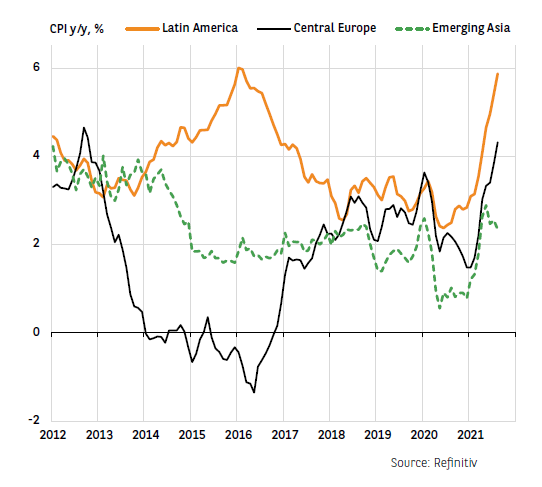
Emerging economies have faced mounting inflation pressures since the beginning of 2021. Headline inflation has continued to accelerate over the summer (except in Asia), primarily reflecting the rise in food and energy prices and weaker currencies against the USD. However, core inflation has also accelerated across the board. As a result, a growing number of central banks in Latin America and Central Europe have started to raise their policy rates. In Asia, inflation has remained low (North Asia) or has levelled off (India), allowing central banks to stay accommodative. So far, central banks engaged in a tightening cycle have increased their policy rate cautiously; even the more reactive ones (in countries such as Brazil and Russia) have remained behind the curve (i.e. the real policy rate is still negative or the central bank has not raised its policy rate as much as the acceleration in inflation).

Whether the increase in inflation is transitory or may become permanent is an open question. On the one hand, the impact of the strong recovery in oil prices is expected to subside with the scheduled increase in OPEC+ production quotas and assuming that global supply-chain disruptions fade rapidly. On the other hand, however, there is a risk of persisting price pressures in case of a lagged pass-through from higher food and energy prices to headline inflation, if supply bottlenecks take time to wane and induce supply-demand mismatches, and/or if nominal wages catch up rapidly with prices, entailing the potential de-anchoring of inflation expectations. Persistently high inflation could pose a downside risk to the economic growth outlook in emerging countries. Moreover, food price increases have been higher in countries where food insecurity is more prevalent, putting poorer households under greater stress and fueling a risk of social unrest.
Chart

Download The Full Eco Flash

Author

BNP Paribas Team

BNP Paribas Team

BNP Paribas

BNP Paribas Economic Research Department is a worldwide function, part of Corporate and Investment Banking, at the service of both the Bank and its customers.


More from BNP Paribas Team
Share:

Editor's Picks

EUR/USD holds lower ground near 1.1850 ahead of EU/ US data

EUR/USD remains in the negative territory for the fourth successive session, trading around 1.1850 in European trading on Friday. A broadly cautious market environment paired with modest US Dollar demand undermines the pair ahead of the Eurozone GDP second estimate and the critical US CPI data. 

GBP/USD keeps losses around 1.3600, awaits US CPI for fresh impetus

GBP/USD holds moderate losses at around 1.3600 in the European session on Friday, though it lacks bearish conviction. The US Dollar remains supported amid softer risk tone and ahead of the US consumer inflation figures due later in the NA session on Friday. 

Gold trims intraday gains to $5,000 as US inflation data loom

Gold retreats from the vicinity of the $5,000 psychological mark, though sticks to its modest intraday gains heading into the European session. Traders now look forward to the release of the US consumer inflation figures for more cues about the Fed policy path. The outlook will play a key role in influencing the near-term US Dollar price dynamics and provide some meaningful impetus to the non-yielding bullion.

US CPI data set to show modest inflation cooling as markets price in a more hawkish Fed

The US Bureau of Labor Statistics will publish January’s Consumer Price Index data on Friday, delayed by the brief and partial United States government shutdown. The report is expected to show that inflationary pressures eased modestly but also remained above the Federal Reserve’s 2% target.

A tale of two labour markets: Headline strength masks underlying weakness

Undoubtedly, yesterday’s delayed US January jobs report delivered a strong headline – one that surpassed most estimates. However, optimism quickly faded amid sobering benchmark revisions.

Solana Price Forecast: Mixed market sentiment caps recovery

Solana (SOL) is trading at $79 as of Friday, following a correction of over 9% so far this week. On-chain and derivatives data indicates mixed sentiment among traders, further limiting the chances of a price recovery.