|

India: Unemployment surges in May

In fiscal year 2019/20 (ended in March), India's GDP growth slowed sharply to only 4.2%, and growth prospects for the current fiscal year look extremely bleak. The slowdown in 2019/20 GDP is especially alarming considering that it predates the outbreak of the Covid-19 pandemic. The economy has slowed since 2018, and even without taking into account the impact of Covid 19, growth was set to fall far short of its long-term potential of 7.3% in the years ahead. As a result, Moody's has downgraded India's sovereign rating.

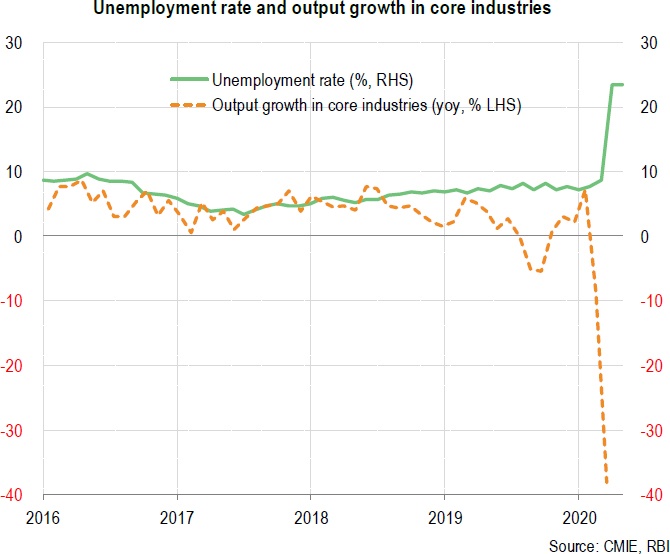
The latest economic indicators suggest a very severe contraction between April and June 2020. In April, electrical power generation and cement production fell 22.7% and 86% year-on-year, respectively, while merchandise transport plummeted 35%. For the second consecutive month, the unemployment rate hit 23.5% in May, compared to 7% in the year-earlier period, and the household confidence index fell dramatically. Even if the country were to ease the lockdown measures in place since 1 June, migrant workers are highly unlikely to return to the cities for several months.
Chart

Download The Full EcoFlash

Author

BNP Paribas Team

BNP Paribas Team

BNP Paribas

BNP Paribas Economic Research Department is a worldwide function, part of Corporate and Investment Banking, at the service of both the Bank and its customers.


More from BNP Paribas Team
Share:

Editor's Picks

GBP/USD drops to multi-week lows below 1.3300

GBP/USD sets aside Friday’s uptick and breaches below the 1.3300 yardstcik on Monday to hit new multi-week troughs. Falling crude oil prices following a pause in the Middle East conflict in combination with the recent soft reading in UK inflation appear to play against any BoE tightening ahead of the bank’s event later in the week.

EUR/USD meets support near 1.1370

EUR/USD fades the initial bull run past 1.1400 the figure, deflating toward the 1.1370 zone on Monday. That said, the pair reverses two daily drops in a row on the back of the irresolute price action in the US Dollar, at the time when investors continue to closely follow developments from the Middle East conflict. Next on tap is the release of the US Consumer Confidence gauge by the Conference Board.

Gold extends the drop below $4,050 on bullish USD

Gold extends the drop below $4,050 in the Asian session on Tuesday amid a bullish US Dollar. The downside seems limited as traders might opt to wait for the outcome of a two-day FOMC policy meeting on Wednesday. Furthermore, a pause in US-Iran hostilities led to a slump in Oil prices, easing inflationary concerns and tempering bets for Fed rate hikes, which could limit the Gold price pullback.

WTI consolidates near one-week low, around $81.00 as traders eye US–Iran talks
West Texas Intermediate (WTI) – the benchmark US Crude Oil price – is seen consolidating the previous day's heavy losses and trading around the $81.00 mark, just above a one-week high set during the Asian session on Tuesday. Traders now seem hesitant and opt to wait for further developments surrounding the Middle East crisis before placing fresh directional bets.
Neither Hormuz nor Oil at $120: Why Japanese bond yields are the real market threat
While geopolitical headlines continually send traders rushing to the Oil charts, history shows that the biggest market moves often begin when liquidity disappears, not when crude spikes. Rising bond yields, particularly in Japan and Switzerland, threaten to trigger the unwinding of one of the largest leveraged trades in financial history.
US Dollar mid-year outlook: Exceptional currency, exceptional risks?
The US Dollar enters the second half of 2026 in a markedly different position from a year ago. The King currency has recovered, reflecting persistent US inflation, changing expectations for Fed policy, geopolitical tensions and renewed demand for defensive assets.