If you want to get rich, built a portfolio to commodities first

There is a Chinese proverb that says: if you want to get rich, build a road first. To paraphrase the proverb, we would say: if countries want to become rich, they must first build infrastructure. The conditions for this to happen in the current era seem ideal. Policy makers will have to continue to provide liquidity after the end of the pandemic, with much of it going to private and public spending on infrastructure.
This policy will increase debt and, as a result, countries will inevitably keep interest rates lower than inflation and growth in order to make debt manageable. So, they will continue to implement the policy of Financial Repression for many more years. Low interest rates will create even greater incentives to invest in infrastructure in both developed and developing economies.
Developed economies mainly use the infrastructure that they developed and created many decades ago, so they are obliged to modernize them. Developing economies, on the other hand, are forced to invest in infrastructure to catch up with the infrastructure of developed countries and thus become competitive in order to effectively promote their products and services around the world.
In addition, for both developed and developing countries, humanity's next great challenge to Environmental Sustainability creates enormous infrastructure needs to support a sustainable environment for all countries of the world.
The need for infrastructure is reflected in the demand for commodity products that are necessary for them and is reflected in the prices of these commodities. Metal commodity prices, as shown in the following chart of the London Metal Exchange [LME] Index that consists of 6 major metals, increased significantly due to strong demand that much include infrastructure from the emerging economies and especially from China in the first decade of 2000, and until the 2008 financial crisis. The 2008 financial crisis hit the economy and created significant pressure on LME index prices which, however, recovered two years later. Then, as global growth slowed by the sovereign debt crisis, prices fell again and until last year they were looking for direction.
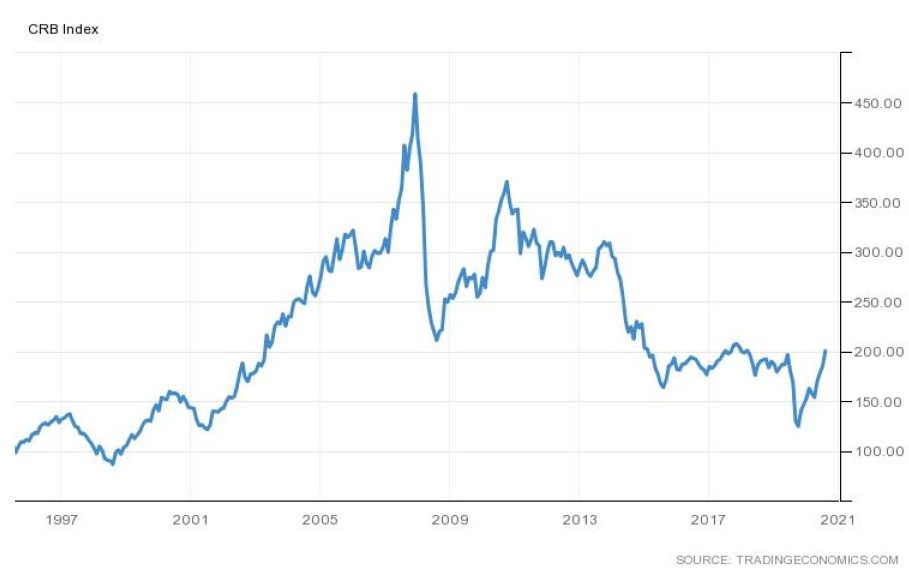
But since last year the conditions look different and that is why they deserve our attention. Actually, since the beginning of last summer and despite the high negative impact of the Covid-19 pandemic on global growth, LME prices have been rising steadily. This recent uptrend in LME prices is likely to be very different from the previous upward movements because for a number of reasons it's possible to indicate the beginning of a long rising cycle not only for metals but for more other commodities.
In fact, the return of the United States to the Paris Agreement on Climate Change is likely to trigger the new round of rising prices in commodities, as it will create, along with China and Europe, the axis of coordination of all countries for green investment all around the globe, which will require funds of many trillions of dollars. The needs in the market not only for metals but also for other commodities to cover the needs for the environmental sustainability becoming enormous and thus, can lead to a large upward cycle of all commodity prices.
In addition to green investments huge stimulus programs for the economies around the world are expected to significantly reduce unemployment, as the goal of policymakers is to create in many countries such as the US by 2022 conditions of full employment. If this is achieved, then wages and household income will increase. Wage increases, especially for middle-class households, would lead to faster housing formation, making strong demand for construction products and home appliances.
In summary, some of the important global conditions in the economy and the market are as follows:
-
Interest rates are and will remain low for many more years making debt manageable and financing the economy and large long-term infrastructure projects with cheap money.
-
Developed countries need to modernize their infrastructure while developing countries need to build infrastructure to be competitive in the global market.
-
The return of the United States to the Paris Agreement on climate change in conjunction with the relevant infrastructures that need to be built, which require investments of hundreds of billions of dollars, is likely to trigger a significant demand for goods related to environmental sustainability.
-
The huge stimulus programs of the economies will continue for a long time, leading to a reduction in unemployment, which will create a great demand for durable goods in the post-pandemic era.
All of these conditions establish a powerful combination capable of triggering a huge demand for all commodities and therefore a continuous long-term upward cycle of commodity prices.
Obviously, there is also the argument that economies are still in the middle of a pandemic and thus the economic recovery may be delayed. Also, some of the products like oil and petrol will be gradually withdrawn.
But consider, for the boost in commodities prices, they are not only what have mentioned above. The population of the earth is increasing rapidly, and in the last 20 years, people and companies are gaining more knowledge than ever before, so they are producing and consuming more than ever before. In fact, companies need more materials to produce more products that will be consumed by people who are now earning higher incomes than ever before.
And yet commodity prices as shown in the chart below, from the Thomson Reuters/Core Commodity CRB Index consisting of 19 commodities are close to the levels they were 20 years ago.
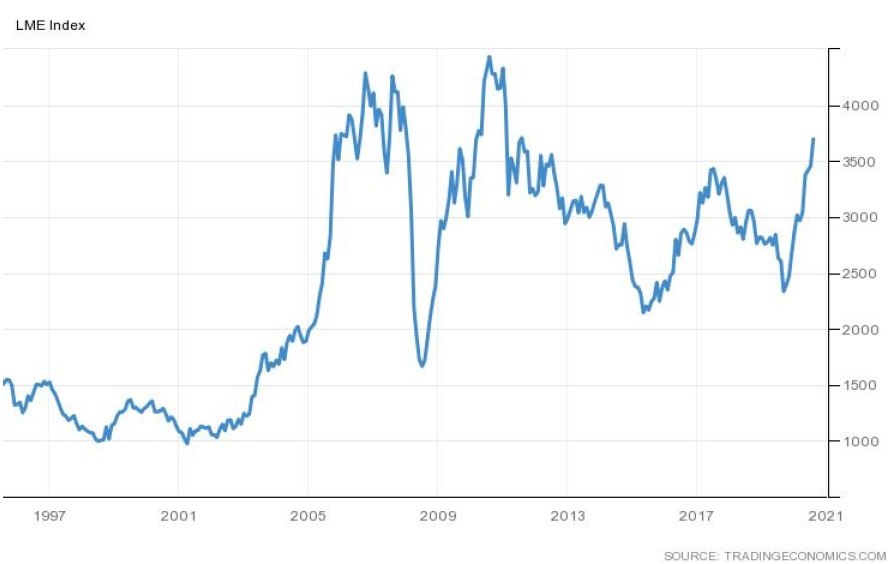
The global increase in demand for products is more than certain. The trigger for a new upward cycle seems to have been given by the metals market, confirming that the global reality is now creating new roads for economic growth.
So, trying to rewrite the Chinese proverb Ι would say that: If you want to get rich, built a portfolio to commodities first, because they are that will play a leading role in the construction of the new roads to global development.
Author
Nikolaos Akkizidis
LegacyFX
Mr Nikolaos Akkizidis is an economist, with 20+ years of experience in multiple roles in the financial sector.

















