How Trump might bypass US courts to continue his tariff agenda

A US court ruled that President Donald Trump exceeded his authority using the 1977 International Emergency Economic Powers Act (IEEPA) to impose tariffs. Directly affected by this ruling are the 10-30% tariffs on China, Canada, Mexico, and the rest of the world. The sectoral tariffs on steel, aluminium, and automotive, however, remain.
The ruling
On 28 May, a US federal court, the Court of International Trade, delivered a landmark ruling that US President Donald Trump overstepped his authority by imposing tariffs under the International Emergency Economic Powers Act (IEEPA). The court found that the IEEPA does not grant the president power to unilaterally impose broad import duties, especially when the declared national emergencies – such as drug trafficking, immigration, and trade imbalances – are not directly addressed by the tariffs themselves.
The court’s ruling mainly follows the argument that a trade deficit that has persisted for 49 years does not meet the requirement of an “unusual and extraordinary threat”.
The tariffs affected by the ruling
-
Fentanyl and immigration-related tariffs on imports from China, Canada, and Mexico, ranging from 10% to 30%.
-
Global trade surplus tariffs of 10% or more, including reciprocal tariffs that were suspended until 9 July.
The tariffs not affected by the ruling
The decision does not impact tariffs imposed under other legal authorities, such as:
-
Steel and aluminium tariffs (25%), in force since 12 March.
-
Autos and auto parts tariffs (25%), in force since 3 April and 3 May, respectively.
What happens now
The court has given the White House 10 days to halt the affected tariffs. However, the administration has already filed an appeal to the US Court of Appeals for the Federal Circuit. The case is widely expected to reach the Supreme Court, which could ultimately decide the legality of the IEEPA-based tariffs.
If the ruling is upheld, the US government may be required to refund tariffs collected under IEEPA, which amount to some $13.7bn up to 30 April, according to US Customs and Border Protection. A significant portion – $7.9bn – was paid on goods from China and Hong Kong.
What this means for future trade policy
Regardless of the outcome, the ruling is likely to shift the focus toward tariffs imposed under other trade laws and acts, such as:
-
Section 232 (national security).
-
Section 301 (unfair trade practices).
These statutes require more extensive investigations but ultimately still allow the president to act unilaterally. Several ongoing investigations could lead to new tariffs on:
-
Pharmaceuticals.
-
Semiconductors.
-
Trucks.
-
Critical minerals.
-
Seafood.
-
Cranes.
-
Copper.
-
Lumber.
-
Aircraft.
-
Shipbuilding.
Pending investigations/Section 232 and Section 301 tariffs to come
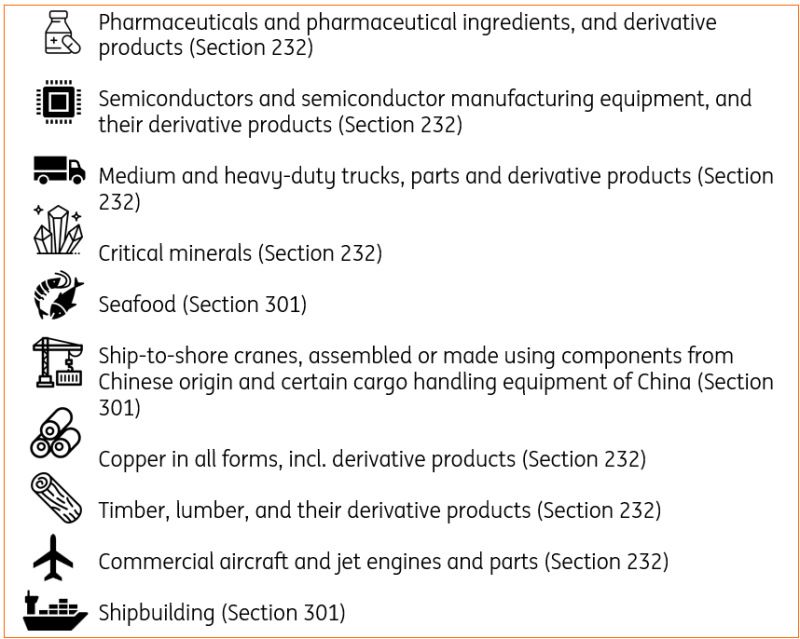
Source: White House, Federal Register, ING Research
Additionally, the administration retains the option to use Section 122 (balance of payments) and Section 338 (retaliatory tariffs), further expanding its tariff toolkit, as we’ve discussed previously here.
The bottom line
This ruling marks a significant legal and political challenge to the use of emergency powers in trade policy and adds another layer of uncertainty to the whole US trade policy. It also signals that companies and countries will likely intensify efforts to eliminate sector-based tariffs, which have become a favoured instrument of US trade enforcement. As of 30 April, these tariffs had generated $26.8bn in customs revenue for FY2025.
We expect the pace of sector-based tariffs to accelerate, with additional measures likely to be announced soon. This will be important for ongoing negotiations with the EU and China; the negotiations that have the strongest impact on the global economy and financial markets. In this regard, we warn against too much relief or even complacency at this point.
In the case of Europe, the largest part of tariffs affects the automotive sector, and this part simply remains in place. If the US administration moves along with the intended tariffs or quotas on European pharmaceuticals, the largest part of European exports to the US would still be subject to tariffs of more than 20%.
Finally, the pushback against President Trump could trigger more aggressive tariffs or other economic policy announcements, which may impact key trading partners. Let’s not forget that one justification behind current trade tensions was not only the US trade balance deficit but also the search for additional government revenues. The lack of which would further fuel the current debt (un-)sustainability debate.
Market reaction: A relief rally
US equity market futures greeted the court ruling with a rally of just over 1%. This reaction was no doubt helped by some encouraging first-quarter results from Nvidia. US Treasuries sold off 5bp across the curve on what could be some better news for the US consumer. However, we note that the 10-year US swap spread continues to trade wide at 55bp and there could be some concerns that a lower tariff revenue take will only compound fiscal concerns as President Trump pushes his expansionary bill through Congress.
The dollar has enjoyed a modest bounce on the news that Washington’s tariff policies do face some constitutional oversight after all. A large risk premium has been embedded in the dollar since April. This ruling could alleviate a little of that risk premium and allow the dollar to reconnect with some dollar-positive interest rate differentials. However, a significant dollar advance looks unlikely given the threat of new sectoral tariffs and concerns in the US Treasury market this summer.
Read the original analysis: How Trump might bypass US courts to continue his tariff agenda
Author
ING Global Economics Team
ING Economic and Financial Analysis
From Trump to trade, FX to Brexit, ING’s global economists have it covered. Go to ING.com/THINK to stay a step ahead.

















