How soon is the BoJ likely to resume interest rate hikes?
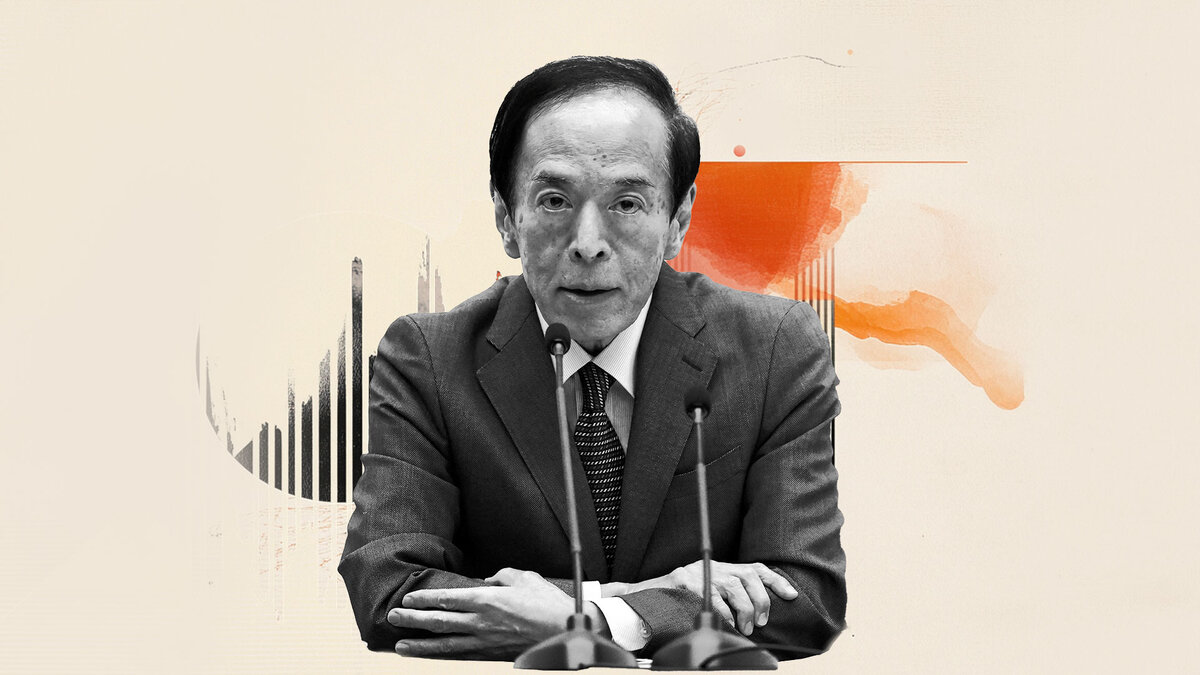

The Bank of Japan once again finds itself walking a tightrope between political pressure, economic data, and market expectations. With interest rates still anchored at 0.5%, speculation is growing over when Governor Ueda will pull the trigger on the next hike. But the decision is anything but straightforward, as Prime Minister Sanae Takaichi’s calls for continued monetary support clash with the BOJ’s growing concerns about inflation and currency weakness.
As December policy meetings approach, investors are watching closely for signs that Japan’s wage growth—and the yen’s trajectory—will finally give the central bank enough confidence to act. Let’s take a closer look:
Political pressure complicates the BoJ's decision
Japanese Prime Minister Sanae Takaichi's remarks yesterday, given her well-known support for aggressive fiscal and monetary easing, highlighted the difficult position in which the Bank of Japan now finds itself. Her administration’s preference for maintaining low rates and fiscal stimulus has already complicated the timing of the BOJ’s next rate hike, even before her latest statements.
This political dynamic adds further pressure to what is already a difficult judgment call. Central banks generally prize their independence from political interference, but Takaichi's public statements signal that any "aggressive" rate hikes would face pushback from the government. The Prime Minister's call for "close coordination" with the BOJ—while diplomatically phrased—carries an implicit expectation that monetary policy will support, rather than undermine, the government's economic agenda.
Next rate hike: December or January?
Although the BOJ left its benchmark rate unchanged at 0.5% during its last meeting, Governor Ueda has indicated that the central bank could raise rates as early as December if policymakers gain enough confidence that companies will sustain wage increases into next year. The timing hinges on evidence that Japan's wage growth momentum is sustainable and not a temporary phenomenon.
The BOJ's upcoming policy meeting on December 18-19 could represent a crucial decision point. By then, policymakers will have access to several key data releases that could provide decisive hints about next year's wage outlook. Most importantly, the central bank's quarterly "tankan" business survey—due on December 15, just days before the meeting—will offer fresh insights into corporate sentiment and hiring intentions. More corporate earnings reports for the current quarter will also be available, revealing whether companies have the financial capacity to sustain wage increases.
These data points are critical because the BOJ needs confidence that wage growth is becoming embedded in corporate behavior, not just a one-time adjustment. If the tankan survey shows businesses planning substantial wage increases for 2026, and if earnings remain robust enough to support those raises, the case for a December rate hike would strengthen considerably.
The case for waiting until January
However, many analysts believe the BOJ may opt for a more conservative approach by waiting until its January 22-23 meeting. Why? Because most major Japanese manufacturers finalize their wage plans at the start of the calendar year, meaning that waiting until late January would provide more concrete evidence of 2026 wage intentions rather than preliminary signals.
The January timing offers additional advantages for the central bank. By then, there will be greater clarity on the Takaichi administration's budget plans and broader economic policies, including details of the stimulus package currently being finalized. This would allow the BOJ to better assess the combined impact of fiscal and monetary policy on the economy.
Furthermore, the BOJ can offer a more thorough and detailed analysis justifying a rate hike in its quarterly outlook report, which is scheduled for release after the January meeting. This comprehensive report would provide political cover for what is certain to be a controversial decision, given the Prime Minister's stated preferences.
The risk of delay: Yen Weakness and imported inflation
Yet waiting too long carries its own risks. A delay in the next rate hike could trigger renewed yen declines that would push up import costs and fuel broader inflation. This is precisely the scenario the BOJ wants to avoid: interest rates that remain too low for too long, allowing the yen to weaken further and importing the kind of cost-push inflation that Takaichi herself has criticized.
The Yen is currently hovering around its lowest level against the Euro and a nine month low against the U.S. Dollar. This potential cycle of currency depreciation and import-price inflation creates a dilemma for the central bank: hike rates too soon, and risk undermining the wage growth and economic recovery that Japan desperately needs, or wait too long, and allow currency weakness to generate the exact type of harmful, cost-driven inflation that policymakers want to avoid.
The currency angle also illustrates how closely global monetary policies are intertwined, and the drivers behind the USD/JPY rally (or the EUR/JPY rally) warrant deeper examination. Is the move primarily due to a stronger U.S. Dollar as expectations for rate cuts fade, rather than yen weakness linked to Japan’s forthcoming fiscal stimulus? Japan cannot simply set interest rates based on domestic conditions alone; it must consider how its policy stance compares to other major economies as well and how those differentials affect the yen.
For now, the central bank appears to be hoping that currency markets remain relatively stable while it gathers more evidence on wages, inflation and growth. But if the yen begins another significant slide, the BOJ may find that currency considerations, rather than domestic data, ultimately determine the timing of its next move. In Japan's import-dependent economy, exchange rate stability isn't just a side consideration—it's increasingly central to the inflation outlook and, by extension, to monetary policy itself.
Weekly USD/JPY technical outlook
The USD/JPY pair is trading near its highest level since February 2025 at around 154.68, maintaining strong upward momentum. On the weekly chart, the pair has stayed above the Ichimoku cloud for over a month, confirming a sustained bullish trend. Both the RSI and MACD indicators remain in positive territory, further supporting the outlook for continued yen weakness and potential upside of the FX pair in the near term.
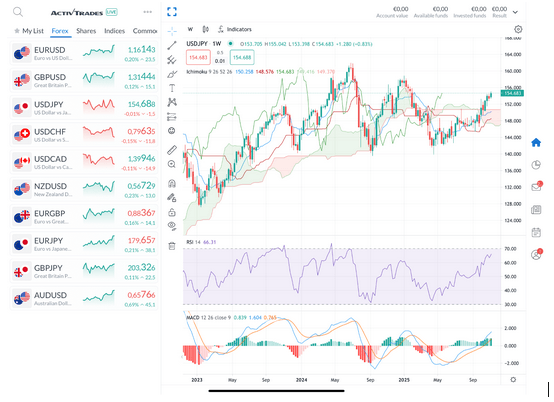
Weekly USD/JPY Chart - Source: ActivTrader
Stay up to date with what's moving and shaking on the world's markets and never miss another important headline again! Check ActivTrades daily news and analyses here.
Stay up to date with what's moving and shaking on the world's markets and never miss another important headline again! Check ActivTrades daily news and analyses here.
Author
Carolane de Palmas
ActivTrades
Carolane graduated with a Masters in Corporate Finance & Financial Markets and got the AMF Certification (Financial Markets Regulator in France). Afterward, she became an independent trader, investing mostly in European and American stocks/indices.