How Are China-Dependent Economies Performing?


Fears about a deceleration in the Chinese economy continue to weigh on financial markets. When looking at GDP growth in China-dependent economies, growth has not fallen off a cliff, but it is the slowest since 2009.
Analyzing the Chinese Economy Through a Different Lens
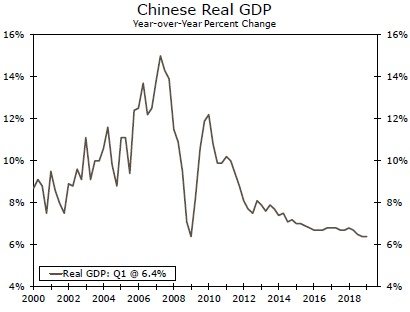
Fears about global growth generally and China specifically remain at the forefront for financial markets. Yet, even just analyzing the current state of the Chinese economy can be a challenging task. Economic data in China is less granular and transparent than it is in places like the United States, and some analysts have questioned the veracity of the Chinese figures. Unlike most countries, China also has an explicit growth target, perhaps making GDP and other indicators partly endogenous variables (top chart).
To develop another lens through which to view the Chinese economy, we first ranked the world's economies by how much of each country's total value added is derived from final demand in China. Next, we took an unweighted average of year-over-year real GDP growth in the five economies with the largest China exposure (Taiwan, Hong Kong, Malaysia, Singapore and Korea) as well as Chile and Australia, which ranked eighth and tenth, respectively, and provide some geographic diversity. Using an unweighted average of GDP growth in these seven economies gives a sense of whether all of these economies are moving in the same direction, as a quirk in one economy's performance is less likely to dominate the overall measure.
Perhaps the first conclusion we can draw from this measure is that there exists a fairly solid relationship between this constructed series and Chinese economic growth, though there are differences in magnitude (middle chart, note the two different axes). The correlation coefficient between the two is relatively high, about 0.62 since 2001. Another interesting finding is that China is not alone in seeing less volatile economic growth in the current expansion. The standard deviation in the average growth rate for the Chinadependent economies was 2.1 from 1999 to 2007 but just 1.6 from 2010 to the present. This provides some evidence that the remarkable steadiness in Chinese real GDP growth over the past several years is not solely due to calculation methods used by the Chinese authorities.
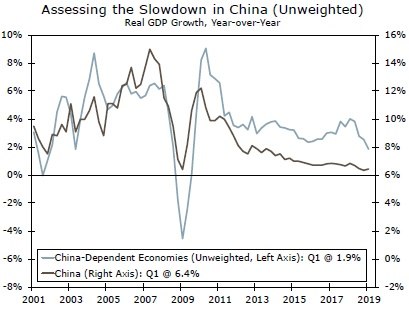
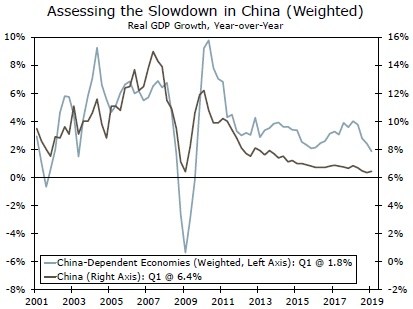
The implications for global growth are more mixed. Encouragingly, average growth in the China-dependent economies has not completely fallen off a cliff, as it did during the Great Recession or the Asian Financial Crisis. This is consistent with reported real GDP growth in China, which has only slowed by 0.4 percentage points since Q1-2018. That said, average growth in the China-dependent economies has been halved since Q1-2018 and is below 2% for the first time since 2009. Using the same methodology but instead weighting the economies by their relative exposure to China offers a similar result (bottom chart). In our view, this analysis suggests that the Chinese economic outlook may be a bit more concerning than the official data suggest. Thus, with China-dependent economies flashing a warning sign and the struggles in Europe ongoing, a further escalation in the U.S.-China trade dispute could slow global growth to lows not seen since the Great Recession.
Author
Wells Fargo Research Team
Wells Fargo