High frequency activity tracker – European recovery led by an odd couple


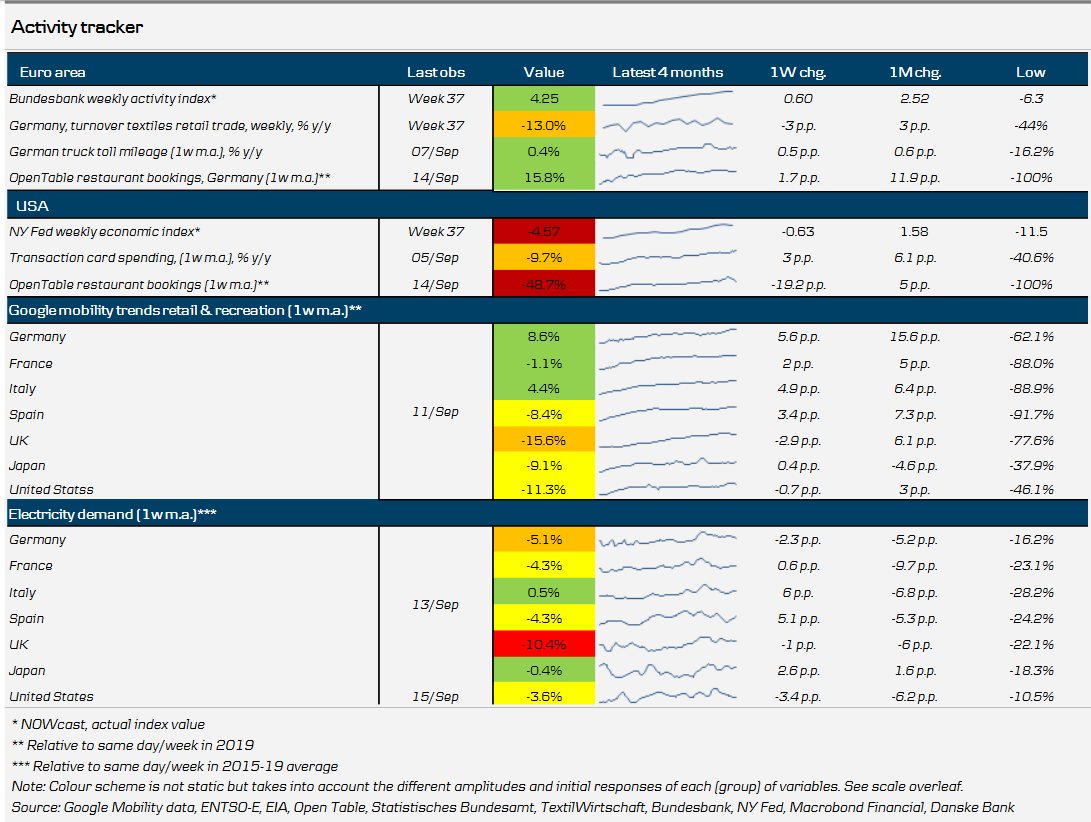
Google mobility trends in retail and recreation improved in the four euro area members again this week. Germany and Italy are now both well above pre-COVID-19 pandemic levels. Common for both countries is a relatively low current infection rate in the second wave, which seems to be transitioning into a speedier recovery. However, German electricity demand remains lower than the pre-pandemic level, with no sign of improvement in the past month.
The US recovery remains on track, with the past week again bringing a small overall improvement and an expected fall of 19pp in restaurant bookings due to extraordinary Labour Day activity. The pattern around Labour Day suggests the low rate of bookings is due to hesitance in spending rather than the fear of catching COVID-19 from eating out. On the upside, card spending in the US crossed into ‘some improvements' territory last week, with an increase of 3pp.
Explanation
In this document, we present a range of high frequency data points in order to assess the current state of key economies. High frequency data is of particular interest in the COVID-19 crisis, as conventional data points come with a significant lag and do not necessarily show the true picture in extraordinary times.
Data series
Google Mobility tracks the (physical) movement trends of people over time and across different categories among the public, such as retail and recreation, groceries and pharmacies, parks, transit stations, workplaces and residential. We focus on the retail and recreation category and use this as a measure of ‘social life' (see more here).
OpenTable restaurant bookings. This includes seated diners at restaurants in the OpenTable network across online reservations, phone reservations and walk-ins. We compare data with the same day of the week in the previous year. Only states or cities with 50-plus restaurants in the sample are included.
Electricity demand: We compare current demand with average demand for the same period (day/week) over 2015-19. Factors other than economic activity, for example weather conditions, can affect demand for electricity, so we suggest reading smaller movements with caution.
New York Weekly Economic Index is an index of real economic activity in the US using high frequency data. If the index is -2 for a full quarter, the expected GDP in the given quarter would be 2% lower than in the same quarter the previous year.
Bundesbank Weekly Activity Index is designed to measure real-time real economic activity in Germany using both high frequency data and, for example, industrial production (monthly). It fluctuates around the long-term mean; hence, a value above (below) zero indicates growth above (below) the long-term average. Therefore, we cannot equate the index directly with quarterly GDP growth in the same way we can with the New York weekly economic index.
Download The Full The Big Picture
Author
Danske Research Team
Danske Bank A/S
Research is part of Danske Bank Markets and operate as Danske Bank's research department. The department monitors financial markets and economic trends of relevance to Danske Bank Markets and its clients.