Here's one reason this Gold bull run likely still has legs

Gold has surged to record highs of over $2,350 per ounce, and there is reason to believe this bull run has plenty of legs left.
Gold dipped below $2,000 for the last time in mid-February. Since that time, it has gained nearly 18 percent. But despite the rally, a lot of investors in the West have not jumped on the bandwagon – yet.
In fact, pundits on financial news networks have been poo-pooing this gold bull run all the way up. On March 8, CNBC featured a commodity analyst urging people to sell gold. Since then, the price is up over 8 percent.
You can see that institutional investors have been slow to jump into the rally by looking at the flow of gold into and out of exchange-traded funds (ETFs).
A gold ETF is backed by metal owned and stored by the issuer. In most cases, investing in an ETF does not entitle you to any amount of physical gold. You own a share of the ETF, not gold itself. The movement of gold into and out of ETFs can have a significant impact on supply and demand dynamics.
Even with the price of gold climbing rapidly, there are still outflows of metal from gold-backed funds. The last time ETFs added gold on net globally was October 2023, and that was a one-off event.

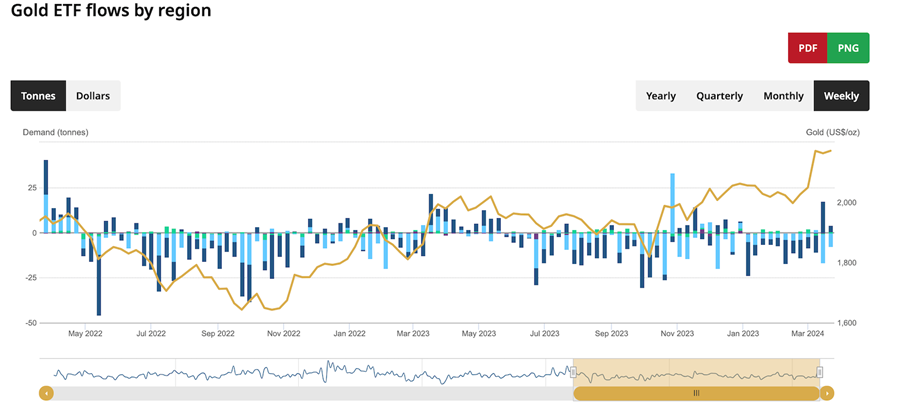

But as Abrdn director of investment strategy Robert Minter noted in an interview with Kitco News, outflows of gold from ETFs have slowed to a trickle in recent weeks. Even a slowdown in selling can shift supply and demand dynamics, and if ETFs begin adding gold, that shift could be significant.
Over the last year, around 750 tons of gold have flowed out of ETFs globally. That dumped a large supply of gold into the marketplace.
Central banks took up that slack and then some. In 2023, central banks globally increased their gold reserves by a net of 1,037 tons. That was just 45 tons short of 2022’s multi-decade record.
There is no indication that central bank gold buying will slow down. As Minter noted, “If you were a prudent central bank fund manager in some of these countries, you would diversify away from the dollar to reduce your risk, plain and simple.”
With ETF gold selling slowing and a flip to buying possibly on the horizon, along with continued robust central bank buying, we could see a significant strain on the gold supply, driving prices even higher.
Minter said he thinks a lot of institutional investors are waiting until the Federal Reserve delivers a rate cut to jump into the fray. And while sticky inflation and strong economic data have pushed the timing of cuts later into the year, Minter said he doesn’t think the Fed can wait too long given the levels of debt in the economy.
“If you were the Chair, you would have to know the impact of the magnitude of the rate rises you've done in a short time will have on the economy. This kind of monetary policy usually breaks something in the economy on a structural level, and you have to play catch up really quickly. You certainly wouldn't risk much higher unemployment just to bring housing inflation down a few tenths of a percent.”
Minter said regardless of the timing, cuts are the next move for the central bank. That could give buying another boost, and that is bullish for gold.
“Regardless of timing or magnitude, the next Fed funds move is a cut, and historically, that led to 57 percent, 235 percent, and 69 percent gold price increases in 2000, 2006, and 2018. Even with prices up 18 percent, we haven’t seen anything yet.”
The reality is the Fed structurally broke the economy more than a decade ago when it pushed interest rates to zero in 2008 and held them there for nearly a decade, and then doubled down with loose monetary policy during the pandemic. It’s only a matter of time before that breakage manifests itself. At that point, the Fed will be forced to cut much faster and deeper than most people anticipate.
Minter is right. We haven’t seen anything yet.
To receive free commentary and analysis on the gold and silver markets, click here to be added to the Money Metals news service.
Author

Mike Maharrey
Money Metals Exchange
Mike Maharrey is a journalist and market analyst for MoneyMetals.com with over a decade of experience in precious metals. He holds a BS in accounting from the University of Kentucky and a BA in journalism from the University of South Florida.