Headwinds for Oil prices: Output hikes and trade uncertainty

As the global oil market moves into the second half of 2025, the outlook remains clouded by uncertainty. While analysts still anticipate moderate growth in global oil demand, this is being increasingly offset by a sharp rise in supply and persistent geopolitical and trade-related tensions. These combined forces are putting significant downward pressure on oil prices and dampening investor sentiment.
According to financial data from ActivTrades, Brent crude prices have fallen nearly 14% since the start of the year, with April marking a particularly bearish month — prices dropped close to 19%, their steepest monthly decline in years. Despite brief rebounds driven by diplomatic developments, overall momentum remains weak as the market struggles to absorb a growing supply glut.
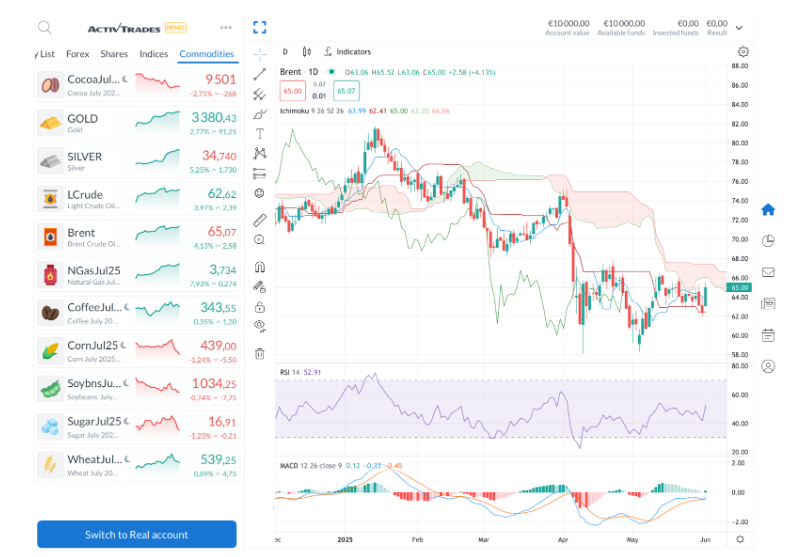
Daily Brent Chart - Source: ActivTrader
For traders and investors, navigating this volatile environment means staying vigilant and understanding the factors influencing oil prices.
Among the most critical are the strength and trajectory of global economic growth, changes in OPEC and non-OPEC production, geopolitical risks such as supply disruptions or regional conflicts, and fluctuations in Saudi Arabian output (the largest oil producer in the world). The U.S. dollar — often inversely correlated with oil prices — also plays a central role, along with seasonal demand patterns and the behavior of speculative traders in oil futures markets.
Weak demand and trade tensions dampen Oil outlook
According to a Reuters poll conducted in May, global oil demand is expected to grow by an average of 775,000 barrels per day this year. This is slightly higher than the International Energy Agency’s latest forecast of 740,000 barrels per day. However, this growth is slower than previous years and reflects broader economic concerns. Analysts point to persistent trade tensions, the possibility of a global economic slowdown, and the accelerating shift to electric vehicles as key headwinds limiting demand.
Price forecasts have also been downgraded for the third month in a row. The same Reuters survey now sees Brent crude averaging $66.98 per barrel in 2025, down from $68.98 previously. U.S. crude (WTI) is forecast at $63.35, lower than April’s estimate of $65.08. These projections are a notable drop from the year-to-date averages of around $71 for Brent and $67.50 for WTI.
Even though some trade tensions have eased, uncertainty around tariffs and international negotiations remains a major factor clouding the outlook. Tobias Keller, analyst at UniCredit, notes that unresolved trade conflicts could continue to depress global demand for oil products.
In the U.S. and China — the world’s two largest consumers of oil — demand growth is being curbed by improvements in fuel efficiency, slowing economic momentum, and the continued rise of electric vehicles. Meanwhile, Russia’s war in Ukraine remains a geopolitical wildcard, although analysts believe the risk premium has already been mostly priced into the market.
Bank of America has warned that the ongoing trade war could slash oil demand growth by half this year, precisely as OPEC+ adds more barrels to the market. The bank sees a potential surplus of 1.25 million barrels per day and warns that escalating tariffs could lead to broader economic repercussions, reducing business activity and, ultimately, fuel consumption.
Oil price outlook: A bearish consensus emerges
J.P. Morgan lowered its Brent crude forecast to $66 for 2025 and $58 for 2026. The bank expects oil demand to grow by just 800,000 barrels per day this year, down 300,000 from its earlier forecast. Despite some optimism around the effects of recent trade deals, J.P. Morgan believes that oil prices are unlikely to return to the mid-$70s range in the current environment.
According to Natasha Kaneva, head of Global Commodities Strategy at the bank, the U.S. administration’s priority to lower crude prices to manage inflation — potentially targeting levels as low as $50 per barrel — limits any upside potential.
Goldman Sachs holds a similar outlook. They predict Brent will average $60 per barrel in 2025 and WTI $56. They anticipate a rising oil surplus: 1 million barrels per day this year, jumping to 1.5 million in 2026. Goldman also expects OPEC+ to increase production by 411,000 barrels per day in August, further pressuring prices.
UBS analyst Giovanni Staunovo has outlined a worst-case scenario in which a deeper U.S. recession combined with a hard landing in China could push Brent prices down to as low as $40–$60 per barrel in the coming months.
Stay up to date with what's moving and shaking on the world's markets and never miss another important headline again! Check ActivTrades daily news and analyses here.
Stay up to date with what's moving and shaking on the world's markets and never miss another important headline again! Check ActivTrades daily news and analyses here.
Author

Carolane de Palmas
ActivTrades
Carolane graduated with a Masters in Corporate Finance & Financial Markets and got the AMF Certification (Financial Markets Regulator in France). Afterward, she became an independent trader, investing mostly in European and American stocks/indices.