Greenflation: How inflationary is the energy transition?

Green production will initially cost more
The green transition will largely involve a change in production methods. The physical capital used to produce today is largely responsible for the high greenhouse gas (GHG) emissions. In order to produce “green”, this capital will need to be replaced by structures, equipment, materials and techniques that emit fewer GHGs. These major changes are likely to be inflationary, although opposite effects cannot be ruled out. We distinguish between several channels.
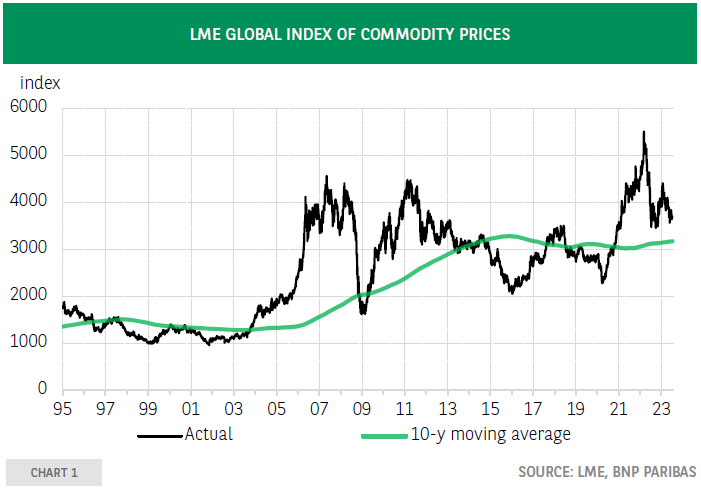
First, some of the minerals needed to develop a “net zero” industry are available in limited quantities and some are difficult to extract even though they are in high demand. According to the International Energy Agency, total demand for minerals to produce low-carbon technologies is expected to increase fourfold by 20401 assuming that the objectives of the Paris Agreements are met (see Chart 1). Regarding lithium, for example, for which demand is expected to quadruple between 2025 and 20352, scientists are still divided as to whether the reserves available will be sufficient to meet the growing demand for electric batteries. A first major difficulty comes from the high concentration of ore supply in the hands of a very small number of producers.
Author

BNP Paribas Team
BNP Paribas
BNP Paribas Economic Research Department is a worldwide function, part of Corporate and Investment Banking, at the service of both the Bank and its customers.
















