Gold Weekly Forecast: XAU/USD to remain bearish amid rising US yields
- Gold recovered from monthly lows but closed the week in the red.
- The technical outlook points to a neutral bias in the near term.
- FOMC Minutes next week could impact the market pricing of Fed rate hikes.

Gold suffered heavy losses at the beginning of the week amid surging US Treasury bond yields but managed to stage a rebound mid-week. With the greenback starting to gather strength ahead of the weekend, XAU/USD failed to extend its recovery and ended up posting weekly losses.
What happened last week?
The bond selloff continued on Monday and the yield on the benchmark 10-year reference reached its highest level since May 2019 at 2.55%, causing inversely-correlated gold to fall sharply. XAU/USD extended its slide and touched its weakest level in nearly a month at $1,873 early Tuesday.
With month/quarter-end flows triggering a decline in yields on Wednesday and Thursday, XAU/USD reversed its direction and gained nearly 1% in that two-day period. Some cautious comments from Fed officials on the policy outlook also weighed on yields in the first half of the week.
"There are some signs in the data, and in what we hear from our contacts, that supply chain constraints are finally easing,” Philadelphia Fed President Patrick Harker said and argued that rate hikes need to be deliberate and methodical. Additionally, Atlanta Fed President Raphael Bostic noted that the heightened uncertainty due to the Russia-Ukraine conflict was a source of risk for demand.
In the meantime, risk flows dominated the markets amid renewed optimism for a diplomatic solution to the Russia-Ukraine conflict and caused the safe-haven dollar to lose interest. Following Tuesday’s talks, a Ukrainian negotiator said that they made enough progress to plan a meeting between Ukrainian President Volodymyr Zelenskyy and his Russian counterpart Vladimir Putin. Furthermore, Russia’s ministry of defense announced that military activity in Kyiv and Chernihiv will be scaled down significantly in order to create conditions for further dialogue.
On Wednesday, the data from the US showed that employment in the private sector increased by 455,000 in March and the real Gross Domestic Product expanded at an annualized rate of 6.9% in the fourth quarter. The US Bureau of Economic Analysis reported on Thursday that the Core Personal Consumption Expenditures (PCE) Price Index, the Fed’s preferred gauge of inflation, edged higher to 5.4% on a yearly basis from 5.2% Although this print came in slightly lower than the market expectation of 5.5%, it helped the dollar hold its ground and limited XAU/USD’s upside.
The 10-year US T-bond yield regained its traction on Friday and retraced the majority of its weekly decline, making it difficult for gold to build on its recovery gains. The US Bureau of Labor Statistics announced that Nonfarm Payrolls in March rose by 431,000, compared to analysts' estimate of 490,000. More importantly, the underlying details of the jobs report revealed that wage inflation, as measured by Average Hourly Earnings, climbed to 5.6% on a yearly basis from 5.2%. US T-bond yields continued to stretch higher after these figures, not allowing XAU/USD to turn north.
Next week
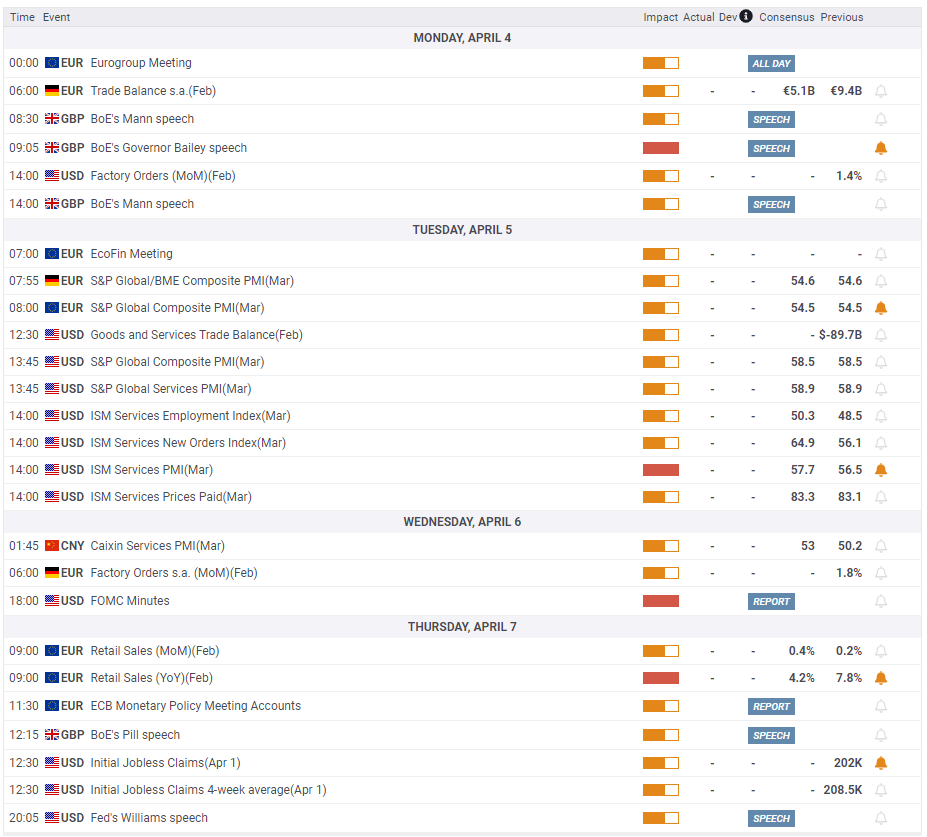
The ISM Services PMI data will be featured in the US economic docket on Tuesday. FOMC policymakers have been paying close attention to inflation data since the beginning of the year. Hence, investors are likely to react to the Prices Paid component, which is expected to rise to 83.3 in March from 83.1 in February, rather than the headline PMI reading.
On Wednesday, the FOMC will publish the minutes of the March policy meeting. As it currently stands, the CME Group FedWatch Tool shows that markets are pricing in a 71% probability of a 50 basis points rate hike in May. In case the publication reveals that policymakers are willing to continue to raise the policy rate in an aggressive way in the upcoming meetings, US Treasury bond yields could continue to push higher and weigh on gold.
Market participants will also watch the developments surrounding the Russia-Ukraine conflict. Russia is reportedly moving its troops around and preparing for another offensive rather than pulling away. Furthermore, Russia announced late Thursday that they will force gas purchases to be made in roubles. If the west ramps up sanctions and tensions re-escalate with Russia turning aggressive against Ukraine, investors could start seeking refuge in gold. The precious metal should find demand in a risk-averse atmosphere, although the dollar’s valuation is likely to be the primary driver of XAU/USD’s price action.
Gold technical outlook
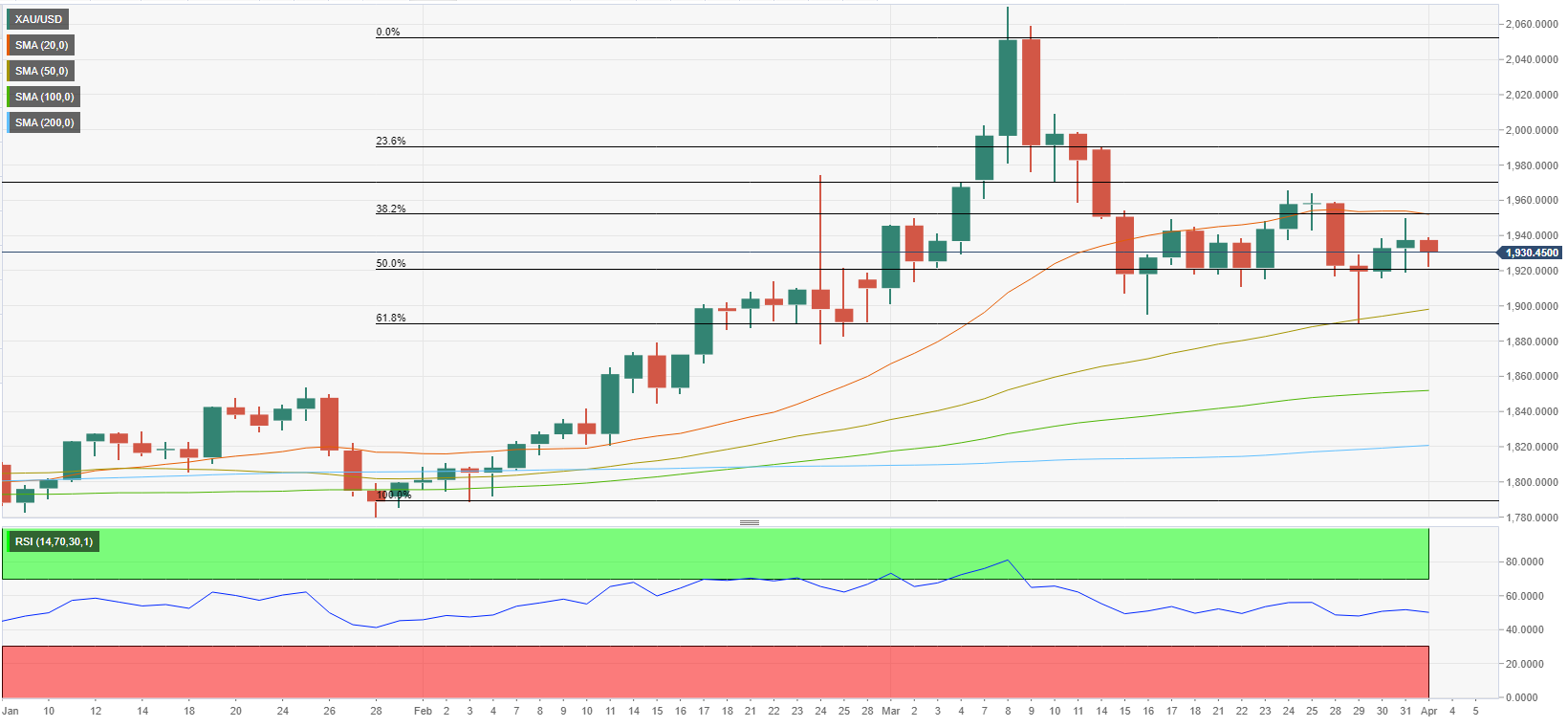
Gold continues to fluctuate between the 20-day and 50-day SMAs. The Relative Strength Index (RSI) indicator on the daily chart is also moving sideways near 50, reflecting XAU/USD indecisiveness.
The Fibonacci 50% retracement of the latest uptrend forms the first support at $1,920. With a daily close below that level, additional losses toward $1,900 (psychological level, 50-day SMA) and $1,890 (Fibonacci 61.8% retracement) could be witnessed.
On the upside, gold needs to rise above $1,950 (Fibonacci 38.2% retracement, 20-day SMA) and start using that level as support in order to target $1,970 (static level) and $1,990 (Fibonacci 23.6% retracement).
Gold sentiment poll
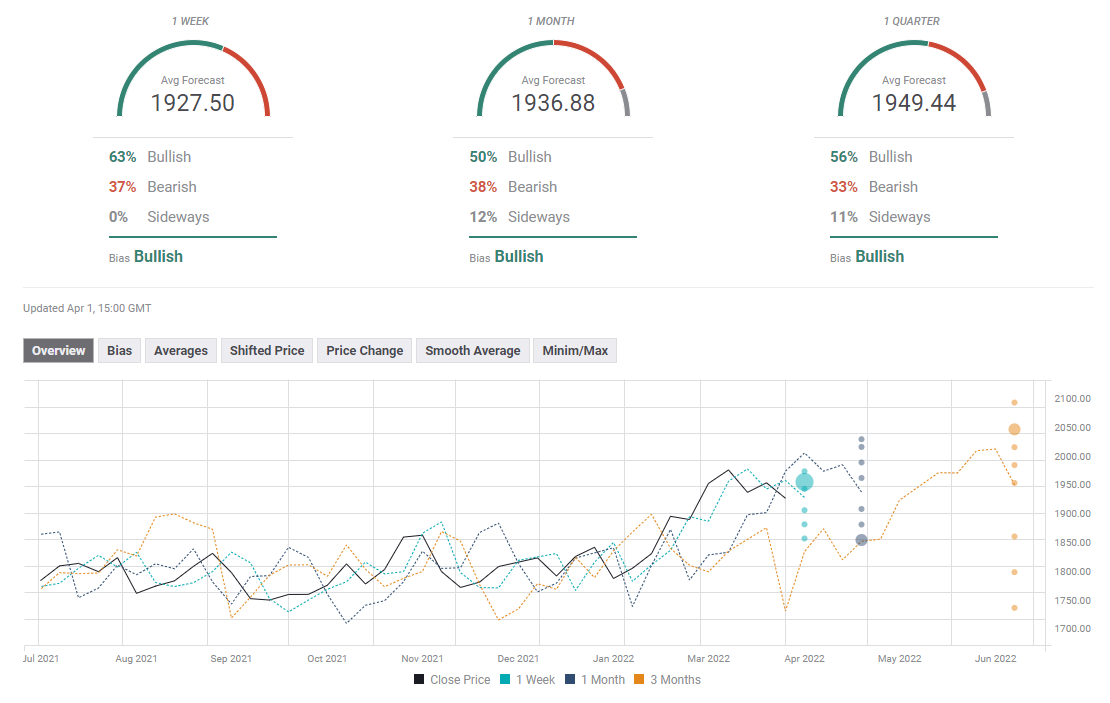
The majority of experts that took part in the FXStreet Forecast Poll see gold edging higher in the near term. The one-month outlook paints a mixed picture and the average price target of $1,936 highlights the lack of a clear directional clue.
Author

Eren Sengezer
FXStreet
As an economist at heart, Eren Sengezer specializes in the assessment of the short-term and long-term impacts of macroeconomic data, central bank policies and political developments on financial assets.