Gold Weekly Forecast: ISM, NFP data expected to trigger next big moves
- Gold failed to make a decisive move in either direction this week.
- The near-term technical picture highlights a neutral outlook.
- Next week’s high-tier data releases from the US could influence Gold’s valuation.

Following the previous week’s steep decline, Gold (XAU/USD) struggled to rebound this week, pressured by the broad-based US Dollar (USD) strength and rising US Treasury bond yields. High-tier macroeconomic data releases from the US next week could significantly influence the market pricing of the Federal Reserve’s (Fed) interest rate outlook and trigger the next big action in XAU/USD.
Gold buyers remain on the sidelines
With the US markets remaining closed in observance of the Memorial Day holiday on Monday, Gold edged slightly higher and closed the day in positive territory. Meanwhile, reports of Israeli air strikes killing at least 45 people in Rafah on Sunday caused investors to adopt a cautious stance at the beginning of the week and helped Gold hold its ground.
On Tuesday, the data from the US showed that the Conference Board’s (CB) Consumer Confidence Index improved to 102.00 in May from 97.5 in April. Assessing the survey’s findings, “the strong labor market continued to bolster consumers’ overall assessment of the present situation,” said Dana M. Peterson, Chief Economist at the CB. “Views of current labor market conditions improved in May, as fewer respondents said jobs were hard to get, which outweighed a slight decline in the number who said jobs were plentiful.” Upbeat confidence data, combined with hawkish comments from Minneapolis Fed President Neel Kashkari, who argued that the Fed potentially could even hike interest rates if inflation fails to come down further, lifted US Treasury bond yields and supported the USD, limiting XAU/USD’s upside.
The benchmark 10-year US Treasury bond yield continued to push higher on Wednesday, and the bearish action seen on Wall Street helped the USD to gather strength. In turn, Gold came under renewed bearish pressure and lost nearly 1% on the day. With US stock index futures stretching lower during the European trading hours on Thursday, Gold extended its slide and touched its lowest level in three weeks near $2,320.
The Bureau of Economic Analysis (BEA) announced on Thursday that it revised the annualized real US Gross Domestic Product (GDP) growth lower to 1.3% in the first quarter from 1.6% in the initial estimate. The 10-year US yield turned south with the initial reaction to the GDP revision and opened the door for a modest rebound in XAU/USD.
The BEA report on Friday that inflation in the US, as measured by the change in the Personal Consumption Expenditures (PCE) Price Index, held steady at 2.7% on a yearly basis in April. This reading matched March's increase and came in line with the market expectation. On a monthly basis, the PCE Price Index rose 0.3% as forecast. Finally, the core PCE Price Index, which excludes volatile food and energy prices, rose 2.8% on a yearly basis, also meeting analysts' estimates. The 10-year US yield edged lower following these figures and allowed Gold to recover above $2,350.
Gold investors shift focus to US jobs report
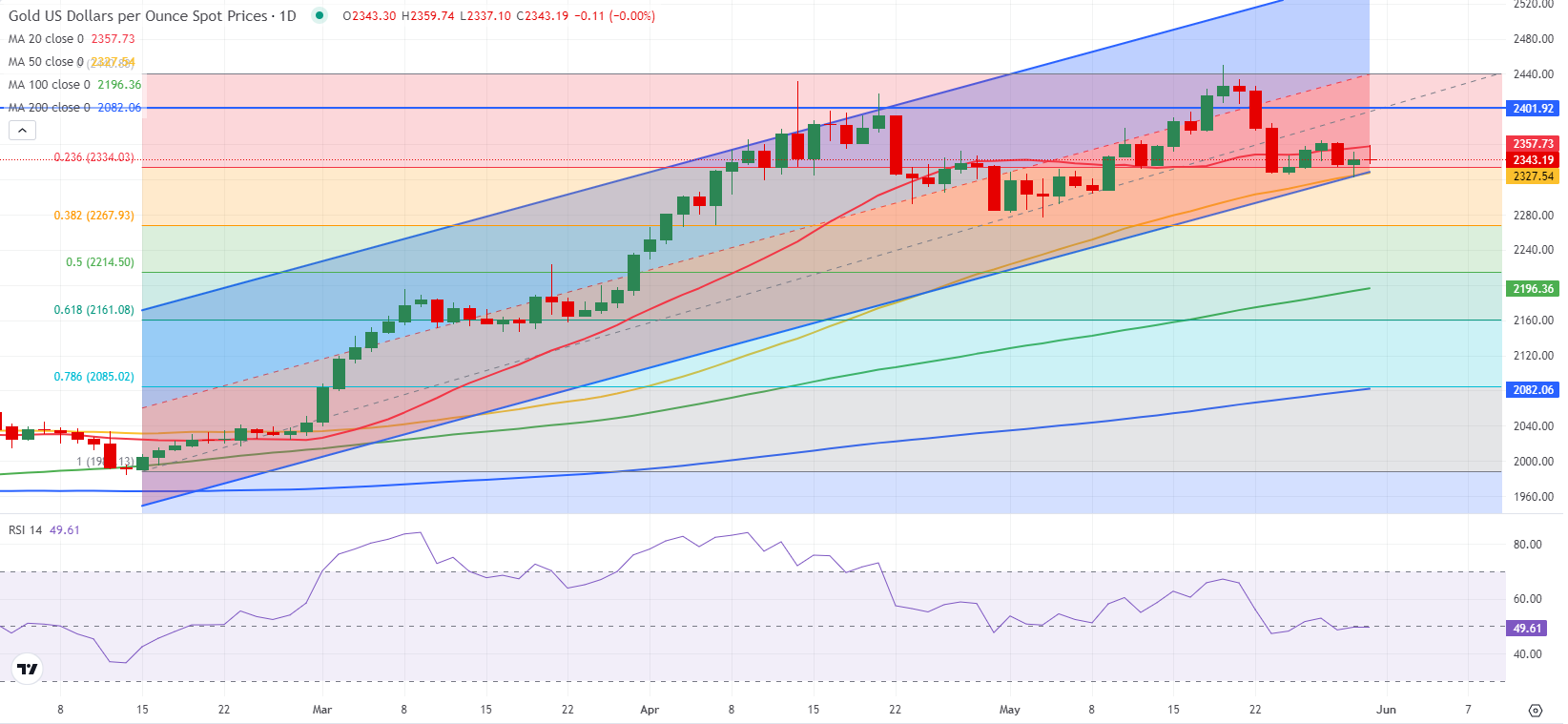
The US economic docket features the ISM Manufacturing PMI data for May on Monday. Earlier this month, S&P Global reported that the preliminary May Manufacturing PMI climbed to 54.4 from 51.3 and helped the USD find demand. Hence, the USD could hold its ground and limit XAU/USD’s upside on Monday in case the ISM Manufacturing PMI recovers back into the expansion territory above 50.
On Wednesday, the ADP Employment Change and ISM Services PMI data for May will be watched closely by market participants. The market reaction to these data could be straightforward, with an upbeat print supporting the USD and vice versa, but remain short-lived ahead of Friday’s key jobs report for May.
Following the impressive 315,000 increase recorded in March, Nonfarm Payrolls (NFP) rose 175,000 in April. The USD came under heavy selling pressure with the immediate reaction as investors assessed this sharp decline in NFP as a sign of a loosening in labor market conditions. Nevertheless, Fed policymakers downplayed the disappointing jobs data and reiterated that they will look for several months of good inflation data before considering a reduction in the policy rate. Earlier in the week, Chicago Fed President Austan Goolsbee noted that the jobs market was the strongest part of the US economy and argued that inflation could continue to fall without a meaningful increase in the unemployment rate.
In case the NFP rises 150,000 or less in May, the near-term market reaction is likely to trigger a USD selloff, allowing Gold price to turn north. An increase between 200,000 and 250,000 could be seen as a ‘good enough’ number for the Fed to remain focused on inflation dynamics and fail to have a long-lasting effect on the USD’s valuation. On the other hand of the spectrum, a strong NFP increase of 250,000 or bigger could cause markets to lean toward a single 25 basis points Fed rate cut in 2024 and fuel a rally in the USD and US Treasury bond yields heading into the weekend. In this scenario, Gold could decline sharply.
Gold technical outlook
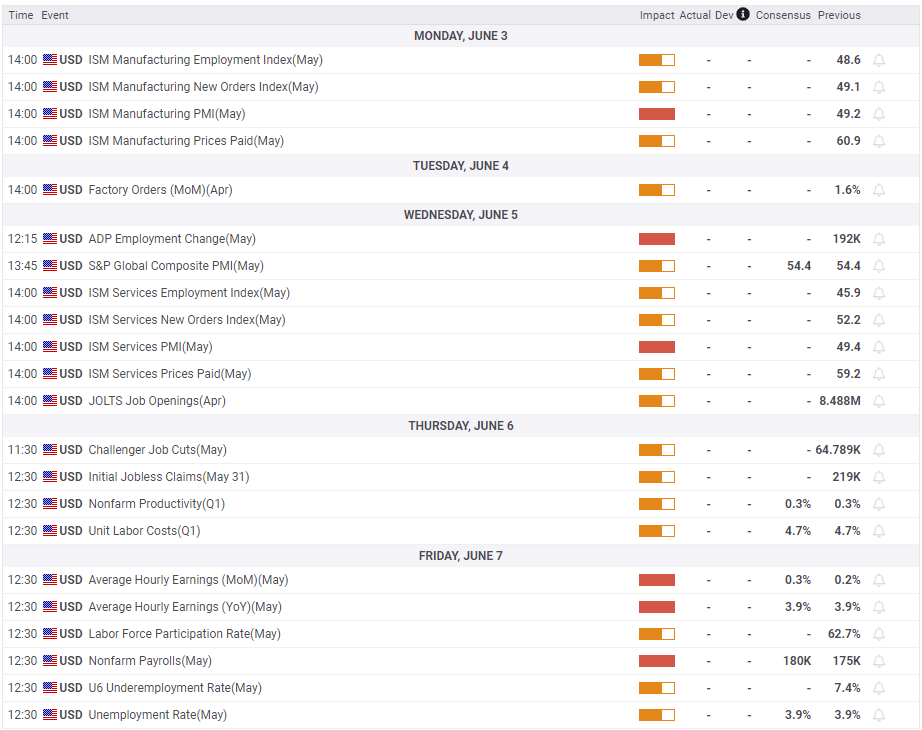
On the daily chart, the Relative Strength Index (RSI) indicator moves sideways near 50, reflecting Gold’s indecisiveness.
The Fibonacci 23.6% retracement from the mid-February movement, the 50-day Simple Moving Average (SMA) and the lower limit of the ascending regression channel form strong support at $2,330. If XAU/USD falls below this level and starts using it as resistance, technical sellers could take action. In this case, $2,300 (psychological level, static level) could be seen as interim support before $2,260 (Fibonacci 38.2% retracement).
On the upside, the 20-day SMA aligns as the first resistance at $2,360 ahead of $2,400 (psychological level, static level) and $2,440 (static level).
Gold FAQs
Gold has played a key role in human’s history as it has been widely used as a store of value and medium of exchange. Currently, apart from its shine and usage for jewelry, the precious metal is widely seen as a safe-haven asset, meaning that it is considered a good investment during turbulent times. Gold is also widely seen as a hedge against inflation and against depreciating currencies as it doesn’t rely on any specific issuer or government.
Central banks are the biggest Gold holders. In their aim to support their currencies in turbulent times, central banks tend to diversify their reserves and buy Gold to improve the perceived strength of the economy and the currency. High Gold reserves can be a source of trust for a country’s solvency. Central banks added 1,136 tonnes of Gold worth around $70 billion to their reserves in 2022, according to data from the World Gold Council. This is the highest yearly purchase since records began. Central banks from emerging economies such as China, India and Turkey are quickly increasing their Gold reserves.
Gold has an inverse correlation with the US Dollar and US Treasuries, which are both major reserve and safe-haven assets. When the Dollar depreciates, Gold tends to rise, enabling investors and central banks to diversify their assets in turbulent times. Gold is also inversely correlated with risk assets. A rally in the stock market tends to weaken Gold price, while sell-offs in riskier markets tend to favor the precious metal.
The price can move due to a wide range of factors. Geopolitical instability or fears of a deep recession can quickly make Gold price escalate due to its safe-haven status. As a yield-less asset, Gold tends to rise with lower interest rates, while higher cost of money usually weighs down on the yellow metal. Still, most moves depend on how the US Dollar (USD) behaves as the asset is priced in dollars (XAU/USD). A strong Dollar tends to keep the price of Gold controlled, whereas a weaker Dollar is likely to push Gold prices up.
Author

Eren Sengezer
FXStreet
As an economist at heart, Eren Sengezer specializes in the assessment of the short-term and long-term impacts of macroeconomic data, central bank policies and political developments on financial assets.

















