GBP/USD tests the key 1.3400 psychological pivot
- GBP/USD tests the key 1.3400 psychological pivot following a corrective retracement from the 1.3530 macro peak.
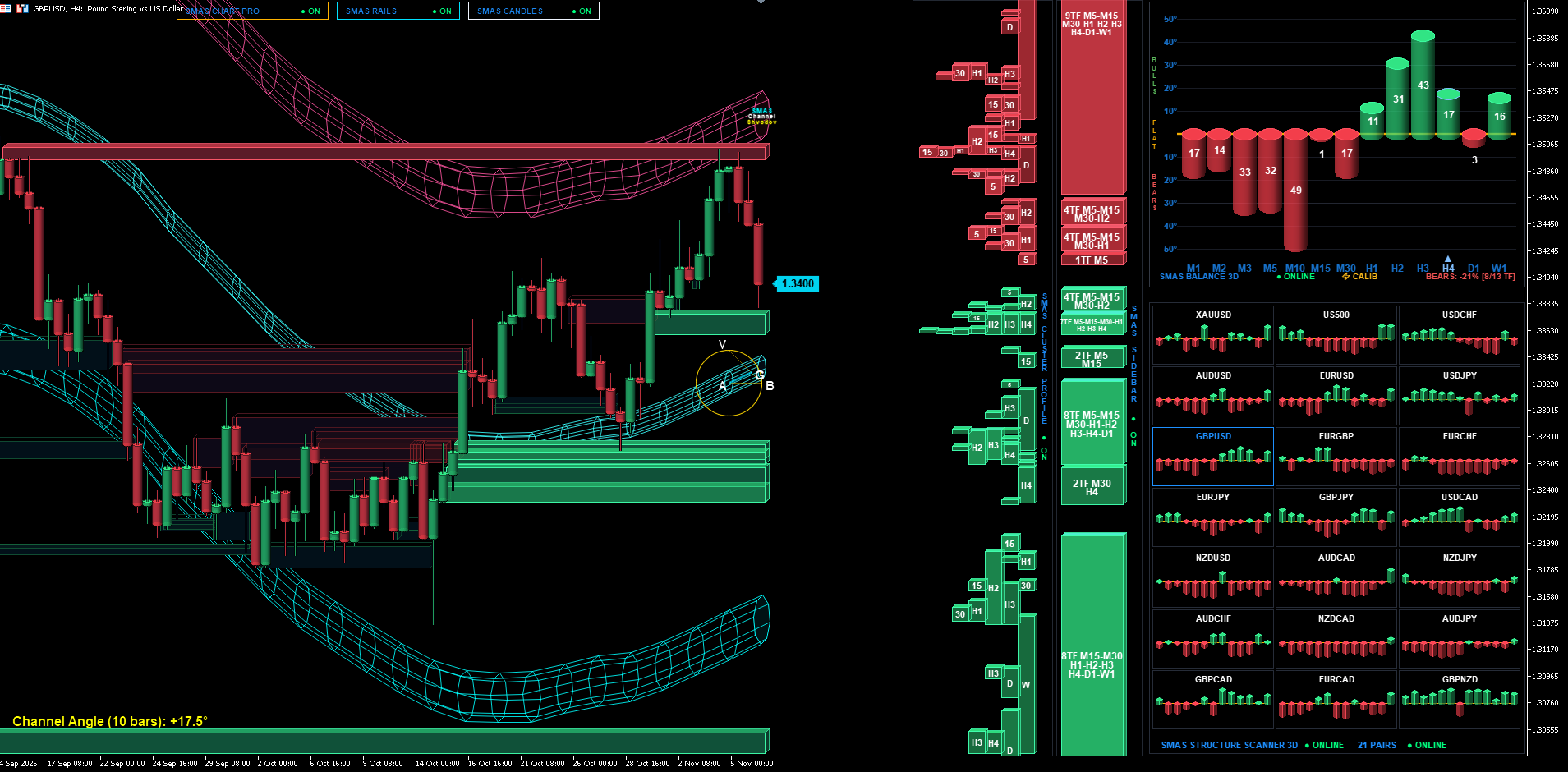
- The Structure Engine 10-bar vector confirms an authoritative +17.5° ascending slope, backed by a massive +43° reading on the H4 execution spine.
- Intraday selling registers Phase Desynchronization into a multi-tiered 7th-Order Demand Cluster (7TF: M5–H4) directly beneath price, while a 9th-Order Titanium Massif (9TF: M5–W1) caps overhead expansion.

Market context and the 1.3400 structural battleground
On the four-hour execution continuum, GBP/USD (Pound Sterling vs US Dollar) is undergoing a controlled corrective pullback toward the 1.3400 structural pivot. This retracement follows an aggressive directional rally that carried price to the 1.3530 coordinate, where the market collided directly with a monumental overhead liquidity barrier.
Rather than signaling an institutional trend reversal, the current retreat reflects a classic volume-absorption sequence. Short-term speculative buyers are taking profit, while aggressive market sellers are driving price into a dense shelf of resting institutional limit bids positioned between 1.3360 and 1.3410.
Structure engine kinetic slope (+17.5°) and channel trajectory
The central ordinary least squares (OLS) regression axis generated by the SMAS Structure Engine continues to project an unyielding bullish trajectory. The scale-invariant radial measurement across the 10-bar vector (Triangle A−B−V−G) registers an upward angle of +17.5°.
Crucially, the 3D volumetric rails show that price action is rotating back into the central equilibrium conduit of the channel. The structural momentum of the move remains deeply anchored in positive territory. As long as price respects the ascending regression spine, this retracement represents an orderly energy compression phase rather than a structural breakdown.
Multi-timeframe phase telemetry (Structure Balance 3D)
The SMAS Structure Balance 3D telemetry reveals an archetype textbook case of the Spring Compression Pattern (BEARS: -21% [8/13 TF]):
- Micro-scale corrective cascade: The micro-intraday spectrum from M1 to H1 is registering intense short-term selling pressure, led by M15 (-49°), M5 (-33°), and M10 (-32°). This reflects the mechanical exhaustion of late retail breakout buyers.
- Macro-scale institutional divergence: In stark contrast to the micro-noise, the senior macro continuum is locked in unanimous bullish alignment: H2 (+11°), H3 (+31°), H4 (+43°), D1 (+17°), and W1 (+16°).
The immense +43° reading on the H4 execution spine proves that senior institutional capital is completely untouched by the intraday drop. The downward micro-impulse is physically slamming into the immovable floor of the macro institutional basin, coiling potential energy for an explosive resumption of the primary trend.
Order-book massifs and liquidity clusters (Sidebar 3D)
The SMAS Sidebar 3D and Cluster Profile decode the precise structural boundaries framing the current price action:
1. Immediate demand shelf (Underlying support): Directly below the current 1.3400 mark sits a layered cushion of multi-order demand:
- 7th-order cluster (7TF): M5 - M15 - M30 - H1 - H2 - H3 - H4 (spanning 1.3360 to 1.3410).
- Auxiliary slabs: 4TF M5-H2 and 2TF M5-M15.
- Macro bedrock: A deeper 8th-Order Super-Massif (8TF: M5–D1) positioned between 1.3260 and 1.3300 guarantees structural trend integrity.
2. Overhead Resistance (9th-Order Super-Cluster): The ceiling that halted the previous advance at 1.3530 is an extraordinary market phenomenon: a 9th-Order Titanium Super-Cluster (9TF: M5-M15-M30-H1-H2-H3-H4-D1-W1). Nine independent temporal scales have converged on this single coordinate, creating an immense concentration of institutional limit sell orders that will require significant kinetic momentum to overcome on a second test.
Actionable institutional execution protocol
With the master channel angle holding at +17.5°, senior H4 telemetry at +43°, and price absorbing resting liquidity within the 7TF demand massif, tactical protocol favors high-convexity trend continuation long positioning:
- Execution setup: Trend-Continuation Long on Structural Demand Absorption.
- Entry Zone (Long): 1.3375 — 1.3405 (Staged within the active 7TF Demand Cluster and above the central regression axis).
- Structural Invalidation (Stop loss): 1.3325 (Placed safely beneath the lower boundary of the 7TF demand massif; calculated risk ~50 to 80 pips).
- Take Profit 1 (50% volume): 1.3480 (Re-approach to the lower edge of the 9TF supply massif; +75 to +105 pips / Move SL to Breakeven).
- Take Profit 2 (Macro target): 1.3565 (Kinetic breakout and liquidity expansion through the 9th-order super-cluster; +160 to +190 pips).
- Asymmetric risk/reward: Exceeding 1: 2.5.
Structural invalidation: A confirmed four-hour bar close below 1.3325 fractures the intermediate 7TF demand foundation, deferring the bullish thesis toward the senior 8TF continental massif at 1.3280.
Author

Andrey Shvedov
SMAS Quantum Research
Andrey Shvedov is an active quantitative trader, software architect, and financial market researcher with over 24 years of live market microstructure experience.