Gold Weekly Forecast: Next significant XAU/USD move depends on US T-bond yields
- Gold closed the week modestly higher above $1,740.
- USD weakness on dovish FOMC outlook was short-lived.
- Key technical levels for XAU/USD remain intact in the near-term.

Gold started the week in a quiet manner as investors refrained from taking large positions ahead of the FOMC’s policy announcements. After fluctuating in a relatively tight range below $1,740 during the first couple days of the week, the XAU/USD pair capitalized on the broad USD weakness on Wednesday and extended its climb to a fresh two-week high of $1,755.59 during the Asian trading hours on Thursday. However, the pair struggled to preserve its bullish momentum and closed the day in negative territory before going into a consolidation phase on Friday. Nevertheless, gold settled above $1,740 and managed to post gains for the second straight week.
What happened last week
The US dollar’s market valuation, rather than risk sentiment, remained the primary driver of XAU/USD’s movements throughout the week. Although the monthly report published by the US Census Bureau revealed on Tuesday that Retail Sales in February contracted by 3%, compared to analysts’ estimate for a decrease of 0.5%, investors showed no immediate reaction. In the meantime, the 5.3% increase in January got revised up to +7.6%, offsetting any potential negative impact of the disappointing data on the greenback.
Following its two-day policy meeting on Wednesday, the Federal Open Market Committee (FOMC) announced that it left the benchmark interest rate, the target range for federal funds, unchanged at 0-0.25% as widely expected. In its updated Summary of Projections, the so-called dot-lot, the Fed noted that policymakers continue to see no rate hikes through 2023. The number of policymakers who anticipate a rate hike by the end of 2022 rose to four from one in December’s publication.
During the press conference, FOMC Chairman Jerome Powell reiterated that they will not even think about tapering until they see substantial progress toward their inflation and employment goals. Commenting on the dot-plot, “a strong bulk of the Committee is not showing a rate increase during this forecast period,” Powell noted. When asked about the rising US Treasury bond yields, Powell acknowledged that it's “absolutely essential” to maintain financial stability and carefully monitor it, but argued that the connection between low rates and financial instability was not as tight as people think.
Powell’s dovish tone and the FOMC’s commitment to continue to support the economic recovery triggered a USD selloff late on Wednesday and helped XAU/USD gain traction. However, the benchmark 10-year US Treasury bond yield extended its rally on Thursday and reached its highest level in nearly 14 months at 1.754%, allowing the buck to regather its strength. The US Dollar Index, which tracks the USD’s performance against a basket of six major currencies, retraced Wednesday’s decline and closed 0.5% higher on Thursday, making it difficult for XAU/USD to continue to push higher.
Next week
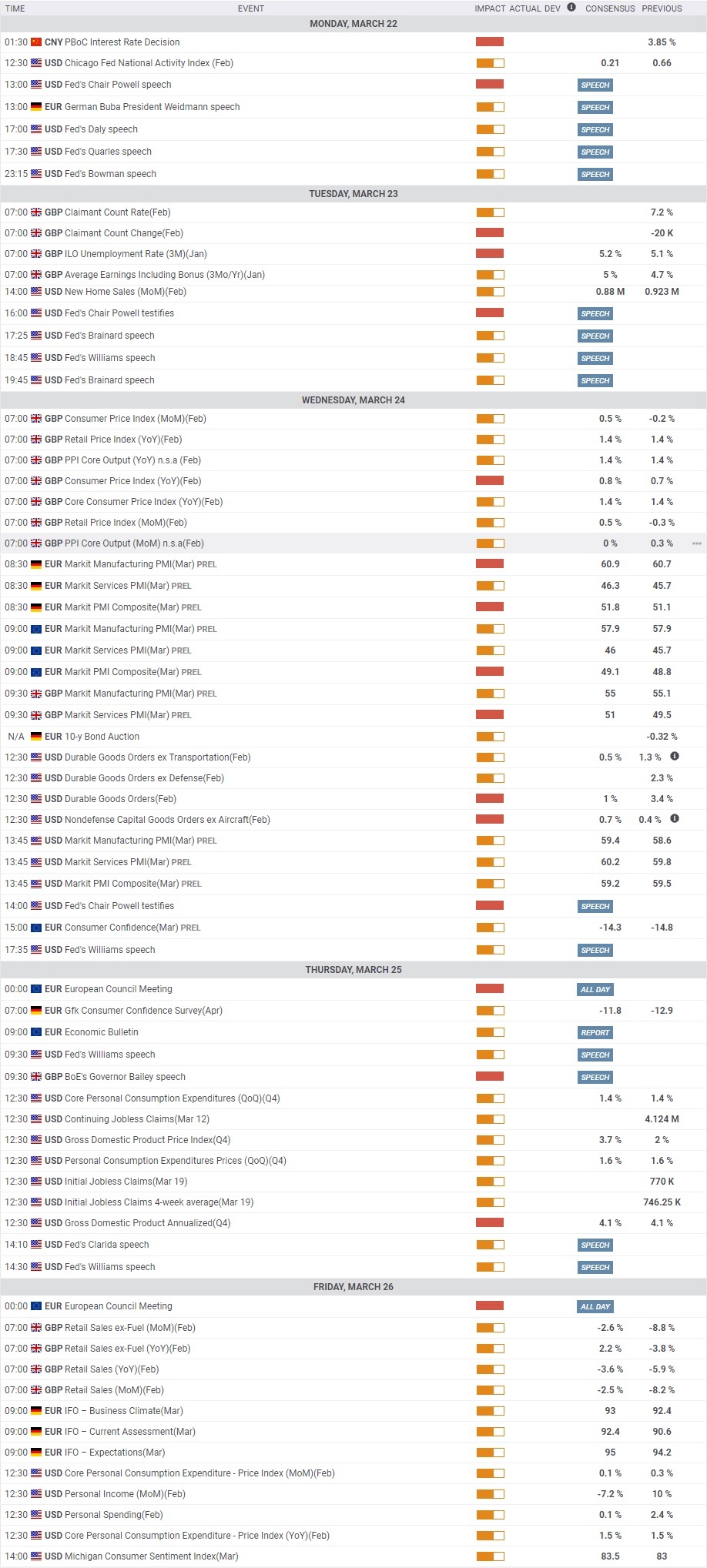
There won’t be any significant macroeconomic data releases at the start of the week but several members of the FOMC, including Chairman Powell, will be delivering speeches on Monday and later in the week. Powell is unlikely to change his tone only a few days after the policy meeting but market participants will keep a close eye on bond yields. The benchmark 10-year US T-bond yield seems to have met strong resistance at 1.75% and a break above that level could provide a boost to the USD and weigh on gold.
On Wednesday, the IHS Markit’s Manufacturing PMI figures are largely expected to show that the business activity in the manufacturing sectors of the euro area and the US continued to expand at a robust pace in March. February Durable Goods Orders report will be featured in the US economic docket as well but it would be a big surprise if there was a noticeable market reaction to these data.
On Thursday, the US Bureau of Economic Analysis will publish its final reading of the fourth-quarter Gross Domestic Product (GDP) growth. More importantly, the Core Personal Consumption Expenditures (PCE) Price Index, the Fed’s preferred gauge of inflation, will be looked upon for fresh impetus. The market consensus points to an unchanged reading in the Core PCE Price Index at 1.5% on a yearly basis in February. The USD could benefit from a higher-than-expected print and vice versa.
Gold technical outlook
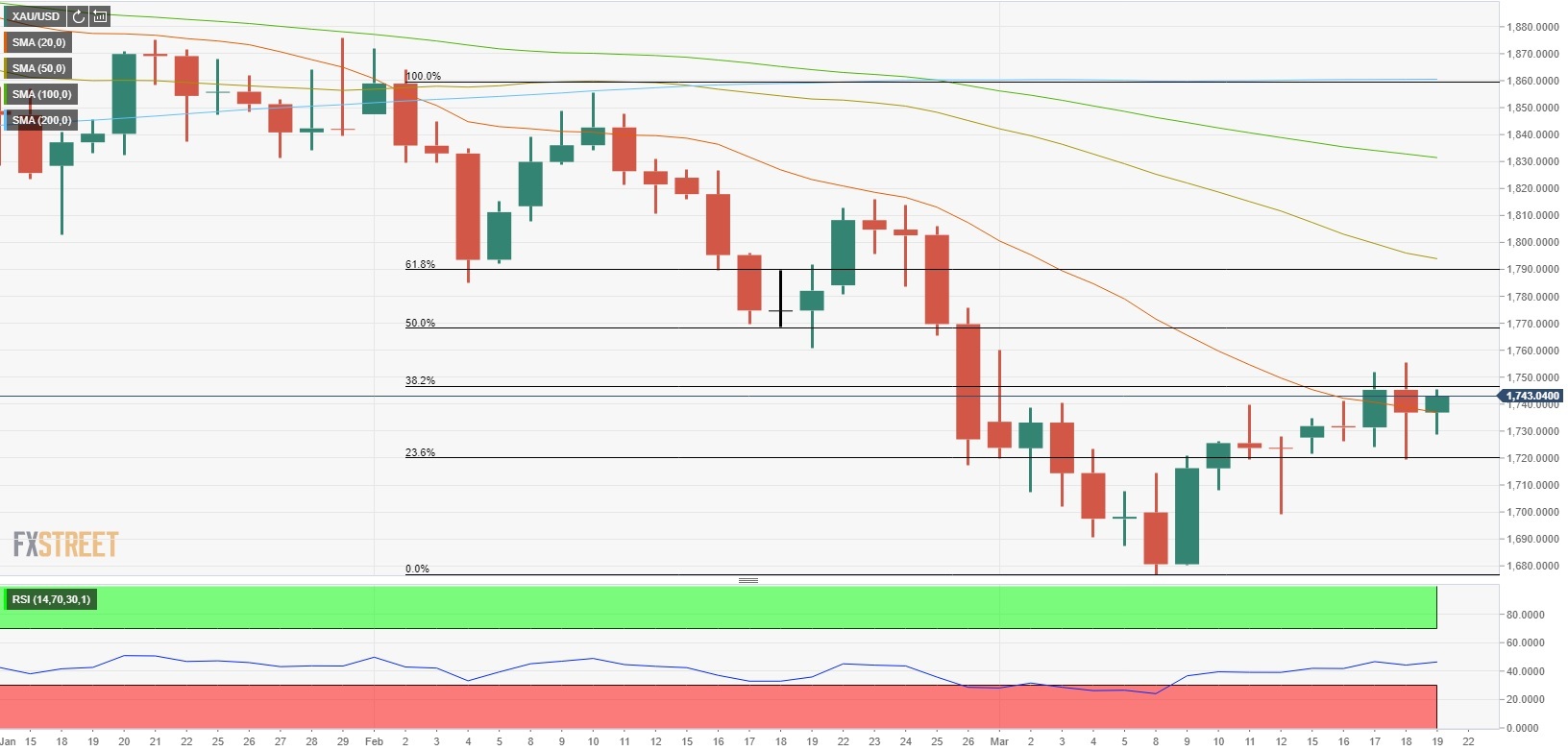
Despite some sharp swings witnessed earlier in the week, key levels for gold remain unharmed. Additionally, the Relative Strength Index (RSI) indicator on the daily chart is moving sideways a little below 50, confirming XAU/USD’s indecisiveness in the near term.
On the upside, the first hurdle is located at $1,745 (Fibonacci 38.2% retracement of the Feb. 2-Mar. 8 downtrend). On Wednesday and Thursday, gold rose above that level but ended up closing beneath it. If XAU/USD manages to clear that resistance, the next target could be seen at $1,767 (Fibonacci 50% retracement) ahead of $1,790 (50-day SMA, Fibonacci 61.8% retracement).
Support, on the other hand, could be seen at $1,735 (20-day SMA), $1,720 (Fibonacci 23.6% retracement) and $1,700 (Mar. 12 low, psychological level).
Gold sentiment poll
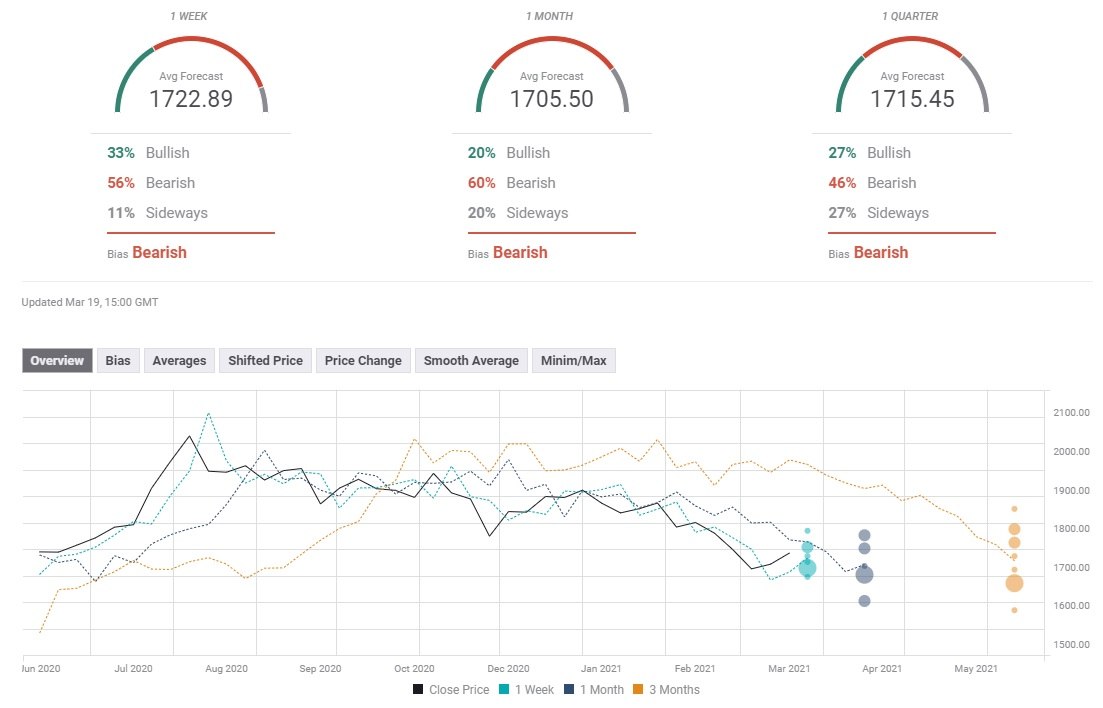
Following this week’s action, experts’ bearish tone seems to have softened with the FXStreet Forecast Poll showing an average price target of $1,722 on a one-week view, compared to $1,686 last week. Similarly, the one-month target edged higher to $1,705 from $1,687.
Author

Eren Sengezer
FXStreet
As an economist at heart, Eren Sengezer specializes in the assessment of the short-term and long-term impacts of macroeconomic data, central bank policies and political developments on financial assets.