Gold Weekly Forecast: Hawkish Fed rhetoric, possible deleveraging weigh heavily on precious metal
- Gold remained under persistent selling pressure and plunged to a fresh 14-month low.
- Gold suffers amid liquidity pressure and growing expectations for an aggressively hawkish Fed policy outlook.
- The near-term technical outlook points to oversold conditions for XAU/USD.


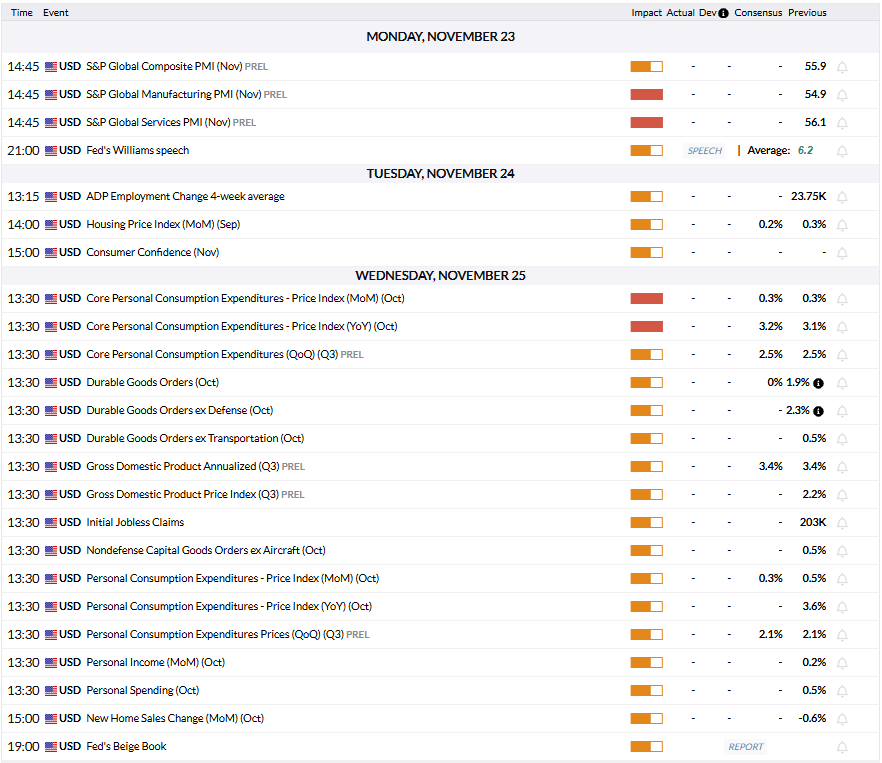
Following a quiet start to the week, Gold (XAU/USD) came under heavy bearish pressure and fell to its lowest level since September 2025 near $3,500. After losing more than 6% in both September and October, the precious metal remains on track to end the third consecutive month deep in negative territory. The United States (US) economic calendar will feature Personal Consumption Expenditures (PCE) Price Index data for October next week and investors will also pay close attention to comments from Federal Reserve (Fed) policymakers before the blackout period starts on November 28.
Gold fails to shake off the bearish pressure
Inter-market correlations that have been influencing Gold’s valuation seem to be breaking down lately. Earlier this year, Gold lost its appeal as a safe haven when the crisis in the Middle East fuelled inflation fears and expectations for further policy-tightening by major central banks. Even then, the precious metal managed to find demand whenever Oil prices corrected lower.
In November, that dynamic flipped. The barrel of West Texas Intermediate (WTI) is down over 20% on the month, yet Gold has also lost about 8%. There seem to be two main reasons behind the relentless selling pressure surrounding the yellow metal.
First, Fed rhetoric remains clearly hawkish despite easing Oil prices. According to the CME FedWatch Tool, markets are fully pricing in a 25 basis points (bps) hike in interest rates in December, and see about a 65% chance for another consecutive hike in January.
Earlier in the week, Fed Governor Christopher Waller told CNBC that inflation is heading in the wrong direction and spreading across more categories, adding that the US central bank should raise rates by half a percentage point if it isn’t prepared to signal a faster pace of hikes in the coming months. Meanwhile, minutes from the Federal Open Market Committee’s (FOMC) October meeting showed that some policymakers cautioned that inflation might force them to adopt a tighter policy, with some even considering a bigger hike in December if the data worsened. In turn, the US Dollar (USD) gathered strength and XAU/USD fell more than 3% on Wednesday.
Analysts at ING say the “prospect of faster Fed tightening and continued dislocation in tech stocks is sucking funds into the Dollar and the Yen,” and further argue that “given that a hawkish Fed lies at the heart of the current correction in risk assets, and there are no signs of Fed rhetoric softening anytime soon, USD can stay strong.”
Second, Gold seems to be under liquidity pressure through potential deleveraging by investors with exposure to AI-related stocks, who might be looking to sell Gold to raise cash to cover margin calls or to cut portfolio risks in the current market environment. As the Nasdaq Composite fell more than 2% and touched its weakest level since April on Thursday, Gold lost about 2.7% on the day and extended its slide to a new 14-month low near $3,500 during the Asian trading hours on Friday.
According to Deutsche Bank, the latest bout of risk aversion is spilling over into precious metals, with the bank highlighting that the “risk-off tone has also weighed on a wide variety of other asset classes, with Gold sliding to a 14-month low,” underscoring how the move lower in Gold has accelerated alongside the broader deterioration in risk sentiment.
Gold investors await PCE inflation data
On Monday, S&P Global will publish preliminary Manufacturing and Services Purchasing Managers’ Index (PMI) data for November. Unless either of the headline PMIs unexpectedly drops below 50 and triggers a USD selloff, Gold’s reaction is likely to remain short-lived.
The US Bureau of Economic Analysis (BEA) will publish the Personal Consumption Expenditure (PCE) Price Index data for October on Wednesday. On a monthly basis, the core PCE Price Index, the Fed’s preferred gauge of inflation, is forecast to rise 0.3% and match September’s increase. A reading above the market forecast could feed into expectations for two consecutive Fed interest rate hikes and help the USD continue to gather strength. In this scenario, Gold could come under renewed bearish pressure. Conversely, a reading of 0.1% or lower could have the opposite effect and fuel a rebound in XAU/USD.
Investors will continue to pay close attention to comments from Fed policymakers ahead of the blackout period, which will start on November 28.
In case US central bank officials hint that they are considering a bigger rate hike or a faster pace of tightening in response to inflation, Gold could find it difficult to gain traction in the near term. On the other hand, the precious metal could experience a relief recovery if policymakers push back against the possibility of consecutive increases in interest rates.
Strategists at OCBC argue that “hawkish Fed risks should keep the USD supported for now,” even though they note that the “US labour market has not been the main source of inflation pressure.” Instead, they point out that “inflation remains elevated amid tariffs and rising technology and energy costs,” reinforcing the case for further policy tightening. OCBC adds that “FOMC officials enter their blackout period on 28 November, leaving them about a week to guide expectations if support for a 50bp move strengthens.” For now, however, “our view remains that the Fed will raise rates in December, but an outsized move is unlikely,” with markets “fully pricing a 25bp hike and just 4% for a larger 50bp increase.”
Stock and bond markets in the US will remain closed in observance of the Thanksgiving Day holiday on Thursday and close early on Friday, possibly limiting the volatility in the second half of the week.
Gold technical analysis: Oversold conditions persist
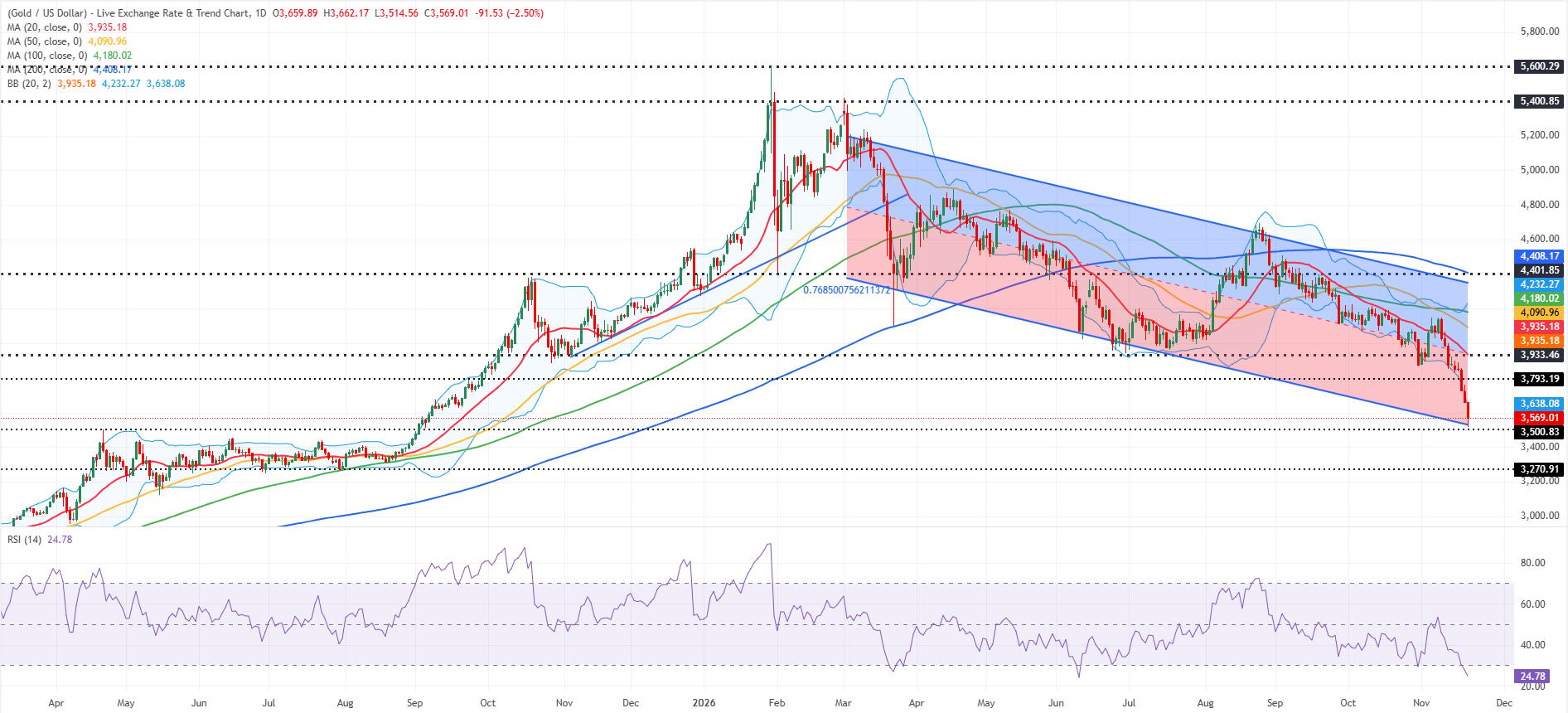
Gold recovered slightly after touching the lower limit of the descending regression channel drawn from March. Still, the Relative Strength Index (RSI) indicator on the daily chart stays below 30, highlighting oversold conditions. Gold also remains below the lower arm of the Bollinger Bands.
On the upside, $3,800 (static level, former support) aligns as an interim resistance level ahead of $4,000 (20-day Simple Moving Average (SMA), psychological level). If Gold manages to stabilize above this level, $4,090-$4,100 (50-day SMA, static level) could be seen as the next hurdle.
Looking south, the first support level could be spotted at $3,500 (psychological level, lower limit of the descending regression channel). In case Gold drops below this level and fails to reclaim it, an extended slide toward $3,270 (static support that held between June and August of 2025) is possible.
Gold FAQs
Gold has played a key role in human’s history as it has been widely used as a store of value and medium of exchange. Currently, apart from its shine and usage for jewelry, the precious metal is widely seen as a safe-haven asset, meaning that it is considered a good investment during turbulent times. Gold is also widely seen as a hedge against inflation and against depreciating currencies as it doesn’t rely on any specific issuer or government.
Central banks are the biggest Gold holders. In their aim to support their currencies in turbulent times, central banks tend to diversify their reserves and buy Gold to improve the perceived strength of the economy and the currency. High Gold reserves can be a source of trust for a country’s solvency. Central banks added 1,136 tonnes of Gold worth around $70 billion to their reserves in 2022, according to data from the World Gold Council. This is the highest yearly purchase since records began. Central banks from emerging economies such as China, India and Turkey are quickly increasing their Gold reserves.
Gold has an inverse correlation with the US Dollar and US Treasuries, which are both major reserve and safe-haven assets. When the Dollar depreciates, Gold tends to rise, enabling investors and central banks to diversify their assets in turbulent times. Gold is also inversely correlated with risk assets. A rally in the stock market tends to weaken Gold price, while sell-offs in riskier markets tend to favor the precious metal.
The price can move due to a wide range of factors. Geopolitical instability or fears of a deep recession can quickly make Gold price escalate due to its safe-haven status. As a yield-less asset, Gold tends to rise with lower interest rates, while higher cost of money usually weighs down on the yellow metal. Still, most moves depend on how the US Dollar (USD) behaves as the asset is priced in dollars (XAU/USD). A strong Dollar tends to keep the price of Gold controlled, whereas a weaker Dollar is likely to push Gold prices up.
Author
Eren Sengezer
FXStreet
As an economist at heart, Eren Sengezer specializes in the assessment of the short-term and long-term impacts of macroeconomic data, central bank policies and political developments on financial assets.

















