Gold Weekly Forecast: Fed policy decisions to trigger next big action in XAU/USD
- Gold entered a consolidation phase after setting a new record high.
- The technical outlook suggests that XAU/USD remains overbought.
- The Fed’s policy announcements could trigger the next directional movement.

Gold (XAU/USD) touched a new record-high above $3,670 before entering a consolidation phase. The Federal Reserve’s (Fed) policy decisions could allow investors to decide whether XAU/USD has more room on the upside, despite technically overbought conditions.
Gold remains within a touching distance of record high
Gold started the week on a bullish note as the negative impact of previous Friday’s disappointing August labor market data on the US Dollar (USD) lingered. After rising more than 1% on Monday, Gold preserved its bullish momentum and notched a new all-time high above $3,670 on Tuesday, supported by the ongoing USD weakness and escalating geopolitical tensions.
The US Bureau of Labor Statistics' (BLS) preliminary benchmark revision to employment data showed that there were 911,000 fewer jobs than initially reported in the 12 months through March 2025. Meanwhile, news of Israel having carried out a strike on senior Hamas leaders in Qatar's capital, Doha, triggered a flight to safety. Israel noted that it targeted people "directly responsible for the brutal October 7 massacre." In an official response, Qatar called the attack a "flagrant violation of international law" and condemned Israel's "cowardly" strike. Additionally, Poland reportedly shot down suspected Russian drones that violated its airspace, causing NATO allies to hold Article 4 consultations, during which parties discussed potential threats to the organization’s territorial integrity, political independence or security.
The BLS reported on Wednesday that the Producer Price Index (PPI) in the US rose 2.6% on a yearly basis in August. This reading followed the 3.1% increase recorded (revised from 3.3%) in July and came in below the market expectation of 3.3%. As this data failed to influence the USD’s valuation in a noticeable way, XAU/USD fluctuated in a tight range to end the day with small gains.
On Thursday, the improving risk mood caused XAU/USD to correct lower, but mixed macroeconomic data releases from the US didn’t allow the USD to gather strength and helped the pair limit its losses. The annual Consumer Price Index (CPI) inflation rose to 2.9% in August as expected, while the weekly Initial Jobless Claims climbed to 263,000 in the week ending September 6 from 236,000 in the previous week, reflecting worsening conditions in the labor market.
The University of Michigan (UoM) reported on Friday that the Consumer Sentiment Index declined to 55.4 in September’s preliminary estimate from 58.2. This print came in worse than the market expectation of 58 and made it difficult for the USD to gather strength heading into the weekend. In turn, XAU/USD stabilized in the upper half of its weekly range.
Gold investors eagerly await Fed policy decisions
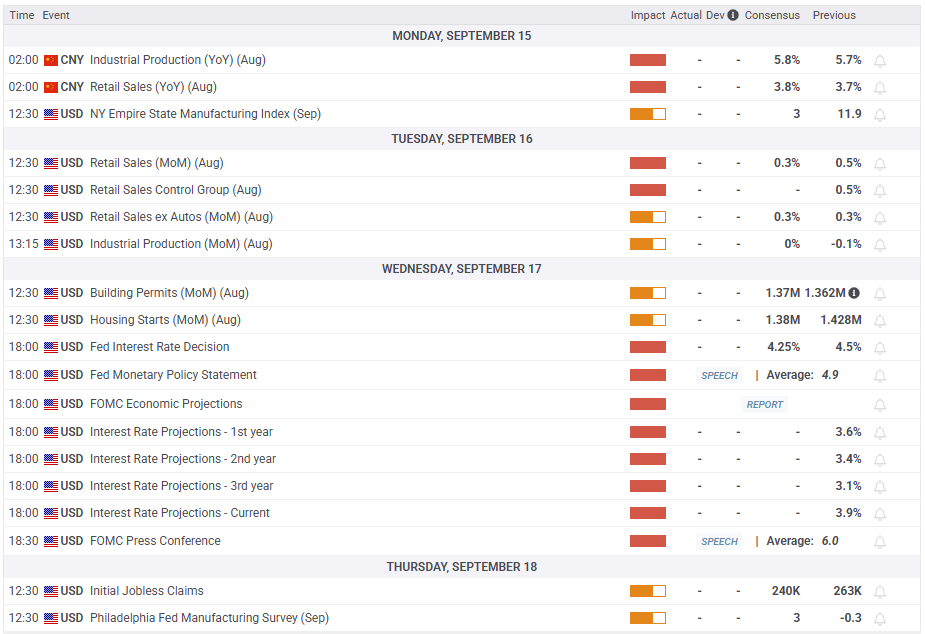
The US economic calendar will feature August Retail Sales figures on Tuesday, but markets are unlikely to pay any attention to this data ahead of the Fed policy announcements on Wednesday. Alongside the policy statement, the Fed will also release the revised Summary of Economic Projections (SEP), the so-called dot plot.
According to the CME FedWatch Tool, markets are currently pricing in about a 93% probability of the Fed lowering the policy rate by 25 basis points (bps) to 4%-4.25%.
In case the Fed surprises markets with a 50 bps rate cut, the USD could come under heavy selling pressure with the immediate reaction and open the door for a bullish rally in XAU/USD. However, the reasoning behind such a decision could confuse the markets. If the Fed opts for a large rate cut but notes that it will take its time to assess the impact of this decision on inflation dynamics before taking another policy step in the near term, the USD could rebound and cause XAU/USD to turn south.
In a different scenario, the Fed could go for a 25 bps cut as expected, but the USD could still weaken if the dot plot points to a dovish shift in the policy outlook. June’s SEP showed that policymakers were forecasting only a 25 bps cut in rates in 2026. If the dot plot shows that Fed officials now project three or more rate cuts next year, the USD could have a difficult time finding demand.
Conversely, the USD could outperform its rivals if the SEP shows only one or two rate cuts are forecast by Fed officials next year, opening the door for a deep correction in Gold.
Investors will also pay close attention to comments from Fed Chairman Jerome Powell in the post-meeting press conference. A concerned tone about the labor market outlook and growth prospects could be bearish for the USD, while a reiteration of inflation risks could support the USD and weigh on XAU/USD.
Gold technical analysis
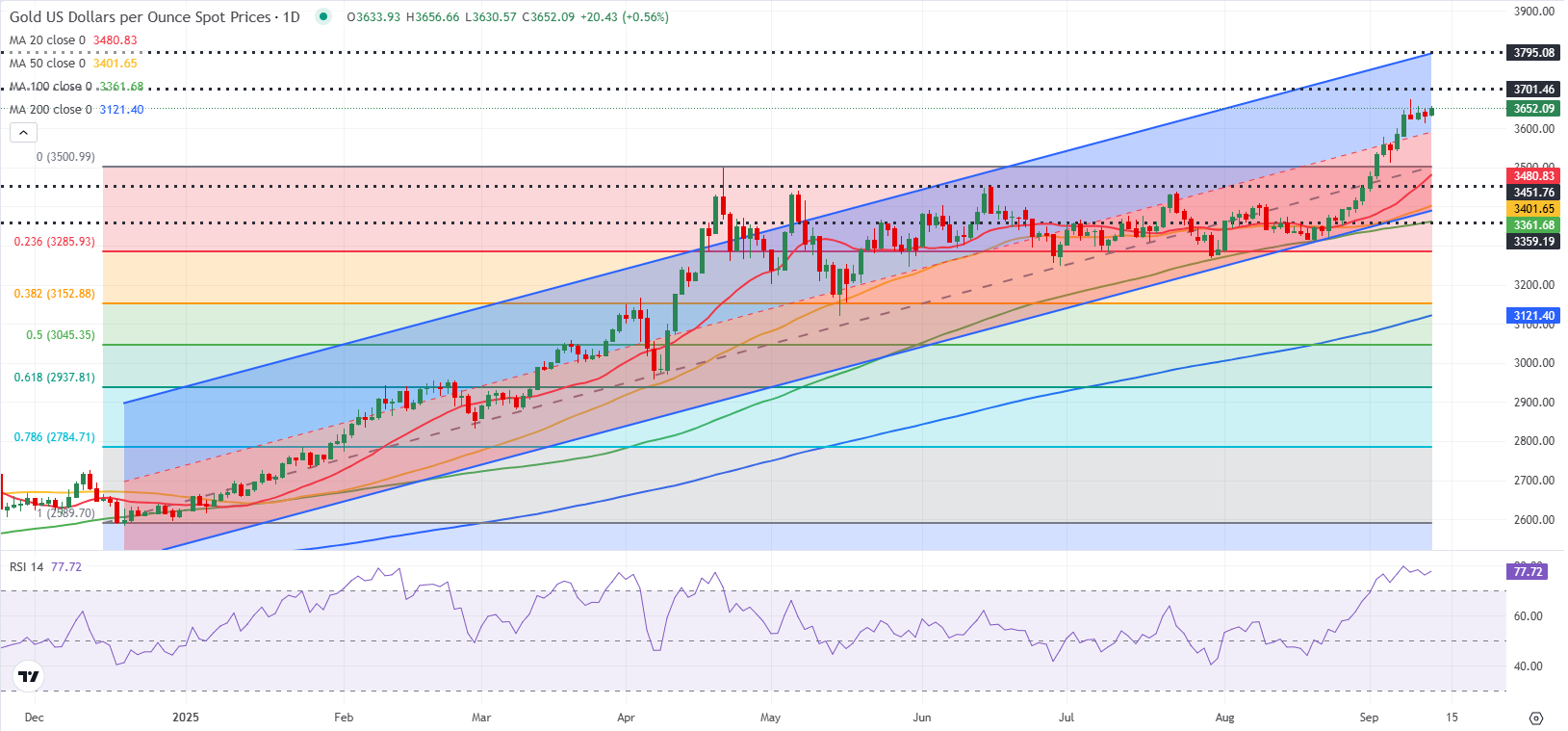
The Relative Strength Index (RSI) indicator on the daily chart holds well above 70, suggesting that Gold remains technically overbought.
On the downside, $3,600 (mid-point of the ascending regression channel) aligns as the first support level before $3,500-$3,480 (static level, round level, 20-day Simple Moving Average). Looking north, the first resistance level could be spotted at $3,700 (round level) ahead of $3,795-$3,800 (upper limit of the ascending channel, round level).
Gold FAQs
Gold has played a key role in human’s history as it has been widely used as a store of value and medium of exchange. Currently, apart from its shine and usage for jewelry, the precious metal is widely seen as a safe-haven asset, meaning that it is considered a good investment during turbulent times. Gold is also widely seen as a hedge against inflation and against depreciating currencies as it doesn’t rely on any specific issuer or government.
Central banks are the biggest Gold holders. In their aim to support their currencies in turbulent times, central banks tend to diversify their reserves and buy Gold to improve the perceived strength of the economy and the currency. High Gold reserves can be a source of trust for a country’s solvency. Central banks added 1,136 tonnes of Gold worth around $70 billion to their reserves in 2022, according to data from the World Gold Council. This is the highest yearly purchase since records began. Central banks from emerging economies such as China, India and Turkey are quickly increasing their Gold reserves.
Gold has an inverse correlation with the US Dollar and US Treasuries, which are both major reserve and safe-haven assets. When the Dollar depreciates, Gold tends to rise, enabling investors and central banks to diversify their assets in turbulent times. Gold is also inversely correlated with risk assets. A rally in the stock market tends to weaken Gold price, while sell-offs in riskier markets tend to favor the precious metal.
The price can move due to a wide range of factors. Geopolitical instability or fears of a deep recession can quickly make Gold price escalate due to its safe-haven status. As a yield-less asset, Gold tends to rise with lower interest rates, while higher cost of money usually weighs down on the yellow metal. Still, most moves depend on how the US Dollar (USD) behaves as the asset is priced in dollars (XAU/USD). A strong Dollar tends to keep the price of Gold controlled, whereas a weaker Dollar is likely to push Gold prices up.
Author

Eren Sengezer
FXStreet
As an economist at heart, Eren Sengezer specializes in the assessment of the short-term and long-term impacts of macroeconomic data, central bank policies and political developments on financial assets.