Gold Weekly Forecast: Bulls can’t catch a break as Fed doubles down on hawkish rhetoric
- Gold edged lower while US Treasury bond yields pushed higher on hawkish Fed outlook.
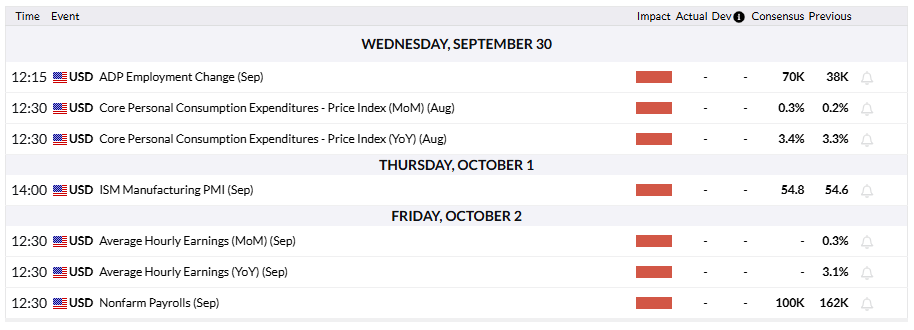
- August PCE inflation and September Nonfarm Payrolls data will be watched closely by investors.
- The near-term technical outlook highlights a lack of buyer interest.

Gold (XAU/USD) failed to benefit from easing geopolitical tensions and falling Crude oil prices as United States (US) Treasury bond yields climbed higher on the Federal Reserve’s (Fed) hawkish rhetoric. August inflation and September employment data from the US next week could ramp up the precious metal’s volatility and provide directional clues.
Gold declines as US 10-year US T-bond yield surges
Gold started the week under modest bearish pressure as the US Dollar (USD) continued to gather strength, with market participants repositioning for a hawkish Fed policy outlook after the September meeting. Meanwhile, Iran’s Islamic Revolutionary Guard Corps (IRGC) warned over the weekend that any new military attack by the US could trigger a response fought across a different geographical area and with different weapons.
As geopolitical tensions eased on Monday with the US envoy to the United Nations (UN), Mike Walt, saying that US President Donald Trump keeps an open mind for Iran to return to the “negotiating table if they do so in good faith,” Gold managed to find support on Tuesday and closed marginally higher.
Nevertheless, surging US Treasury bond yields on hawkish comments from Fed officials and upbeat macroeconomic data releases from the US triggered another leg lower in Gold midweek.
Fed Governor Michael Barr delivered a distinctly hawkish message on Wednesday, with an FXS Speechtracker score of 8/10, above the 7/10 historical average and signaling a stronger tightening bias relative to the established baseline. The assertion that “further rate hikes [are] likely needed” and that “risks to achieving 2% inflation have increased, while labor market risks have receded,” underscored a clear prioritization of inflation control over employment concerns. The admission that the Fed was “out of position” and needed to “recalibrate” policy, combined with comments that inflation is not clearly trending toward target amid strong growth and a solid labor market, reinforced expectations for additional policy tightening and supported the US Dollar.
In the meantime, S&P Global Composite Purchasing Managers' Index (PMI) in the US rose to 58.4 in September's flash estimate from 56 in August, showing a further expansion of the private sector's business activity at an accelerating pace. In this period, the Manufacturing PMI climbed to 57 from 53.9, while the Services PMI improved to 58.7 from 56.5.
The benchmark 10-year US T-bond yield rose more than 3% on Wednesday and reached its highest level since June 2007, above 5.1%, while XAU/USD lost more than 1.5% on a daily basis and returned below $4,300.
Analysts at Deutsche Bank highlight the intensity of Wednesday’s bond selloff, noting that the move was “particularly clear for US Treasuries, where the 10yr yield (+15.2bps) saw its biggest daily jump since the market turmoil after Liberation Day in April 2025, taking it up to a post-2007 high of 5.11%.” They add that this sharp repricing in rates fed directly into FX and commodities, as “the rise in US yields saw the Dollar index (+0.49%) rise to its highest since July, while gold (-1.68%) had its biggest decline in two weeks.”
US T-bond yields continued to push higher on Thursday, and the 10-year reference rose above 5.2%. In turn, Gold extended its slide and touched a fresh weekly low below $4,250. Philadelphia Fed President Anna Paulson reinforced the hawkish stance with her speech receiving an FXS Speechtracker score of 8.1/10, notably stronger relative to the historical average of 7/10. By stressing that the US central bank may need to raise interest rates again, and that “the September hike merely moved policy into a better inflation-fighting posture,” Paulson clearly leaned toward additional tightening prospects. The commitment to “doing what is needed to get inflation back to 2%” and the remark that the best that can be said is that inflation has not worsened underscored a bias toward keeping policy restrictive for longer.
As the downward correction in US T-bond yields and the USD Index remained shallow on Friday, recovery attempts remained limited heading into the weekend and Gold failed to stabilize above $4,300.
Gold investors await key macroeconomic data releases from the US
The US Bureau of Economic Analysis will publish the Personal Consumption Expenditures (PCE) Price Index figures on Wednesday. The core PCE Price Index, the Fed’s preferred gauge of inflation, is forecast to rise 0.3% on a monthly basis in August. In case this data arrives at or above the market forecast, investors are likely to see this as a confirmation for a hawkish Fed outlook. In this scenario, the USD is likely to preserve its strength and make it difficult for XAU/USD to gain traction. Conversely, a reading of 0.2% or lower could ease inflation fears with the immediate reaction and help Gold edge higher. Still, a single soft core PCE inflation print is unlikely to influence the market pricing of the Fed rate outlook in a significant way, causing the potential positive impact on Gold to remain short-lived.
On Friday, the September employment report could ramp up market volatility and trigger a directional move in Gold heading into the weekend. Currently, the CME Group FedWatch Tool shows that there is about a 53% chance that the Fed will raise the interest rate two more times by the end of the year. An increase of at least 90K in Nonfarm Payrolls (NFP), even if it falls slightly short of the market expectation, could be seen as “good enough” to open the door to multiple rate hikes and support the USD, while weighing on XAU/USD. On the other hand, a significant negative surprise, with a print below 60K, could cast doubt on the Fed policy outlook and help Gold stage a decisive rebound.
Strategists at OCBC note that “resilient US economic data, elevated energy prices and persistent inflation concerns continue to drive Treasury yields higher,” a backdrop that is “underpinning the USD while weighing on rate-sensitive and carry-oriented assets.” They flag “next week's US labour market report” as a key event risk, with Bloomberg consensus expecting “Nonfarm payrolls to rise by 100,000 in September, down from 162,000 in August, while the Unemployment Rate is projected to remain at 4.1%.” However, OCBC cautions that “with Initial Jobless Claims trending lower through the month, the risk of an upside payrolls surprise is increasing.” In their view, “a stronger-than-expected employment report could reinforce market expectations for further Fed tightening, keeping US yields elevated and providing additional support for the USD.”
Gold technical analysis: Buyers hesitate but no signs of a bearish reversal yet
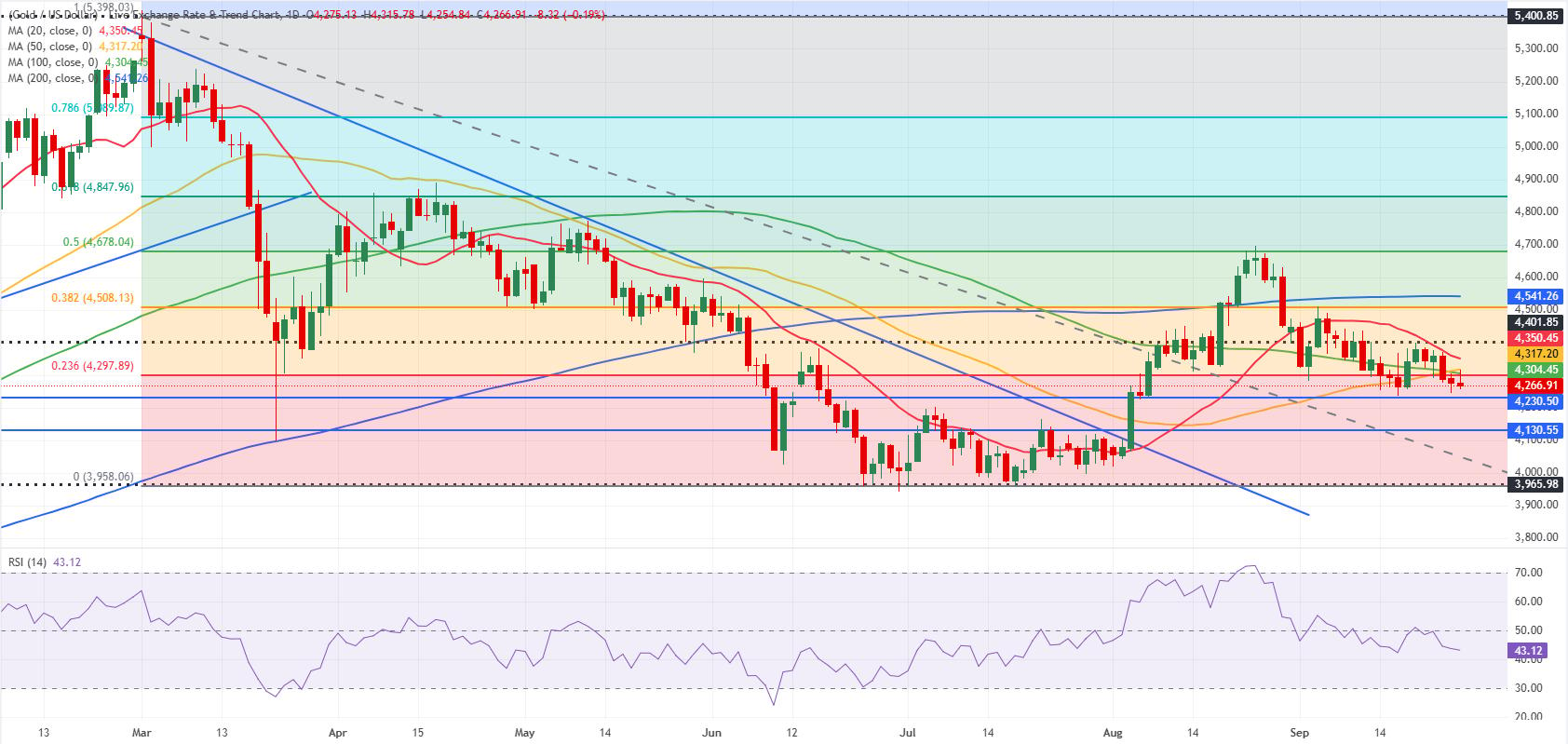
The Relative Strength Index (RSI) indicator on the daily chart stays slightly below 50, while Gold struggles to pull away from the 100-day and the 50-day Simple Moving Averages (SMA), currently located in the $4,300-$4,320 area, reflecting a lack of clear directional conviction in the near term.
On the upside, $4,400 (static level) aligns as an interim hurdle ahead of the important $4,510-$4,540 (Fibonacci 38.2% retracement of the March-August downtrend, 200-day SMA) resistance area. In case Gold clears this region and stabilizes above it, $4,675-$4,700 (Fibonacci 50% retracement, round level) could be seen as the next bullish target.
Looking south, the first important support area could be spotted at $4,230-$4,200 (static level, round level), before $4,130 (static level) and $4,000 (static level, round level).
Gold FAQs
Gold has played a key role in human’s history as it has been widely used as a store of value and medium of exchange. Currently, apart from its shine and usage for jewelry, the precious metal is widely seen as a safe-haven asset, meaning that it is considered a good investment during turbulent times. Gold is also widely seen as a hedge against inflation and against depreciating currencies as it doesn’t rely on any specific issuer or government.
Central banks are the biggest Gold holders. In their aim to support their currencies in turbulent times, central banks tend to diversify their reserves and buy Gold to improve the perceived strength of the economy and the currency. High Gold reserves can be a source of trust for a country’s solvency. Central banks added 1,136 tonnes of Gold worth around $70 billion to their reserves in 2022, according to data from the World Gold Council. This is the highest yearly purchase since records began. Central banks from emerging economies such as China, India and Turkey are quickly increasing their Gold reserves.
Gold has an inverse correlation with the US Dollar and US Treasuries, which are both major reserve and safe-haven assets. When the Dollar depreciates, Gold tends to rise, enabling investors and central banks to diversify their assets in turbulent times. Gold is also inversely correlated with risk assets. A rally in the stock market tends to weaken Gold price, while sell-offs in riskier markets tend to favor the precious metal.
The price can move due to a wide range of factors. Geopolitical instability or fears of a deep recession can quickly make Gold price escalate due to its safe-haven status. As a yield-less asset, Gold tends to rise with lower interest rates, while higher cost of money usually weighs down on the yellow metal. Still, most moves depend on how the US Dollar (USD) behaves as the asset is priced in dollars (XAU/USD). A strong Dollar tends to keep the price of Gold controlled, whereas a weaker Dollar is likely to push Gold prices up.
Author

Eren Sengezer
FXStreet
As an economist at heart, Eren Sengezer specializes in the assessment of the short-term and long-term impacts of macroeconomic data, central bank policies and political developments on financial assets.















