Gold struggles to rally despite Dollar's sharp decline amid escalating trade tensions

Financial markets are witnessing an unusual divergence as gold prices remain stagnant despite the US dollar plunging to a four-month low. Traditionally, gold and the dollar move inversely, making this development particularly intriguing. With President Trump’s aggressive new tariffs looming and global trade tensions mounting, investors are navigating increasingly complex market forces.
The Dollar's dramatic decline
The US dollar has suffered a steep decline over the past week, surprising market watchers. The dollar index, which opened Monday at 107.34, embarked on a three-day slide:
-
Monday: Fell 0.95% to a low of 106.48
-
Tuesday: Dropped another 0.91%, settling at a low of 105.51
-
Wednesday: Plunged 1.18% to a low of 104.26 – its lowest level since December 2023
This rapid depreciation coincides with the implementation of sweeping tariffs targeting America’s key trading partners. As of midnight Tuesday, a 25% import tariff on goods from Mexico and Canada took effect, alongside an increased 20% levy on Chinese imports.
Trade war and economic red flags
Economic analysts now declare that a full-fledged trade war between the US and its largest trade partners has begun. The consequences could be severe, including slower global growth and rising domestic inflation, potentially delaying anticipated interest rate cuts from the Federal Reserve.
Retaliation has been swift. Canada imposed tariffs on over $100 billion worth of US goods, while China implemented countervailing tariffs of up to 15% on various US agricultural exports. Mexico is expected to announce countermeasures by Sunday.
In a Congressional address on Tuesday night, President Trump hinted at further punitive measures set for April 2, including additional "reciprocal tariffs" and non-tariff barriers aimed at correcting what he calls "decades of unfair trade imbalances."
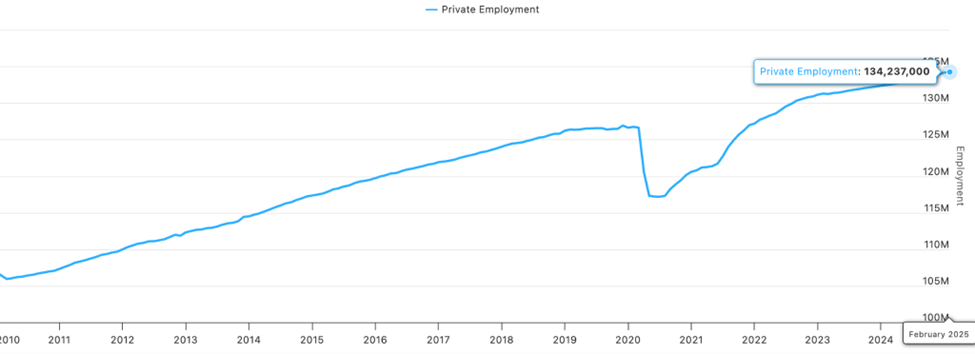
Both gold and the dollar reacted strongly to Wednesday’s ADP private-sector employment report, which revealed a steep decline in hiring. Only 77,000 new jobs were added last month-well below January’s 186,000 and far short of the projected 142,500.
Source: ADP
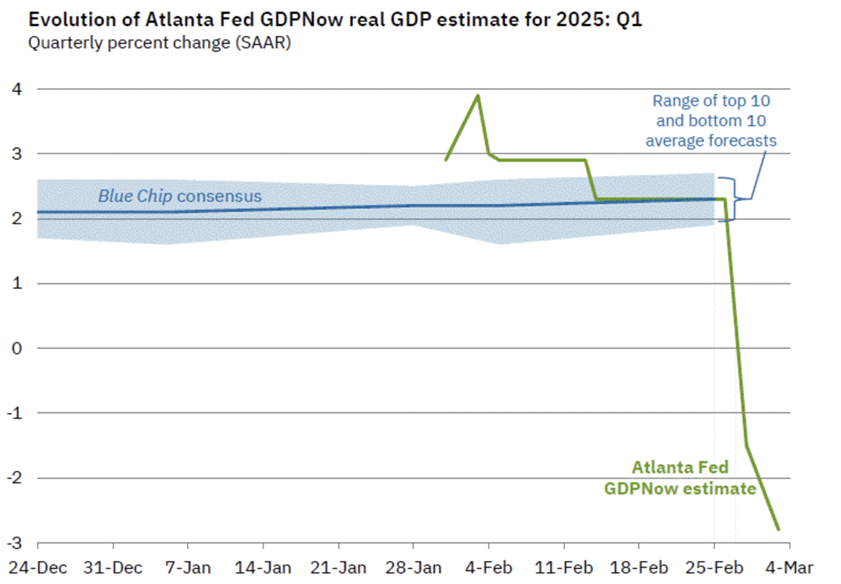
According to analysts, "The ADP report is the latest sign that the US economy is losing steam." Even more concerning, the Federal Reserve Bank of Atlanta's GDPNow model now forecasts a 2.8% contraction in US GDP for the first quarter.
Source: Atlantafed
With an economic slowdown looming and inflationary pressures from tariffs intensifying, concerns over stagflation-a rare combination of stagnation and inflation-are growing. Historically, such conditions have been highly supportive of gold prices.
Gold’s surprising consolidation
Despite these seemingly bullish conditions, gold is retreating, possibly on news that Trump could reach a tariff deal with Mexico and Canada. During Thursday’s Asian session, the metal struggled for direction before a significant pull-back.
Investors remain hesitant to take aggressive positions ahead of Friday’s US Nonfarm Payrolls report, which could provide crucial insights into economic health and potential Federal Reserve policy shifts.
While gold remains in a holding pattern, the fundamental backdrop still favors an eventual breakout. Market analysts suggest that the path of least resistance remains to the upside, with ongoing trade tensions, a weakening US dollar, rising expectations for Federal Reserve rate cuts, and potential stagflationary pressures continuing to support the case for higher gold prices.
Technical analysis: Will Gold rebound?
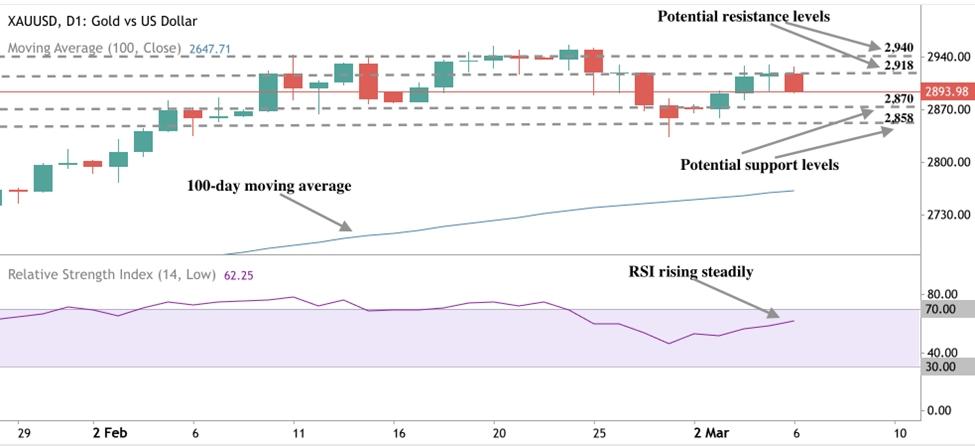
At the time of writing, the yellow metal appears to be retreating from highs that threatened to touch the $3,000 mark. Bullish sentiment and bias is clearly evident as prices remain above the moving average, with a backdrop of strong previous bullish candles. However, the current candle on the daily chart threatens to erase the gains of the past two days. RSI rising steadily towards 70 could also be a hint that we are soon approaching the overbought conditions.
Key levels to watch on the upside are $2,918 and $2,940. On the downside, the current pullback could find support floors at the $2,870 and $2,858 price levels.
Source: Deriv MT5
Author

Prakash Bhudia
Deriv
Prakash Bhudia, HOD – Product & Growth at Deriv, provides strategic leadership across crucial trading functions, including operations, risk management, and main marketing channels.














