Gold reassesses policy expectations as markets prepare for the FOMC Minutes

Key takeaways
Gold trades near the 4,100–4,125 participation zone as investors await the release of the FOMC Minutes.
Treasury yields have stabilized after the recent payroll repricing, shifting market attention toward future policy guidance.
The US Dollar remains in consolidation mode as investors reassess the trajectory of rates during the second half of 2026.
Gold enters the week in a neutral rotational regime, with positioning increasingly influenced by expectations surrounding real yields and Federal Reserve communication.
Gold enters a policy interpretation phase
Gold begins Wednesday's session inside a market that has largely absorbed the Federal Reserve's June decision. The next phase is no longer centered on what policymakers decided, but on how investors interpret the Committee's internal assessment of inflation, growth and labor-market conditions.
The FOMC Minutes have therefore become the dominant macro catalyst.
Markets already understand the policy outcome. What remains uncertain is the degree of consensus within the Committee, the balance between inflation concerns and growth risks, and whether policymakers showed greater confidence that price pressures are gradually easing.
That distinction matters because gold increasingly trades through a credibility framework.
Rather than responding mechanically to individual economic releases, the metal now reflects how investors perceive the consistency between Federal Reserve communication, Treasury pricing and the expected path of monetary policy.
The latest economic data reinforce that interpretation.
ISM Services moderated to 54.0 from 54.5, remaining comfortably in expansion territory while suggesting that economic momentum is gradually becoming more balanced. Labor-market data released last week also reduced expectations of an accelerating economy without pointing toward a meaningful deterioration.
Markets therefore enter the Minutes searching for clarification rather than surprise.
Treasury yields remain the dominant transmission layer
The principal transmission mechanism continues running through the Treasury market.
Expectations regarding Federal Reserve policy shape Treasury yields.
Treasury yields influence real yields.
Real yields affect Dollar positioning.
Dollar positioning ultimately determines participation conditions across precious metals.
Gold remains positioned at the end of that transmission chain.
Recent sessions have seen Treasury yields stabilize after the payroll repricing. Rather than producing another broad adjustment, investors have entered a waiting phase while looking for additional confirmation regarding the policy outlook.
This environment tends to favor more balanced price action across gold.
Participation has neither disappeared nor accelerated.
Instead, institutional investors appear increasingly willing to maintain existing allocations while evaluating whether the Minutes support the current market narrative or introduce a different interpretation of policy risks.
Gold therefore behaves less like a reactionary asset and more like a macro barometer measuring confidence in the credibility of future monetary policy.
Policy communication now matters as much as policy itself
Markets frequently focus on decisions.
Institutional investors often focus on communication.
The June FOMC decision already established the current policy framework. The Minutes now provide greater detail regarding the internal discussion that produced that decision.
Investors will pay particular attention to three questions.
First, how confident were policymakers that inflation continues moving toward target?
Second, how concerned were participants about the recent moderation in labor-market conditions?
Third, how broadly shared were views regarding the appropriate timing of future policy adjustments?
The answers influence expectations for Treasury markets well beyond today's session.
Gold responds because its valuation increasingly reflects confidence in future policy consistency rather than immediate policy action.
If investors conclude that the Committee remains broadly aligned, Treasury markets may remain relatively stable.
If the Minutes reveal greater internal debate, expectations surrounding future rate decisions could become more fluid.
Gold typically performs well in environments where policy uncertainty encourages portfolio diversification without implying systemic financial stress.
Reserve positioning continues supporting the broader framework
Although short-term movements remain driven by macroeconomic releases, structural demand continues supporting gold's longer-term role within institutional portfolios.
Central-bank purchases, reserve diversification and fiscal uncertainty remain part of the broader investment landscape.
Those structural themes do not necessarily dominate day-to-day price action.
They do provide an underlying framework that supports participation whenever macro uncertainty increases.
This explains why recent corrections have remained relatively orderly despite elevated real yields.
Strategic investors continue viewing gold as an asset capable of preserving portfolio flexibility while monetary policy evolves.
That institutional behavior reinforces gold's identity as a credibility asset.
The market increasingly evaluates whether monetary authorities can maintain inflation progress without generating a significant slowdown in economic activity.
Gold reflects that balance.
Technical structure: Gold rotates inside a neutral participation regime
The technical configuration remains fully aligned with the current macro environment.
The Renko structure shows gold trading inside a neutral rotational framework, where directional conviction remains limited ahead of the FOMC Minutes.
Price continues rotating around the 4,100 participation pivot, which has become the principal stabilization area during recent sessions.
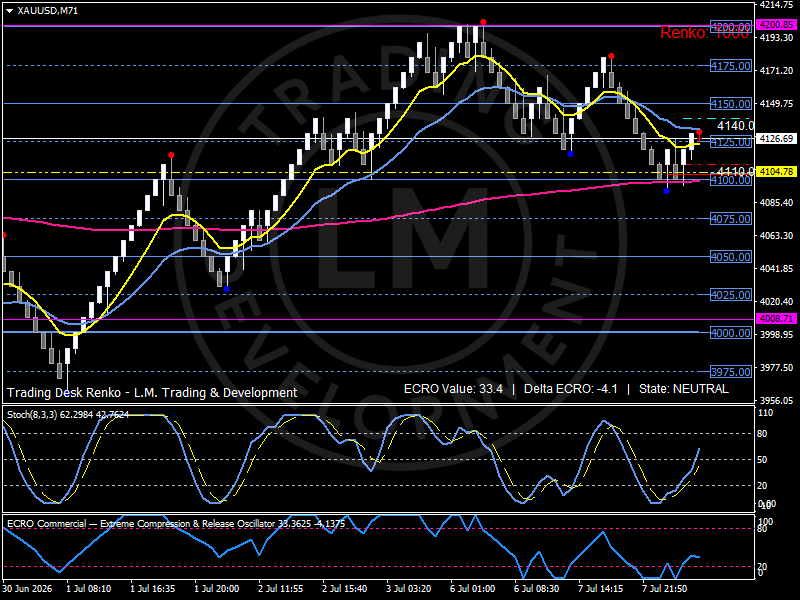
Immediate resistance develops near 4,125, followed by the broader structural corridor around 4,150. Above that level, the next participation zone emerges near 4,175.
Support remains concentrated around 4,075, while a deeper stabilization area develops near 4,050.
The shorter-term EMA 9 has started turning higher after recent consolidation, while the EMA 21 continues providing dynamic support beneath current price action. The EMA 200 remains well below the market, preserving the broader structural uptrend despite recent rotational behavior.
ECRO currently stands near 33.4, while Delta ECRO remains modestly negative. The indicator continues signaling active participation without sufficient directional confirmation to support a sustained expansion phase.
The overall technical picture therefore describes a market storing directional energy while waiting for macro confirmation.
Bird's eye view
Gold currently operates inside a credibility-driven market where policy communication, Treasury positioning and real yields remain tightly interconnected.
The dominant transmission channel continues running from the FOMC Minutes to Treasury yields and from Treasury yields to precious-metals participation.
Structurally, gold remains centered around the 4,100 participation pivot, with resistance developing between 4,125 and 4,150, while support continues around 4,075–4,050.
Both the technical and macro frameworks describe a market waiting for confirmation rather than immediate repricing.
Outlook
Gold enters the FOMC Minutes inside a balanced environment where investors have already priced the June policy decision and are now seeking greater clarity regarding the Committee's internal assessment of inflation, growth and labor-market conditions.
Treasury yields remain the principal transmission channel, while Dollar positioning continues reflecting expectations for the second half of the year.
The next directional phase will likely emerge from the interaction between Federal Reserve communication, real yields and evolving confidence in the credibility of future monetary policy.
Author

Luca Mattei
LM Trading & Development
Luca Mattei is a market analyst focusing on FX, metals, and macroeconomic trends. He develops trading tools for retail and professional traders, coding indicators and EAs for MT4/MT5 and strategies in Pine Script for TradingView.