Gold rally builds on US tariffs, dovish Fed policy, and soft economic data


Gold (XAUUSD) continues to strengthen as trade tensions rise and expectations of Fed rate cuts grow. Fresh tariffs from the US have revived fears of a trade war, increasing demand for safe-haven assets. At the same time, weak economic data has raised expectations for rate cuts. A softer dollar adds to gold's appeal, especially for international buyers. Despite strong equity markets, gold remains in favour. Rising uncertainty and shifting monetary policy continue to drive the rally.
Gold rises on US tariffs, weak economic data, and Fed rate cut expectations
Gold gains strength as trade conflict fuels demand for safe havens. US President Donald Trump's new tariffs on Indian and potentially Japanese imports have reignited fears of a global trade war. These actions increase uncertainty and drive demand for safe-haven assets like gold. Markets view gold as a protective hedge during economic instability.
At the same time, expectations for Federal Reserve rate cuts are strengthening. Weak US economic data, including the Nonfarm Payrolls report and ISM Services PMI, have lowered confidence in the economic outlook. Traders now expect at least two rate cuts by the end of 2025. Gold becomes more attractive when the Fed adopts a dovish stance. As interest rates fall, the opportunity cost of holding gold decreases.
The US Dollar has lost ground due to the market's dovish outlook. A weaker dollar makes gold more affordable for international buyers and further supports its rally. Even with strength in equity markets, gold remains in demand. This highlights how risk-off sentiment and policy changes continue to support gold's strength.
Gold consolidates below $3,400 with breakout toward $3,800 in focus
The gold chart below shows a strong upward trend over the past year. Each upward move has followed a familiar pattern, beginning with a period of consolidation and then a strong breakout. Currently, gold is consolidating once again, this time within the $3,300 to $3,400 range. This setup closely mirrors previous formations on the chart.
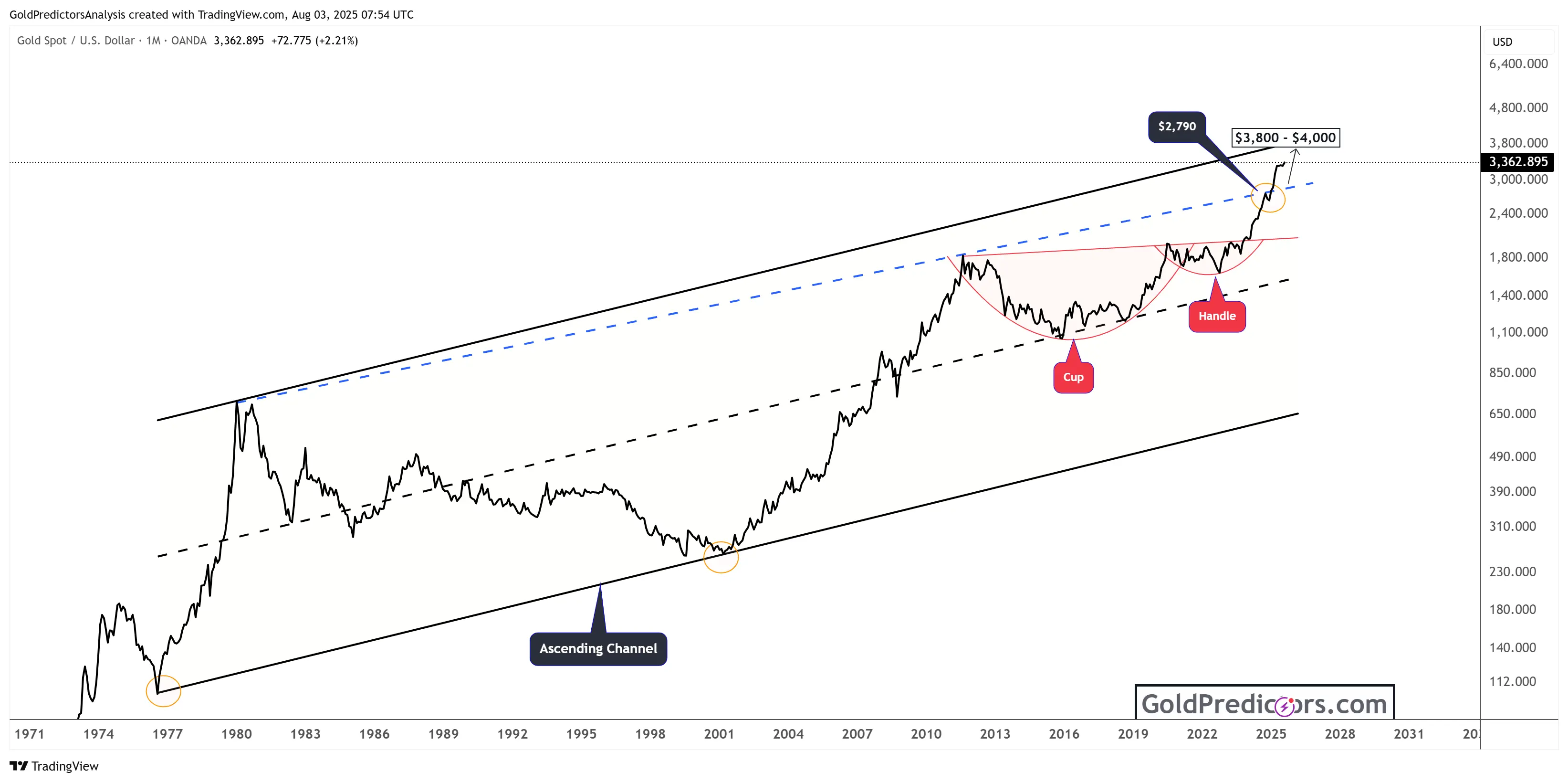
Three key consolidation zones are visible, each of which was followed by a significant breakout to the upside. A new consolidation zone has appeared between $3,250 and $3,400, persisting for several weeks. With the price now approaching the upper boundary of this range, the possibility of another breakout appears strong.
A decisive close above the $3,400 resistance level would confirm this breakout. A successful breakout would set the stage for a move toward $3,600–$3,800, aligning with earlier bullish extensions. Momentum indicators support this outlook, and the series of higher lows continues to reflect strong bullish interest. Key support remains near $3,200, and a drop below this level would invalidate the bullish setup, suggesting a deeper correction. For now, however, the trend remains in favor of buyers.
Conclusion
Gold remains in demand as rising trade tensions and dovish Fed signals increase safe-haven appeal. Risk-off sentiment, a weakening dollar, and supportive technicals all align in favour of further gains. If gold pushes through resistance, upside targets near $3,600–$3,800 may come into play. Until then, the market remains firmly bullish with buyers in control. Any pullback is likely to be seen as a buying opportunity in the current environment.
Unlock exclusive gold and silver trading signals and updates that most investors don’t see. Join our free newsletter now!
Unlock exclusive gold and silver trading signals and updates that most investors don’t see. Join our free newsletter now!
Author
Muhammad Umair, PhD
Gold Predictors
Muhammad Umair is a financial markets analyst and investor who focuses on the forex and precious metals markets.

















