Gold rallied on soft PCE data. Here’s why the move could have further to run

Gold is ending September with substantial losses, not far from its year-low in the $3,940 region. The bright metal enjoyed a temporary boost on Wednesday and peaked around $4,220 early in the American session, but quickly changed course and turned red for the day.
The intraday spike and the subsequent slump resulted from a batch of encouraging United States (US) data that weighed lower the odds of a Federal Reserve (Fed) rate hike in the upcoming October meeting. Odds for a hike plunged from above 70% at the beginning of the week to roughly 40%.
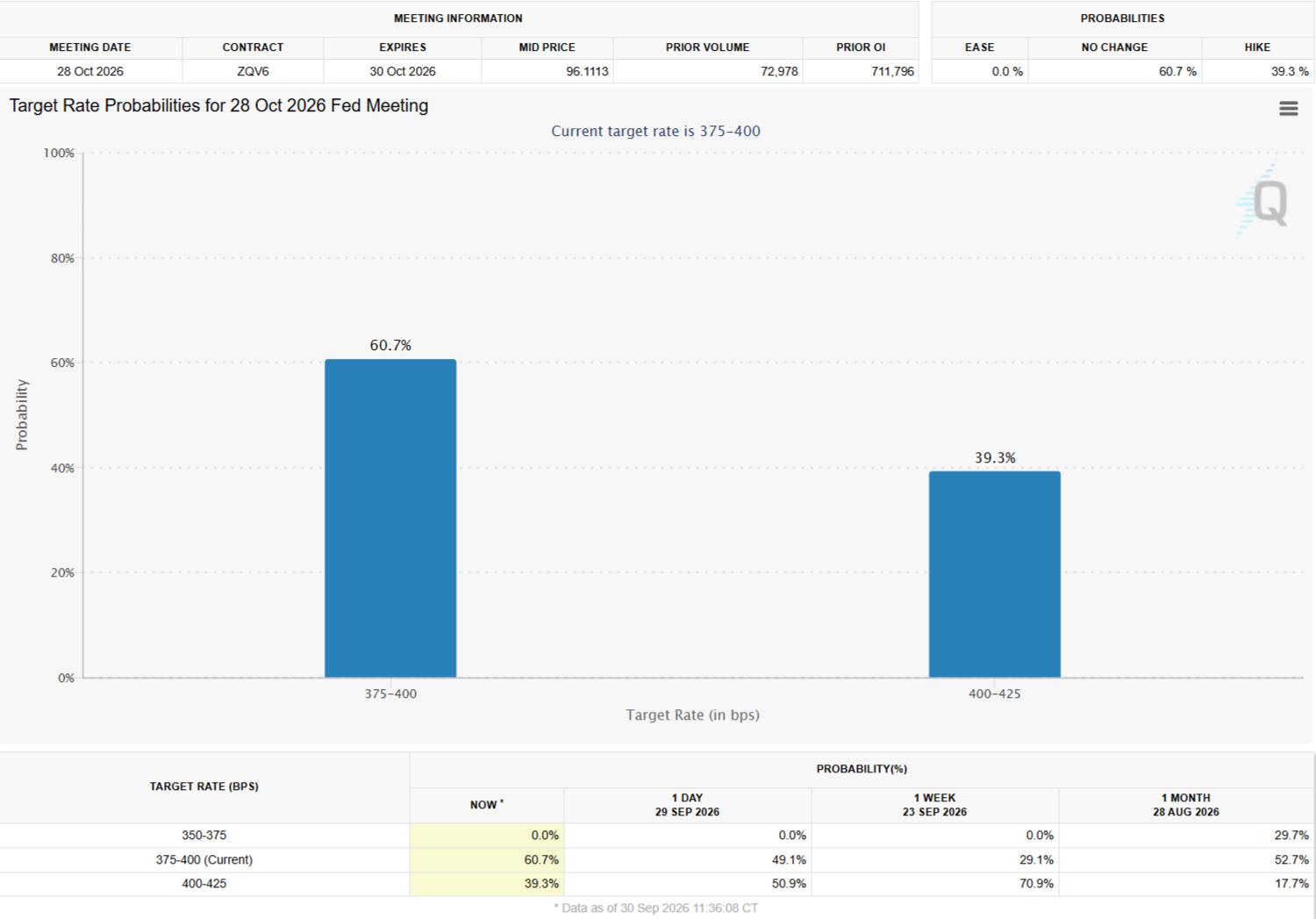
Source: cmegroup.com
The United States economy proved resilient once again
The United States (US) reported on growth, inflation and employment, and all figures were upbeat. Annualized growth, as measured by the Gross Domestic Product (GDP), was upwardly revised to 2.2% from the previous estimate of 1.5% in the second quarter of the year. The private sector added 90K new jobs in the month, according to the ADP Employment Change report, and last but not least, the Personal Consumption Expenditures (PCE) Price Index, the Fed’s favorite inflation gauge, came in softer than anticipated in August, holding at 3.4%.
Three for the price of one: the labor market is healthy, inflation is stable, and economic progress continues regardless. The Fed can breathe, can it?
Actually, there is a caveat: the yield on the 10-year Treasury note stands at fresh multi-decade highs at 5.30%.
Indeed, the always massive US government debt means a steady supply of Treasuries. And for sure, you need US Dollars (USD) to get those; hence, the Greenback standing victorious vs Gold. At the end of the day, the precious metal yields zero.
But this picture that seems to be putting Gold at the risk of a steeper decline is unsustainable in the long run. Yields can’t keep rising forever, and as long as the economy grows, the odds of additional interest rate hikes will keep decreasing. Not to mention, US President Donald Trump would be ecstatic if rates actually go down, a move that remains off the table in the near term.
Anyway, Gold seems weak in the near term, but stable in the longer run, with risk skewing north. The monthly chart shows XAU/USD posting higher lows above a bullish 20-month Simple Moving Average (SMA), and that’s a technical sign worth caring about.
From the macro side, contained inflation is yet another hint of a potential Gold recovery in the medium run.
But what actually will toss the coin on one side or the other will be the Middle East war and Oil prices. Despite the conflict seeming endless, market participants are slowly starting to realize that navigation through the Strait of Hormuz is back to around 80% of pre-war levels, which means Oil prices are likely to ease further, as long as the crisis does not escalate. And with the US mid-term elections around the corner, President Trump will likely sit on his hands, at least for a couple of months.
Bottom line: as long as tensions persist, the USD will have a chance of advancing against the bright metal, yet as soon as Oil turns lower and fears about escalating tensions in the Middle East recede, the odds will be on Gold’s side.
Author

Valeria Bednarik
FXStreet
Valeria Bednarik was born and lives in Buenos Aires, Argentina. Her passion for math and numbers pushed her into studying economics in her younger years.
















