Loonie's rate relief comes after the Fed stops hiking
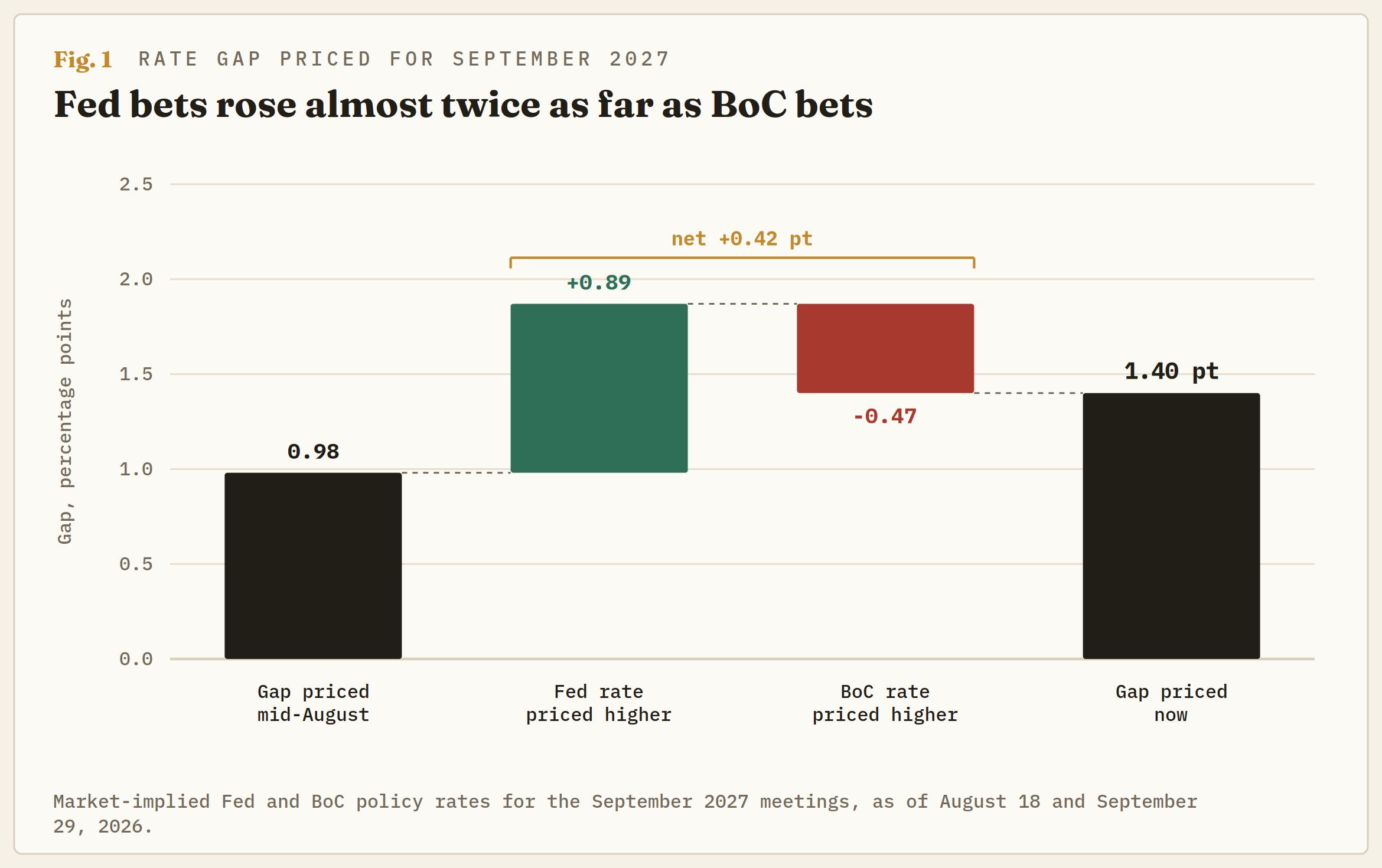
In September, USD/CAD climbed back to the top of the range it has held since 2025, and the Loonie lost that ground to bets on the Federal Reserve (Fed) rather than anything the Bank of Canada (BoC) did. Between mid-August and late September, traders raised the Fed rate they expect for September 2027 by close to nine-tenths of a percentage point, and the BoC rate for the same month by less than half a point. USD/CAD trades the gap between those two expected rates, and the gap moved the US Dollar's way.
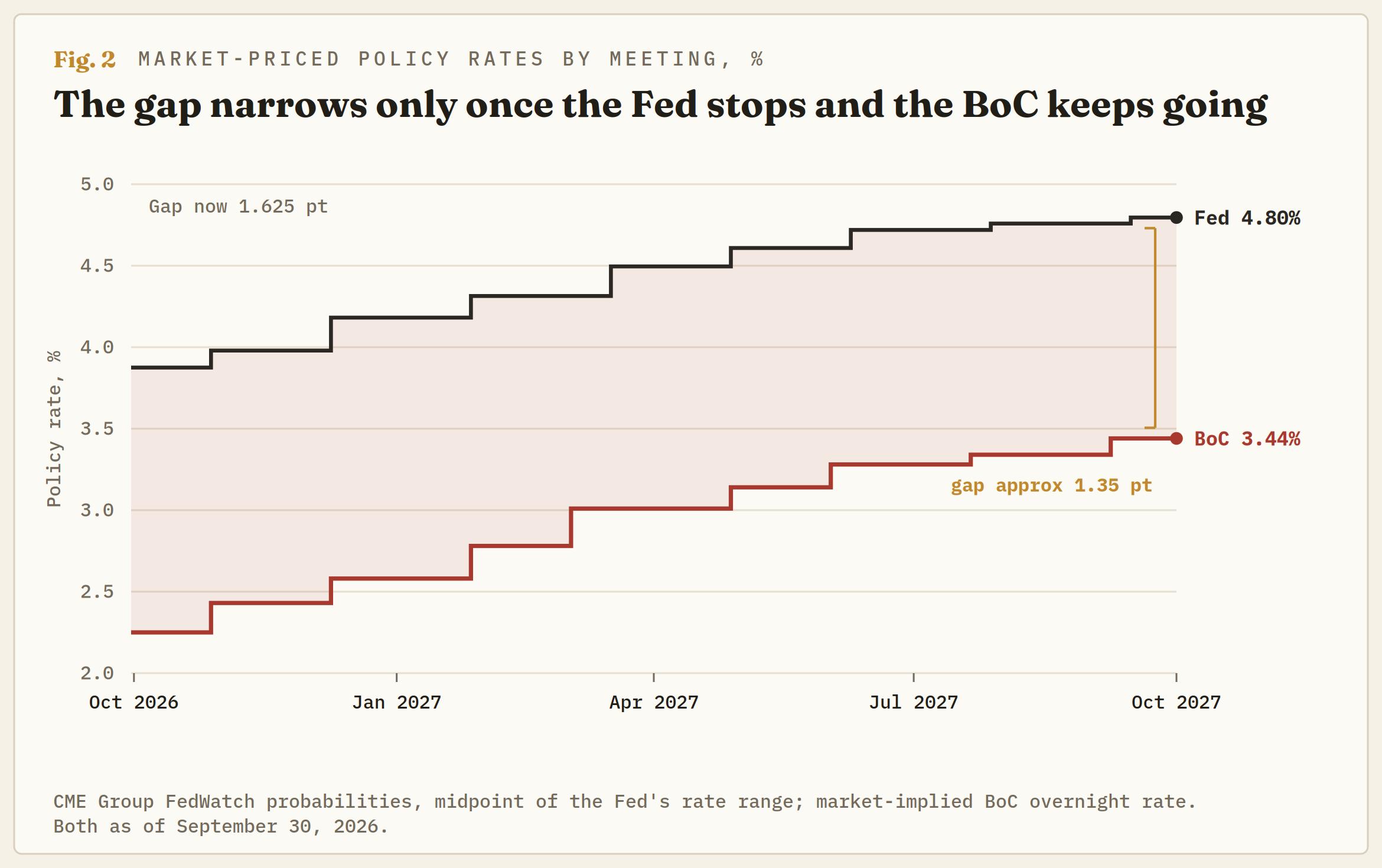
Across the rest of this cycle, traders have priced both central banks to keep raising rates, with the gap staying wide through the winter and narrowing only after the Fed stops and the BoC keeps going. The Loonie's relief from rates is back-loaded and conditional: it needs a BoC that hasn't started hiking to outlast a Fed that has already begun, on inflation the BoC's own core measures put at 2%.
Close to nine-tenths of a point in Washington, under half in Ottawa
The gap matters to USD/CAD because it's the extra interest you earn for holding US Dollars instead of Loonies, and traders move money ahead of changes to it. The Fed raised its rate to 3.75%-4.00% on September 16, its first hike since 2023, which put the midpoint at 3.875%. The BoC has held at 2.25% for seven straight meetings, which leaves US rates 1.625 percentage points above Canada's.
What moved the pair is the gap traders expect for September 2027, which widened from about 1.0 point in mid-August to about 1.4 points by September 29. Most of that came in the fortnight either side of the Fed's September 16 hike, the same stretch in which USD/CAD went from under 1.3800 to above 1.4050. So the Loonie fell for three weeks while traders expected its own central bank to raise rates almost five times.
The year-ahead gap also holds steady when odds for the next meeting swing. New York Fed President Williams played down the need for another quick hike on Tuesday, and soft US inflation figures followed on Wednesday. Together they cut the odds of an October Fed hike by about 28 points and moved the Fed rate traders expect for September 2027 by about four hundredths of a point, so for USD/CAD the next meeting's odds mostly change when the gap moves, not how far it moves.
The Loonie's relief comes to about one extra BoC hike
Line the two priced paths up and both central banks are expected to deliver about two quarter-point hikes by the end of January, which keeps the gap around 1.5-1.6 points through the winter. After that, the Fed is priced to slow down and stop around 4.75% by mid-2027, while the BoC keeps going to about 3.45% by September 2027.
That takes the gap to about 1.35-1.4 points by late 2027, a narrowing worth about one extra BoC hike, and all of it depends on the BoC raising rates after the Fed has stopped. Until then, holding US dollars keeps paying about one and a half points more than holding Loonies.
Both sets of bets are ahead of their central banks
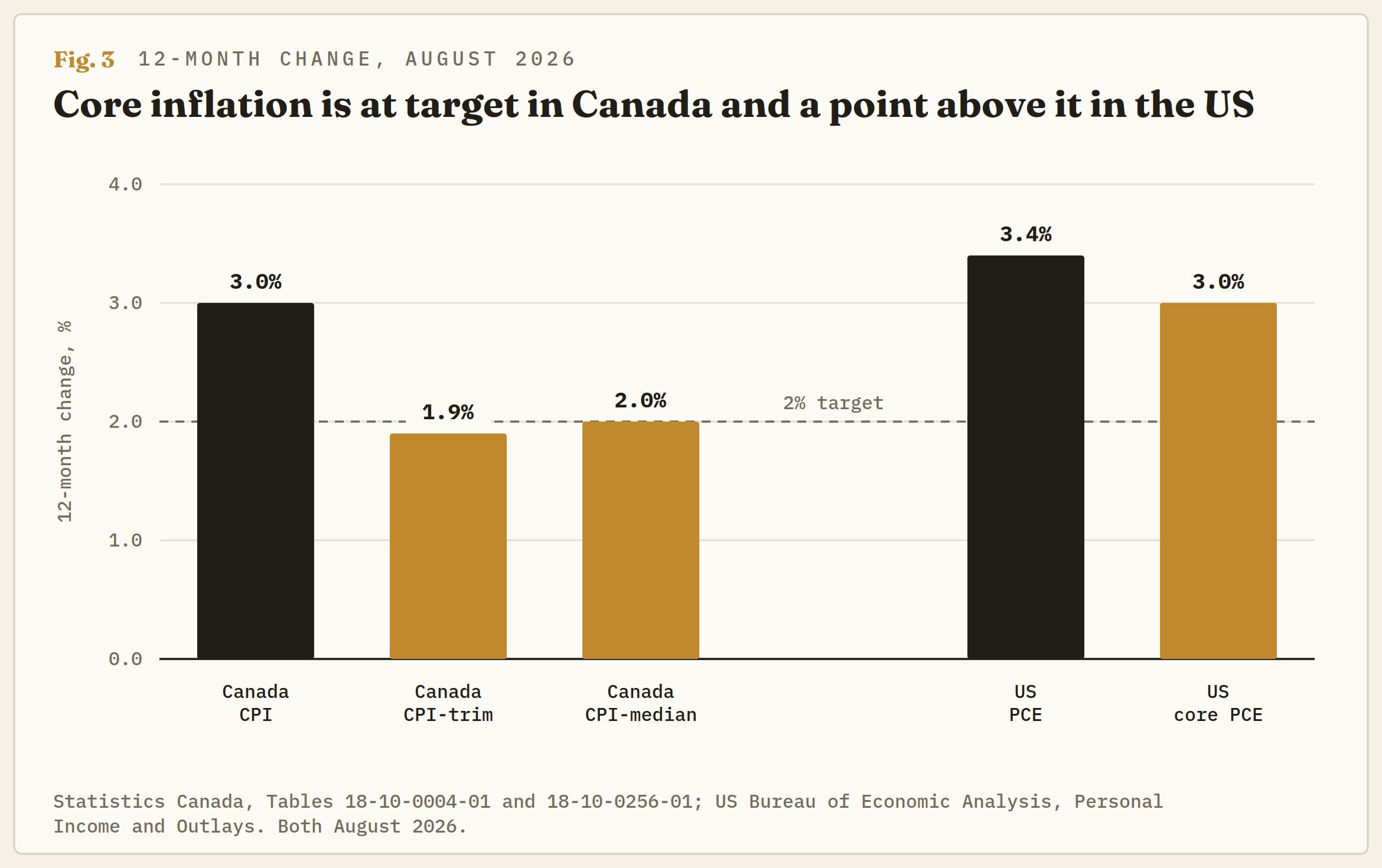
The Fed's own median projection, published with the September 16 hike, puts its rate at 4.1% at the end of 2026 and still at 4.1% at the end of 2027, which is one more quarter-point hike and then a pause. Traders price almost three hikes beyond that by September 2027, and CME Group's FedWatch tool, which turns futures prices into probabilities, has 4.75%-5.00% as the most likely Fed rate by then. The Fed at least has a core inflation problem to point to, since the price index it prefers, stripped of food and fuel, rose 3% in the year to August, a point above its 2% target.
The BoC's case rests on the risk that price rises become persistent, not on evidence that they already have. Canada's Consumer Price Index (CPI) rose 3% in the year to August and 2.4% without gasoline, and the BoC's two preferred core measures, which filter out the month's most extreme price changes, were at 1.9% and 2%. Canada lost 41.7K jobs in August, and real Gross Domestic Product (GDP) was flat in July, with an early estimate of 0.2% growth for August. Traders added BoC hikes through all of it.
BoC Governor Tiff Macklem has given them reasons to. On September 2, the BoC held at 2.25% but dropped the line saying its rate was at the right level, and Governor Macklem said it was ready to raise rates more than once if inflation stayed too high. In a September 21 speech, he said moving too slowly means raising rates faster and further later, and that inflation would edge up if Oil stays near $100 a barrel. Traders have priced the faster and further version before the BoC has raised rates once.
That makes the BoC's leg the less certain half of the trajectory, and it's the half the Loonie needs. The Fed has started and has core inflation above target to keep going, while the BoC has neither and its argument depends on Oil. A fall in Oil would take more out of the BoC's side of the bets than the Fed's, which is the direction that lifts USD/CAD.
One day, two decisions, and the BoC goes first
The first test of the priced trajectory comes on October 28, when both central banks announce decisions and the BoC goes first. Its Monetary Policy Report (MPR) that day is the first to use Prima, the BoC's new model for telling temporary price rises from persistent ones, so the model's first public run comes in the report that could carry the BoC's first hike. Traders expect that first hike by December at the latest, and the Fed's next one by December too. Before it, Canada's jobs and inflation reports land on October 9 and October 19, and US inflation on October 14.
What matters for the Loonie is less the result of any single meeting than which of three things happens over the winter. The first is whether the BoC starts on schedule and says it will keep going, which the 2027 narrowing depends on. The second is whether Canada's core measures begin to follow the headline up, the evidence the BoC's case doesn't have yet. The third is whether US core inflation keeps falling toward the Fed's target, which would end the Fed's cycle sooner and pull the Loonie's relief forward.
A one-year range, and the September run reached its top
USD/CAD has traded between roughly 1.3500 and 1.4250 since October 2025. The September run took it from the lower third of that range to the top in three weeks, close to 90% of the way back from the August low to the late-June high. It pushed the daily Stochastic Relative Strength Index (Stoch RSI), a momentum gauge scored between zero and 100, to the top of its scale, where the gauge also stood when the June run stalled at the same level.
The pair is back above its 200-day exponential moving average (EMA), a trend line that gives recent prices more weight, near 1.3900, a line it has crossed in both directions in 2026. The level that decides the chart is 1.4250, the top of the range. A daily close above it would take USD/CAD to levels it hasn't traded at since early April 2025, and nothing in the priced trajectory widens the gap enough to justify one.
A BoC hold is what takes USD/CAD through 1.4250
While the priced trajectory holds, the rate gap stays around 1.5-1.6 points through the winter and is no reason to buy Loonies, so the lean is higher for USD/CAD within the top half of its range, between 1.3900 and 1.4250. A BoC that starts on schedule keeps the pair inside that band. A break above 1.4250 needs the BoC's leg to fail, with a BoC that holds or stops after one hike because Oil falls or Canada's core measures stay at 2%, and a daily close above 1.4250 opens 1.4300.
The lean is wrong on a daily close below the 200-day near 1.3900. Getting there takes the Fed's cycle ending sooner than priced, with US core inflation falling toward target, while the BoC starts and signals more, which pulls the Loonie's 2027 relief into the winter. Even then, US dollars would still pay more than Loonies through the end of 2027.
Author

Joshua Gibson
FXStreet
Joshua joins the FXStreet team as an Economics and Finance double major from Vancouver Island University with twelve years' experience as an independent trader focusing on technical analysis.
















