The Fed's October hike shrinks with the inflation it was built on
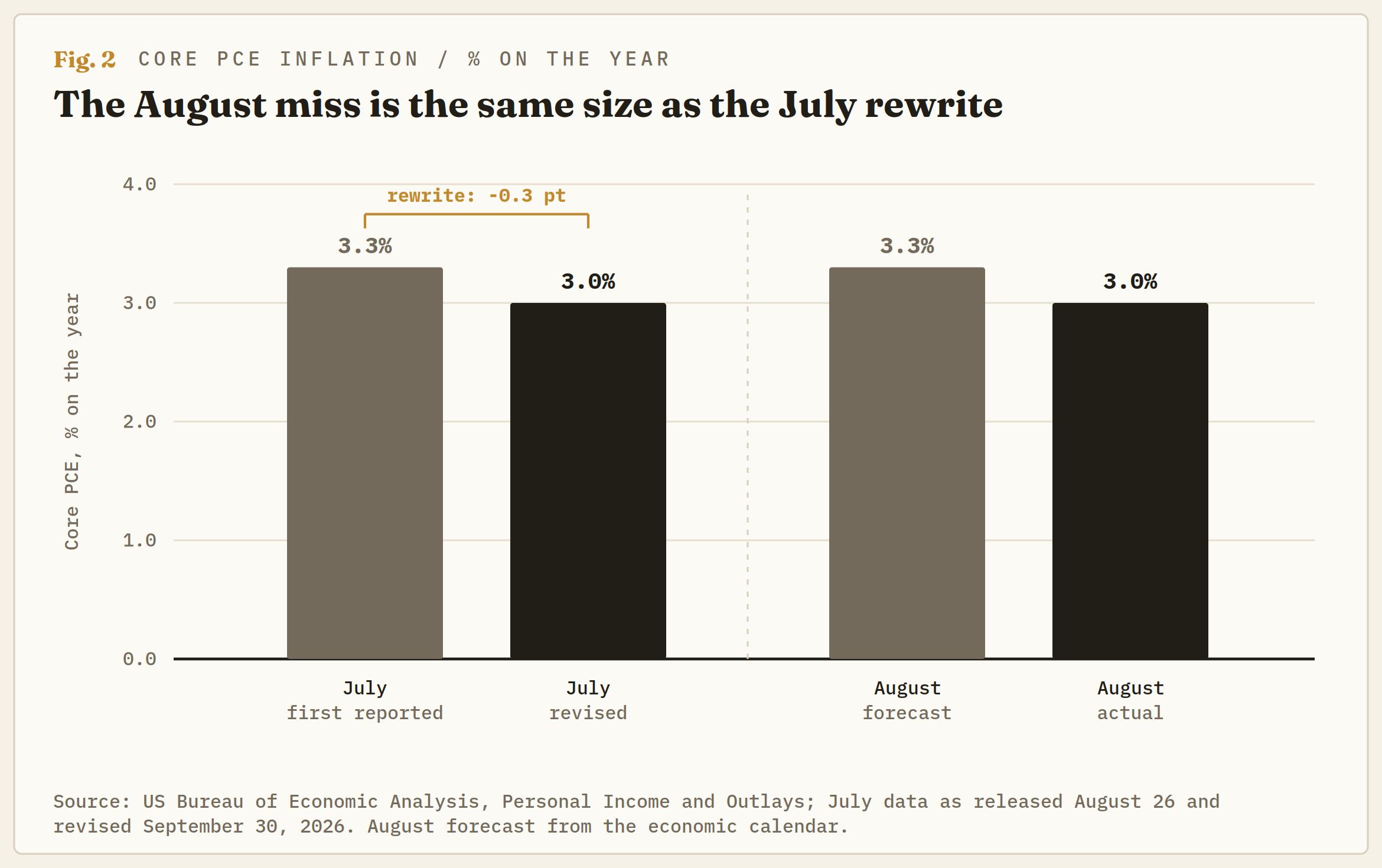
Traders have moved the next Federal Reserve (Fed) hike from October 28 to December 9, and the inflation report that added to the move said more about July than August. The government's annual rewrite, published alongside the August Personal Consumption Expenditures Price Index (PCE), cut July's core reading, which leaves out food and energy, from 3.3% to 3%. The Fed raised rates on September 16 with that 3.3% in hand. The same rewrite showed faster growth, which is why traders delayed the hike rather than dropping it.
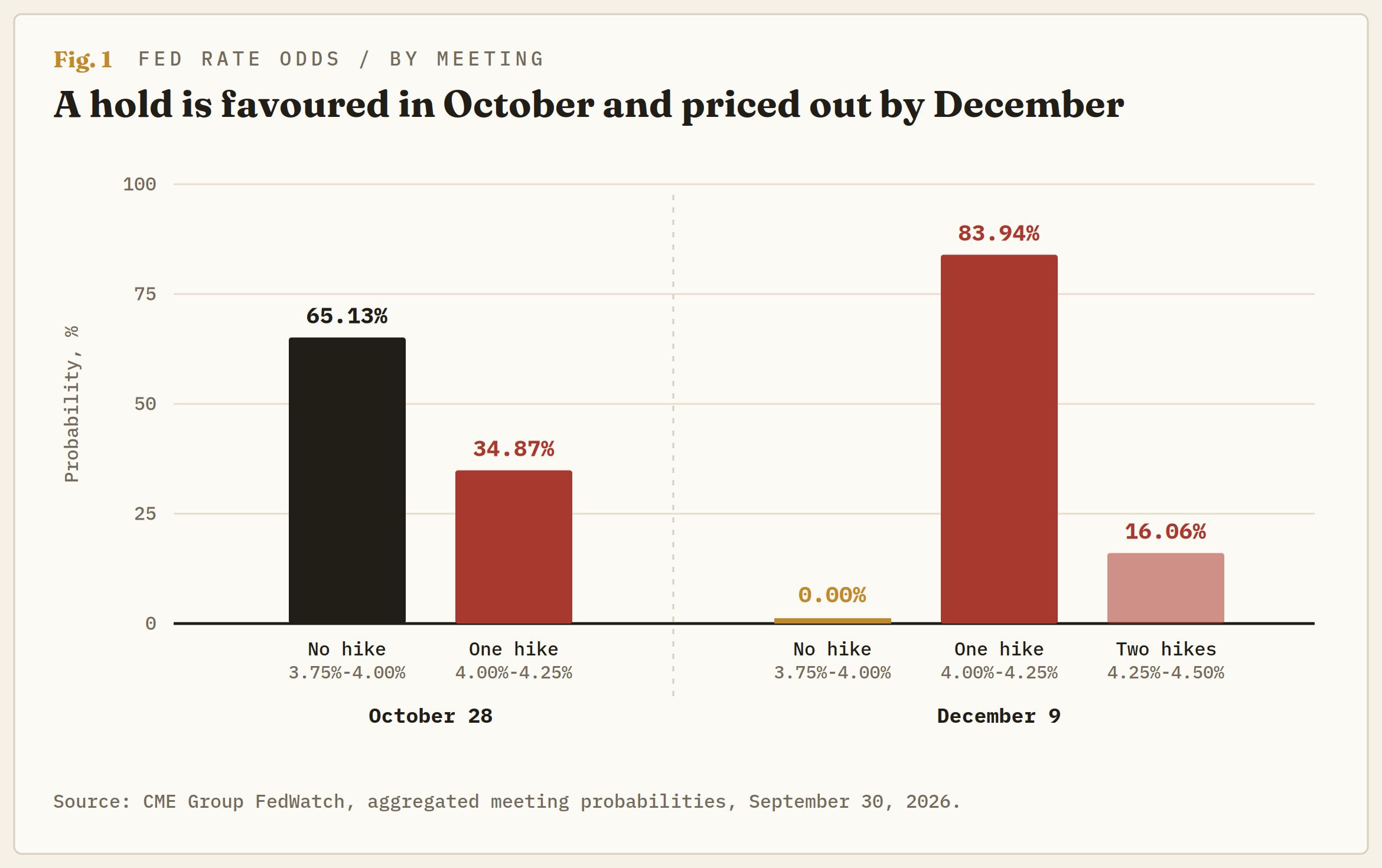
In the two weeks after that hike, traders pushed the odds of another one on October 28 to about 70%. CME Group's FedWatch tool, which turns futures prices into probabilities, has them at 34.87% after the report, with a hike by December 9 priced at 100%. The July reading the Fed raised rates on lasted five weeks.
The biggest news in the August report was about July
The PCE is the inflation measure the Fed targets at 2%. Officials watch the core version for the trend, since food and energy prices swing with harvests and Oil. Core prices rose 0.2% in August against a 0.3% forecast, and 3% on the year against 3.3%. Forecasters were a tenth of a point too high on the month and three-tenths too high on the year, and the difference is the past.
The Bureau of Economic Analysis (BEA) rewrites its figures each year with fuller tax and survey data, and the 2026 rewrite reached back to January 2021. On August 26, it had reported July's core inflation at 3.3% and the headline rate, food and fuel included, at 3.7%. Revised, they're 3% and 3.4%, and August came in at exactly those levels.
For the October decision, the trend matters more than the month. Revised, core inflation has held at 3% for three months, rising 0.1% in July and 0.2% in August, close to the pace a 2% target allows. A second hike six weeks after the first needed inflation stuck high or was climbing, and the revised figures show it flat.
One more hike is in the Fed's forecast, and October isn't
On September 16, the Fed raised its rate from 3.50%-3.75% to 3.75%-4.00%, its first increase since 2023, and every voter backed it. Officials' median forecast, published the same day, puts the rate at 4.1% at the end of 2026. That's one more quarter-point hike, and the forecast doesn't say at which meeting.
Fed Chair Kevin Warsh said on September 16 that inflation had been too high for too long, and at 3% it still is. The forecast that justified the hike has core inflation ending 2026 at 3.4%, so it now needs inflation to speed up to come true. That keeps the case for one more hike. It weakens the case for making it on October 28, since the urgency came from figures that have since been cut.
Three-tenths off inflation and seven-tenths onto growth
Gross Domestic Product (GDP), the value of everything the economy produces, grew at a 2.2% annual pace in the second quarter, not the 1.5% previously reported. The rewrite also showed Americans had saved more than thought. It lifted July's saving rate, the share of after-tax income people don't spend, from 3.0% to 4.6%. Both sides of the argument over another hike got something.
Households spent some of that cushion in August, when spending rose 0.9% against income growth of 0.2%. After adjusting for price rises, it was up 0.6%, the most since March 2025. After-tax income adjusted the same way, didn't grow at all, and the saving rate fell to 4.1%, its lowest since November 2022.
In September, the Chicago Purchasing Managers Index (PMI), a survey where readings above 50 mean growth, jumped to 58.8 from 47.1. ADP's count of private hiring beat its forecast too. A Fed raising rates to slow spending has no reason to stop while spending looks like this, which is why December is still priced as certain.
A speech moved October further than the report did
Chair Warsh has refused to provide forward guidance or advance word on what the Fed plans to do, since taking over in June. On Tuesday, New York Fed President John Williams, vice chair of the committee that sets rates, said the September hike had removed any urgency. He said one more increase may be appropriate before the end of 2026.
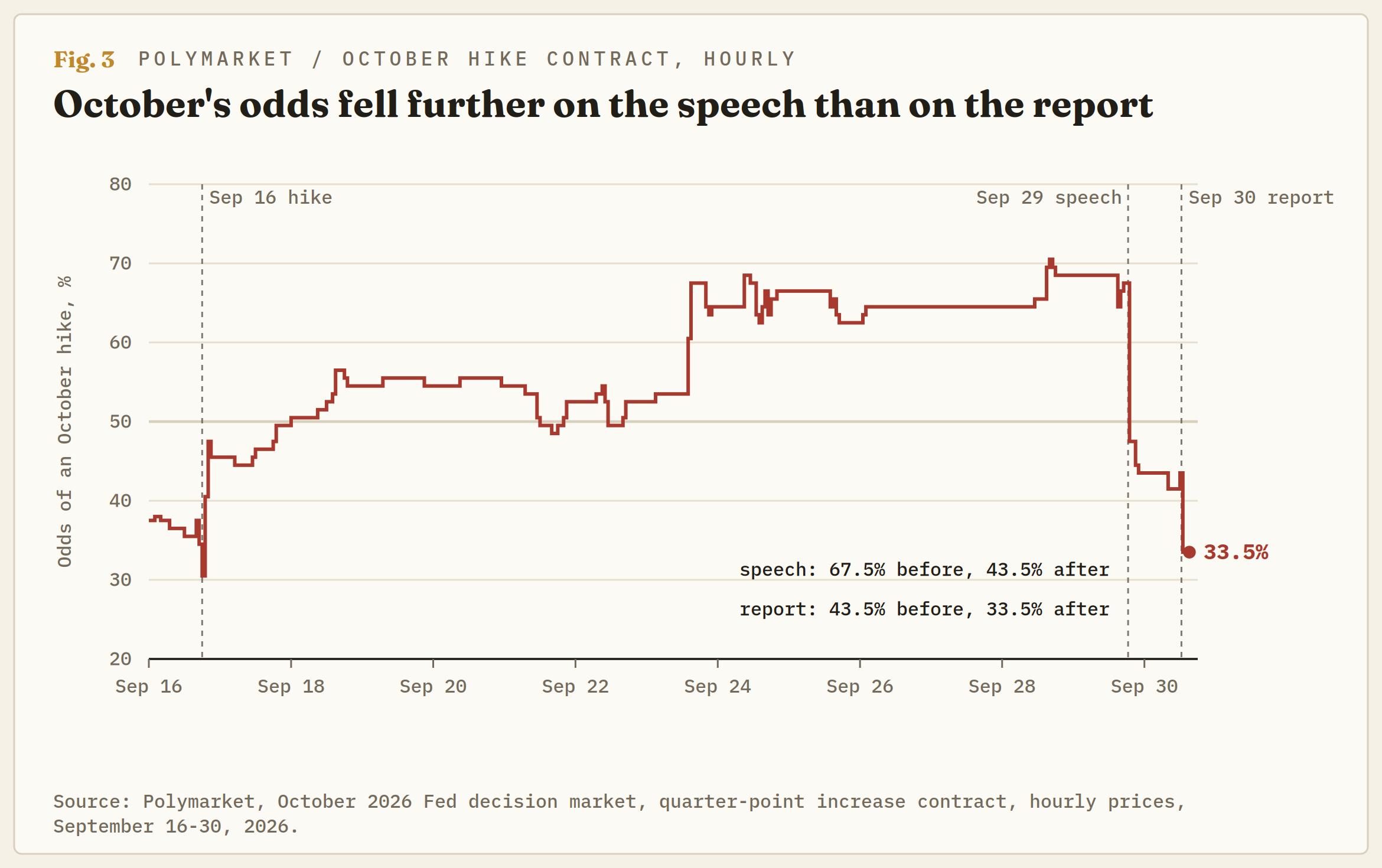
FedWatch's odds of an October hike fell from about 70% to about even after the speech and to 34.87% after the report. Polymarket, where people bet on outcomes, shows the same order, with its October contract falling from 67.5% to 43.5% on the speech and to 33.5% on the report. Guidance was dropped in June, and on September 29 it moved the October odds by about 20 points.
The next hike is priced for the first meeting after the midterms
The Fed decides on October 28, six days before the November 3 mid-term elections, and December 9 is its first meeting after them. After the September hike, President Donald Trump said US rates should be 1% or less and that he'd told Chair Warsh to go along with the majority if he had to. New York Fed President Williams said on Tuesday that the election's timing plays no part.
Holding six days before the vote would draw questions about whether the White House leaned on the Fed. The revision gives a hold a reason on paper, since the figure behind the September hike is now 0.3 of a point lower. So politics don't tilt the October odds either way, leaving the decision to the numbers.
The Fed may time its decisions around elections. In July, 83% of fund managers surveyed by Bank of America expected no hike before the midterms, and the Fed hiked in September.
October rests on two releases, and neither is the next PCE
September payrolls arrive on Friday and September's Consumer Price Index (CPI), the other main inflation measure, on October 14. The next PCE report comes out on October 29, the day after the decision. That makes the Wednesday PCE report the last of its kind the Fed gets before it votes.
The lean is an October hold and a December hike. FedWatch puts them at 65.13% and 100%, and October is back in play only if its odds climb above 50% after the October 14 CPI. That would take a core reading hot enough to undo what the revision did to July. Strong payrolls on Friday would argue for December more than October, since the case against hurrying rests on inflation.
The call is wrong if the hike is being cancelled rather than moved. FedWatch gives two hikes by December 9 a 16.06% chance and none a zero chance, and if those swap places, traders have started pricing a cancellation. The likeliest cause would be August's spending, which rose more than four times as fast as income and can outrun it only while savings last. The statisticians found those savings on September 30, after August's shoppers had started spending them.
Author

Joshua Gibson
FXStreet
Joshua joins the FXStreet team as an Economics and Finance double major from Vancouver Island University with twelve years' experience as an independent trader focusing on technical analysis.
















