Gold Price Weekly Forecast: XAU/USD looks fragile heading into Jackson Hole week
- Gold price lost more than 1% this week, pressured by surging yields and China woes.
- XAU/USD needs to stabilize above $1,900 to discourage bears.
- Headlines from China and central bank speech at Jackson Hole could drive the pair’s action next week.

Gold price declined below $1,900 for the first time in five months, pressured by concerns over an economic slowdown in China and rising US Treasury bond yields. Comments from central bankers at the Jackson Hole Symposium next week could help investors decide whether it’s time for XAU/USD to stage a decisive rebound after sliding for three consecutive weeks.
What happened last week?
After warning of a $7.6 billion loss in the first half of the year ahead of the weekend, Chinese real estate giant County Garden Holdings announced that it will suspend the trading of 11 onshore bonds from Monday. Safe-haven flows dominated the markets following this development and the US Dollar gathered strength, causing XAU/USD to end the day in negative territory.
Data released Tuesday showed that retail Sales in China– the world’s biggest consumer of gold – rose 2.5% on a yearly basis in July, missing the market expectation for an increase of 4.8% by a wide margin. Meanwhile, China's central bank, the People’s Bank of China (PBOC), unexpectedly cut the one-year Medium-term Lending Facility (MLF) rate to 2.50% from 2.65%, reviving fears over an extended slowdown in China’s economic recovery.
In the US, Retail Sales increased 0.7% on a monthly basis in July, exceeding the market expectation for a growth of 0.4%. The upbeat data let the USD preserve its strength and XAU/USD extended its slide. Moreover, markets continued to stay away from risk-sensitive assets after Fitch Ratings warned that a rating downgrade of some big US lenders was on the table.
The cautious market stance helped the USD to hold its ground and didn’t allow XAU/USD to stage an upward correction mid-week. Minutes of the Federal Reserve’s (Fed) July meeting showed that most policymakers saw "significant" upside risks to inflation and agreed that those risks could require further tightening of the monetary policy. The benchmark 10-year US Treasury bond yield climbed above 4.3% for the first time since October 2022 following the Fed’s publication, dragging the pair to its lowest level in five months below $1,890.
Gold price managed to recover above $1,900 in the first half of the day on Thursday but lost its traction as the 10-year US T-bond yield continued to push higher. Reuters reported later in the day that Evergrande – China’s second-largest property developer – filed for protection from creditors in a US bankruptcy court. This headline made it difficult for XAU/USD to make a correction ahead of the weekend.
Next week
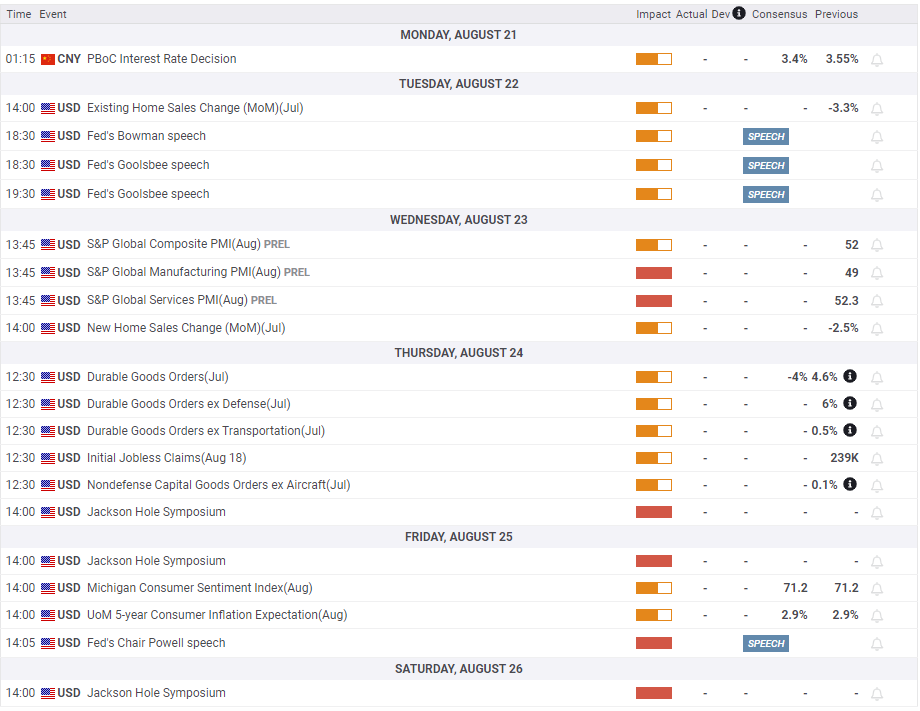
China’s central bank will announce its interest rate decision during the Asian trading hours on Monday. Following the unexpected cut to MLF rate earlier this week, experts anticipate the PBoC to lower the benchmark loan prime rate by 15 basis points. A bigger cut could signal that the slowdown is more severe than expected and weigh on Gold price.
On Wednesday, S&P Global will release the preliminary US Manufacturing and Services PMI reports for August. In case the headline Services PMI drops below 50 and shows a contraction in the service sector’s business activity, the USD could come under pressure and help XAU/USD stage a rebound. Nevertheless, market participants could refrain from taking large positions ahead of the Jackson Hole Symposium that will start on Thursday.
The next Federal Reserve policy meeting will be held on September 19-20 and Chairman Jerome Powell could use the Jackson Hole Symposium as an opportunity to steer market expectations, as he did in the past. At the time of writing, the event’s agenda was not yet released but Powell is likely to deliver the opening remarks at 14:00 GMT on Thursday.
Markets are pricing in a slightly more than 10% probability of a 25 basis points (bps) Fed rate hike in September, according to the CME Group FedWatch Tool. The market positioning suggests that USD’s losses are likely to remain limited even if Powell confirms a pause at the next meeting. Investors are still fairly optimistic that there won’t be another rate increase before the end of the year. The odds of the Fed policy rate rising to the range of 5.5%-5.75% from 5.25%-5.5% are about 30%.
XAU/USD could stretch lower if Powell signals further policy tightening is the most likely scenario, citing tight labor market conditions and sticky services inflation. On the other hand, US Treasury bond yields could turn south and trigger a rebound in Gold price if the Fed’s chairman adopts a cautious stance regarding one more rate hike in 2023.
Assessing the Fed’s potential policy outlook, “given recent favorable inflation and labor market data, we expect the end-of-the-tightening-cycle message to dominate Fedspeak in coming weeks as we approach the September FOMC meeting,” said Oscar Munoz, Chief US Macro Strategist at TD Securities. “Policymakers will also drive the point home that, absent a recession, they will only ease the Fed funds rate if inflation expectations continue to normalize and when consumer-price growth is on a clear path toward the 2% objective. The policy stance will stay largely restrictive in the meantime,” he said.
Gold technical outlook
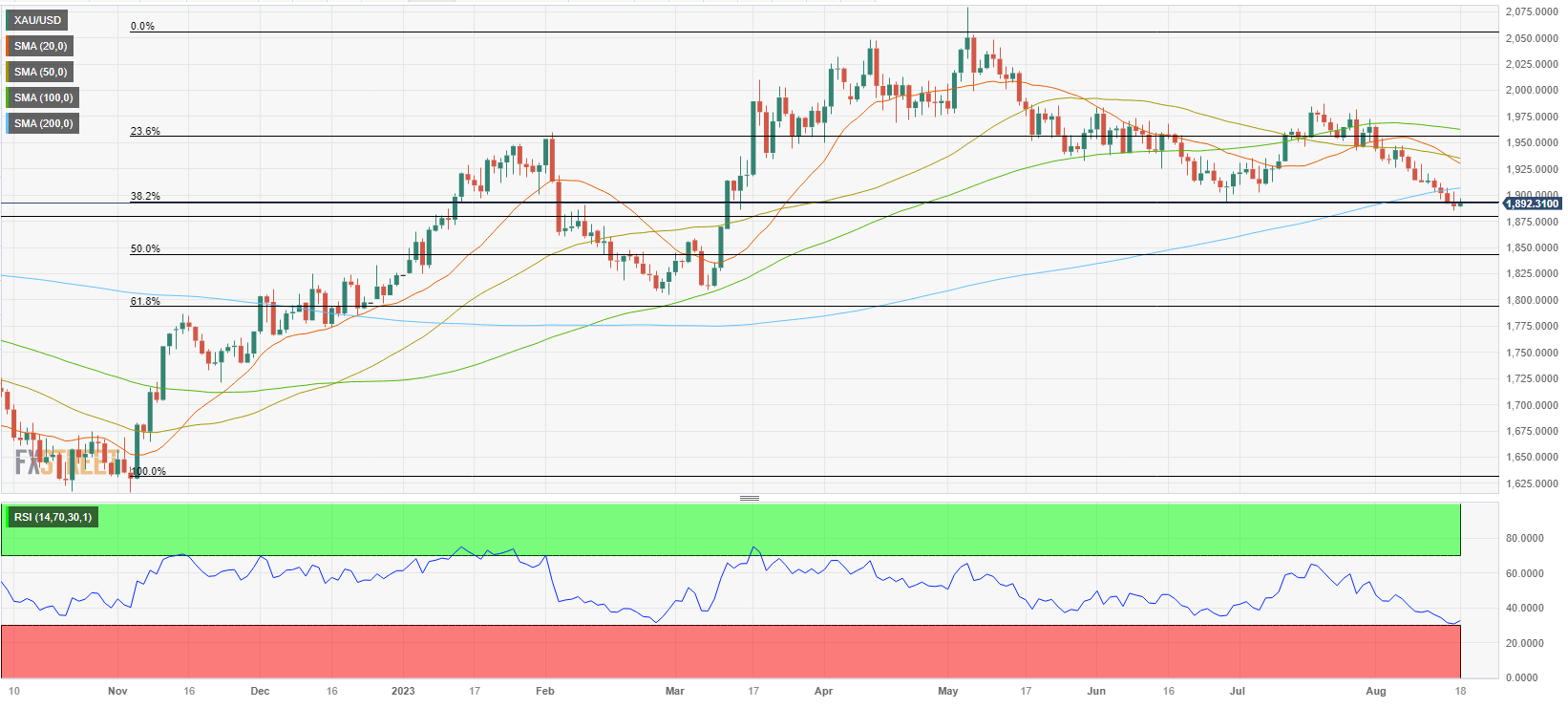
XAU/USD registered a daily close below the 200-day Simple Moving Average (SMA) for the first time since December, reflecting the dominance of sellers. Meanwhile, the Relative Strength Index (RSI) indicator on the daily chart edged slightly higher after touching 30 on Thursday, suggesting that the pair’s recovery attempt was nothing more than a short-lasting technical correction.
On the downside, $1,880 (static level) aligns as interim support ahead of $1,850 (Fibonacci 50% retracement of the November 2022 - May 2023 uptrend). A daily close below the latter could open the door for an extended downtrend toward $1,800, but sellers could hesitate if the pair shows oversold conditions when that happens.
In case XAU/USD rises back above $1,900 (200-day SMA, Fibonacci 38.2% retracement, psychological level) and starts using this level as support, sellers could book their profits and pave the way for another leg higher. In that scenario, $1,925 (20-day SMA, 50-day SMA) could act as next resistance before $1,950 (Fibonacci 23.6% retracement).
Gold forecast poll
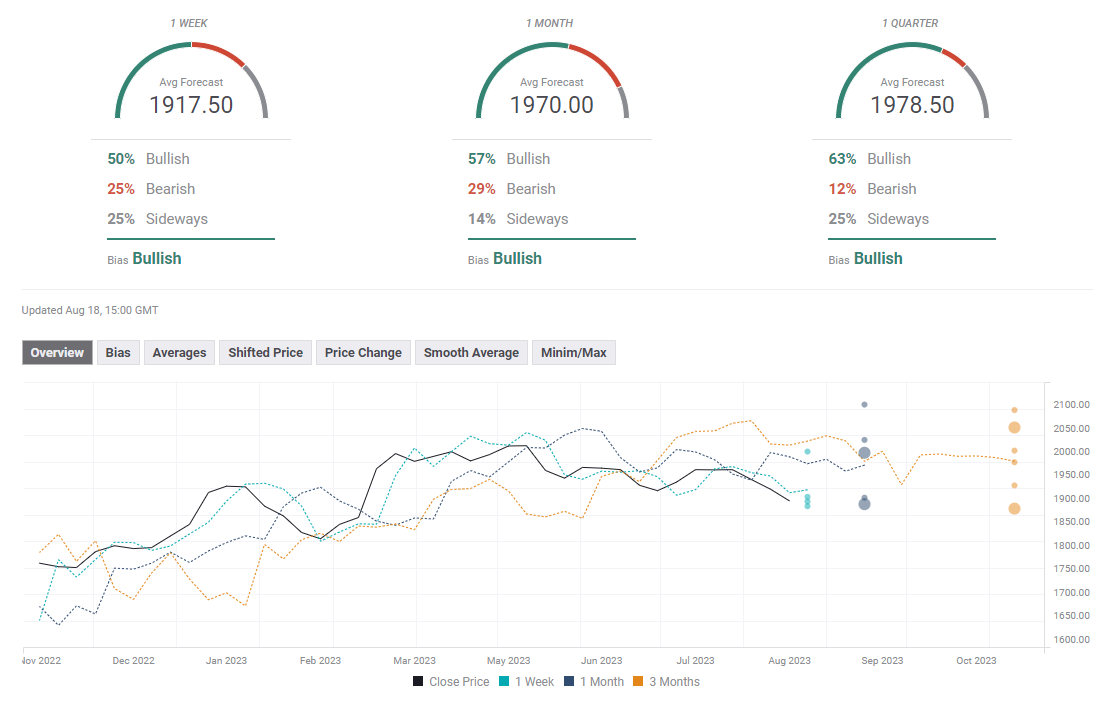
FXStreet Forecast Poll shows that more than half of polled experts see Gold price rising above $2,000 in the one-month view.
Author

Eren Sengezer
FXStreet
As an economist at heart, Eren Sengezer specializes in the assessment of the short-term and long-term impacts of macroeconomic data, central bank policies and political developments on financial assets.

















