Gold Price Weekly Forecast: Sellers look to retain control following bearish breakout
- Global recession fears and major central banks' commitment to tight policy weighed on Gold price.
- Technical outlook points to a bearish shift following this week's action.
- The $1,900 level aligns as key near-term support for XAU/USD.

Gold price started the week on the back foot and extended its slide to a fresh multi-month low at $1,910 after breaking below a three-week-old trading range. Growing fears over a global economic slowdown, combined with major central banks’ hawkish outlook, could make it difficult for XAU/USD to stage a decisive rebound in the near term.
What happened last week?
XAU/USD stayed relatively calm on Monday as trading conditions remained thin with American investors enjoying a three-day weekend. In the early Asian session on Tuesday, the People's Bank of China (PBoC) announced that it lowered the benchmark one-year Loan Prime Rate (LPR) and the five-year LPR by 10 basis points (bps) to 3.55% and 4.2%, respectively. Although this decision came in line with market expectations, it highlighted a loss of economic growth momentum in China, the world’s biggest gold consumer. Following the PBoC’s announcements, Goldman Sachs said that it lowered the full-year Gross Domestic Product (GDP) growth forecast of China to 5.4% from 6% previously anticipated.
On the first day of his congressional testimony on Wednesday, FOMC Chairman Jerome Powell noted that it will be appropriate to raise interest rates “somewhat further” by the end of the year. Powell reiterated that they will consider the implications of incoming macroeconomic data on the economic outlook and that they will make policy decisions on a meeting-by-meeting basis. These comments had little to no impact on market expectations for a 25 bps Federal Reserve (Fed) rate hike in July. Consequently, the 10-year US Treasury bond yield held steady above 3.7%, preventing XAU/USD to stage a rebound.
Renewed US Dollar (USD) strength forced the pair to continue to stretch lower on Thursday. As Gold price fell below the lower-limit of the consolidation channel at $1,930, technical selling pressure gathered momentum, dragging the precious metal to its weakest level since mid-March at $1,910. The Bank of England and the Swiss National Bank’s rate hikes reminded markets of major central banks’ willingness to continue to tighten monetary policy despite signs of softening in global economic activity, causing investors to seek refuge and ramping up the demand for the USD.
Although a pullback in US bond yields on Friday helped XAU/USD erase some of its losses, the pair ended the week in the negative territory. Meanwhile, S&P Global PMI surveys revealed that the business activity in the US private sector expanded at a softening pace in early June with Composite PMI falling to 53 from 54.3 in May.
Next week
XAU/USD’s impressive November-May uptrend that saw its price rise from $1,620 to $2,080 was fuelled by heightened optimism about strong Chinese growth and major central banks moving away from aggressive policy tightening on signs of softening inflation. During that period, the banking crisis in the US provided an extra boost to Gold prices. As markets started to realize that inflation remained sticky in major economies, while quick Fed action contained threats to financial stability, XAU/USD reversed its direction. Meanwhile, investors started to pay attention to the potential hit of the uninspiring performance of major economies on gold’s demand outlook.
Next week’s macroeconomic events are unlikely to influence how markets see the big picture. Hence, XAU/USD could find it difficult to kickstart another uptrend in the near term, leaving recovery attempts as technical corrections.
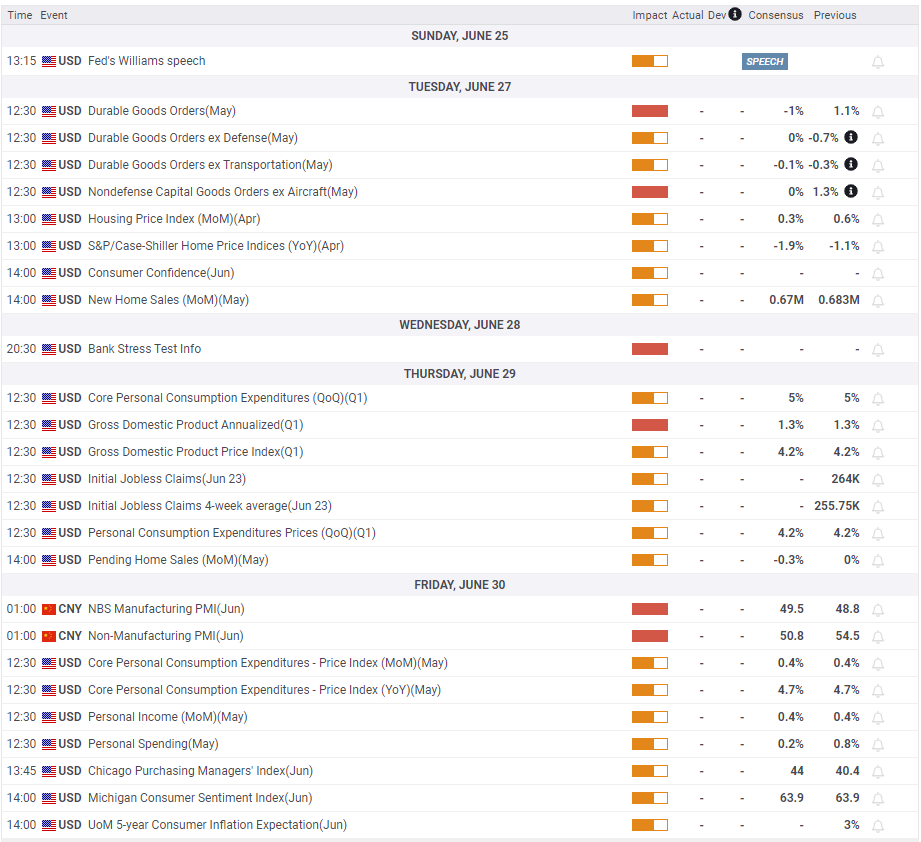
On Tuesday, May Durable Goods Orders and the Conference Board’s Consumer Confidence Index for June will be featured in the US economic docket. On Wednesday, the Fed will release the Bank Stress Test results. If the publication paints a gloomy picture for the banking sector, market participants could start reassessing the Fed’s rate outlook, causing the USD to lose strength and helping XAU/USD erase some of its recent losses. Conversely, the USD could gather strength alongside rising US yields, forcing XAU/USD to come under bearish pressure in case medium and small-sized banks are confirmed to be in a healthy position following the March financial crisis.
The US Bureau of Economic Analysis (BEA) will release on Thursday the final estimate of the annualized GDP growth rate for the first quarter, which is forecast to match the previous estimate of 1.3%. On Friday, the BEA will publish the Personal Consumption Expenditures (PCE) Price Index data, the Fed’s preferred gauge of inflation, for May. On a monthly basis, the Core PCE is forecast to rise 0.4%, matching April’s increase. XAU/USD’s reaction to PCE inflation data should be straightforward: a monthly core reading of 0.4% or higher will likely weigh on the pair, while a print of 0.2% or lower could trigger a bullish action in the short term.
Gold technical outlook
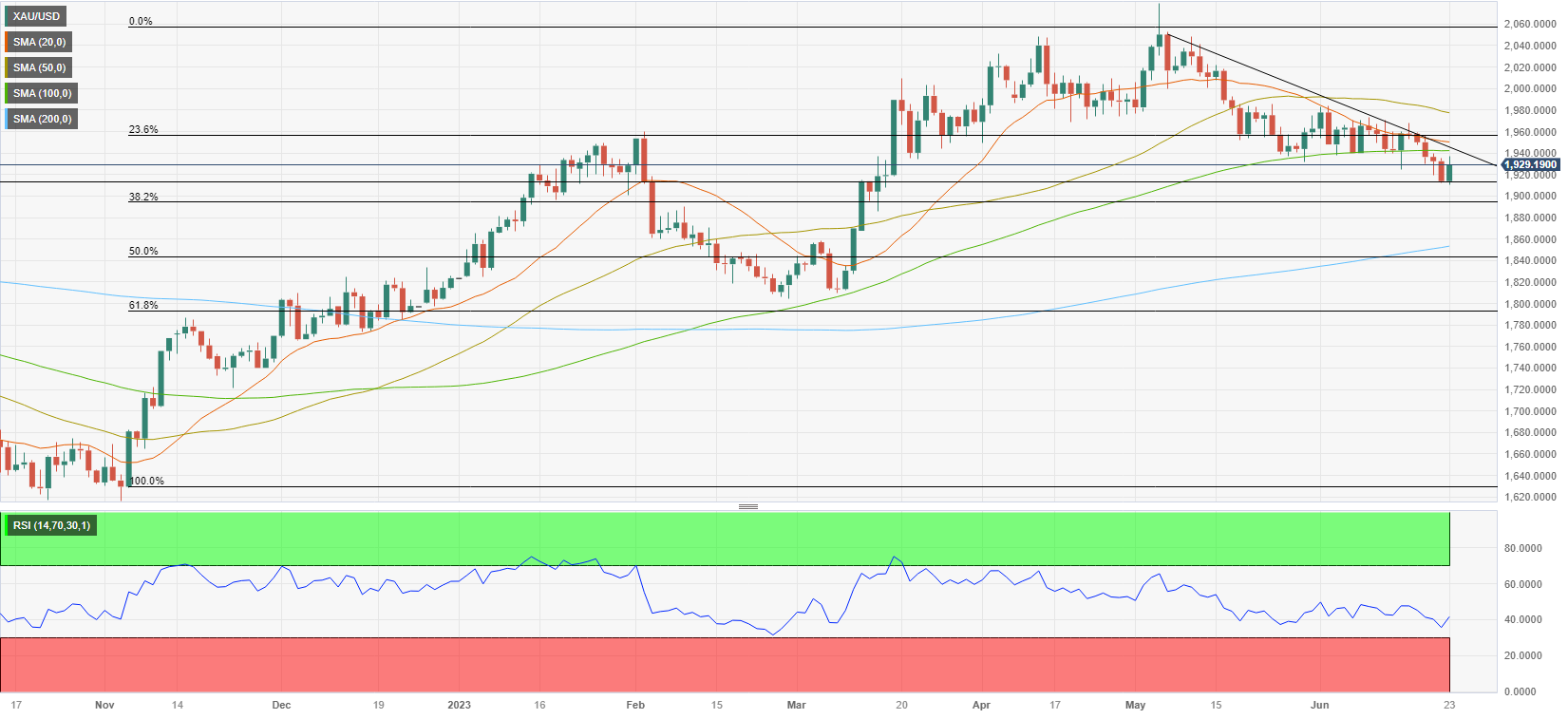
XAU/USD closed the last three days below the 100-day Simple Moving Average (SMA) after having managed to hold above that level during the three-week consolidation phase. Additionally, the Relative Strength Index (RSI) indicator on the daily chart dropped to 40, reflecting the bearish shift in the near-term outlook.
On the downside, $1,910 (multi-month low set on Thursday) aligns as interim support before $1,900 (Fibonacci 38.2% retracement of the latest uptrend, psychological level). In case Gold price falls below $1,900 and starts using this level as resistance, the next bearish target could be set at $1,860 (200-day SMA).
The pair is likely to face stiff resistance at $1,940, where the descending trend line meets the 100-day SMA. A daily close above that level could attract buyers and open the door for an extended rebound toward $1,960 (Fibonacci 23.6% retracement, 20-day SMA) and $1,980 (50-day SMA).
Gold forecast poll
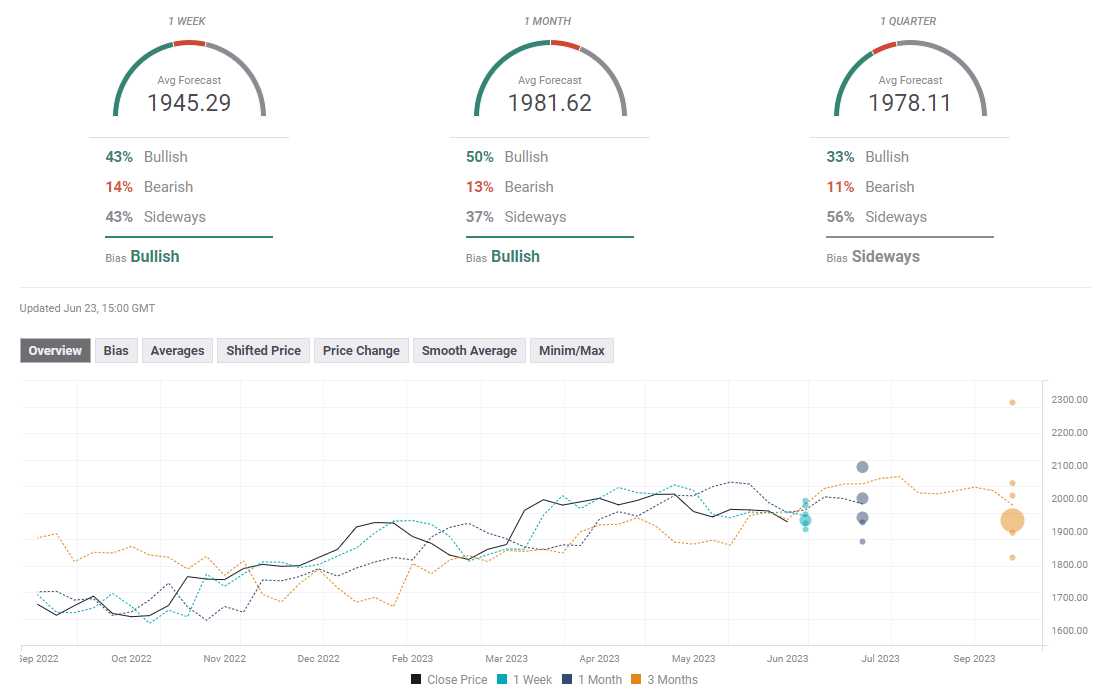
FXStreet Forecast Poll suggests that experts are either expecting a modest rebound or a sideways action in XAU/USD in the near term. The one-month outlook remains relatively bullish but the average target now sits at $1,981, down from $1,998 in the prior week.
Author

Eren Sengezer
FXStreet
As an economist at heart, Eren Sengezer specializes in the assessment of the short-term and long-term impacts of macroeconomic data, central bank policies and political developments on financial assets.