Gold Price Weekly Forecast: $2,000 stays intact as focus shifts to Fed and US data
- Gold price failed to stabilize above $2,000 this week.
- Fed policy announcements and high-tier US data could trigger the next big action in XAU/USD.
- Technical outlook suggests sellers could look to retain control unless Gold price reclaims $2,000.

Following a bullish start to the week, Gold price tried several times to reclaim $2,000 but failed to do so amid a decisive rebound seen in the US Treasury bond yields. XAU/USD’s near-term technical outlook points to a bearish tilt as investors shift their attention to key macroeconomic data releases from the US, including April jobs report, and the Federal Reserve’s policy announcements.
What happened last week?
In the absence of high-impact data releases, Gold price staged a technical correction and registered small daily gains to start the week. After Wall Street’s closing bell on Monday, however, US Treasury bond yields started to push lower with First Republic Bank's earnings report revealing that the bank's deposits plunged by more than $100 billion in the first quarter. In turn, XAU/USD extended its rebound and closed near $2,000 on Tuesday.
Although the US Dollar (USD) weakened against its major rivals on Wednesday, XAU/USD found it difficult to preserve its bullish momentum. Upbeat earnings figures from US tech giants Microsoft and Alphabet Google triggered a risk rally and made it difficult for the USD to find demand. Nevertheless, with the financial stocks staying under selling pressure, US yields continued to push higher and caused Gold price to retreat.
On Thursday, the US Bureau of Economic Analysis (BEA) reported that the US Gross Domestic Product (GDP) expanded at an annualized rate of 1.1% in the first quarter, missing the market expectation for a 2% growth by a wide margin. The underlying details of the GDP report, however, showed that the consumer activity remained healthy in that period while price pressures held strong. Furthermore, markets realized that the 2.26% negative contribution of the change in private inventories to the GDP growth made the economic performance look worse than it actually is. In turn, US T-bond yields gained traction as markets started to price in a delay in the Federal Reserve’s (Fed) possible policy pivot.
According to the CME Group FedWatch Tool, the probability of a 25 basis points Federal Reserve (Fed) rate cut by September declined to 40% after the GDP data, from 60% just a week ago. As the USD continued to benefit from hawkish Fed bets, XAU/USD declined toward $1,980 area early Friday.
The BEA reported on Friday that inflation in the US, as measured by the Personal Consumption Expenditures (PCE) Price Index, declined to 4.2% on a yearly basis in March from 5.1% in February. The annual Core PCE Price Index, the Federal Reserve's preferred gauge of inflation, edged lower to 4.6% from 4.7% in the same period. n the meantime, the data published by the US Bureau of Labor Statistics showed that the Employment Cost Index, compensation costs for civilian workers, increased by 1.2% in the first quarter, stronger than the 1% increase recorded in the previous quarter. Following these data releases, XAU/USD struggled to stage a meaningful rebound. With the 10-year US yield turning south in the American session, however, the pair pulled away from daily lows but remained below $2,000.
Next week
It will be a risky week for Gold investors with several high-impact macroeconomic data releases from the US and the Fed’s policy announcements carrying the potential to trigger wild fluctuations.
At the beginning of the week, NBS Manufacturing PMI and Non-Manufacturing PMI from China will be watched closely by market participants. In case the PMI surveys point to an ongoing expansion in China, the world’s biggest gold consumer’s, business activity, XAU/USD is likely to keep its footing. In case one of those PMIs drop below 50 unexpectedly, Gold price could edge lower in the near term.
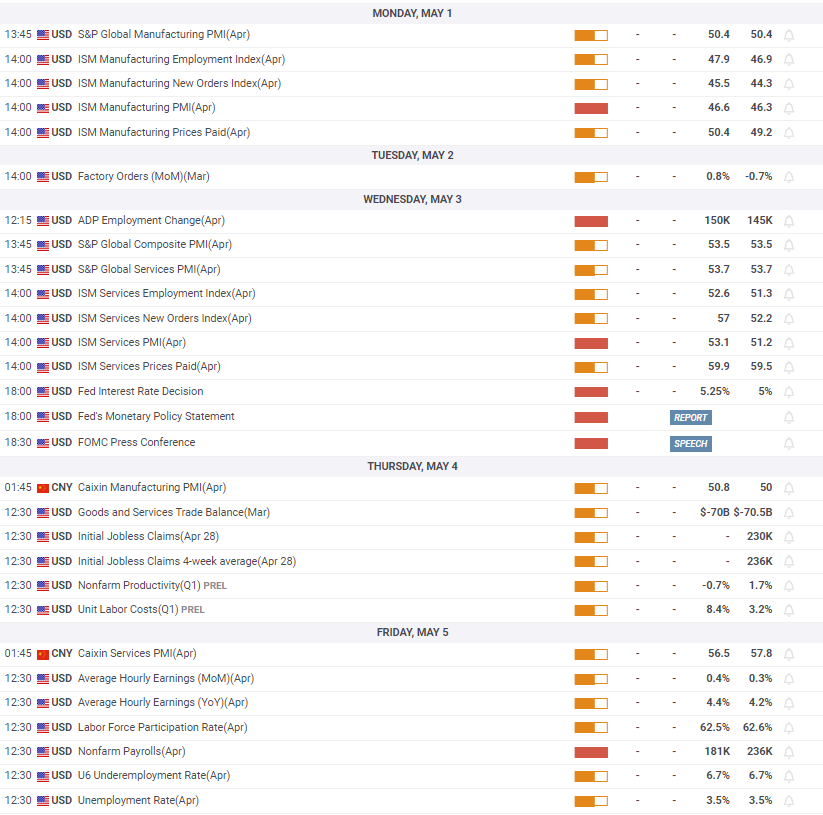
On Monday, the US economic docket will feature the ISM Manufacturing PMI for April, which is unlikely to have a noticeable impact on the USD’s valuation. On Wednesday, the ISM Services PMI survey and the ADP’s private sector employment report should be ignored by investors ahead of the Fed’s policy decisions.
The US central bank is widely expected to raise its policy rate by 25 bps to the range of 5%-5.25% following the May policy meeting. If the policy statement or FOMC Chairman Jerome Powell says that the Fed will pause its hiking cycle to reassess the economic situation, the immediate reaction is likely to weigh on US yields and open the door for a rally in XAU/USD. However, Powell could reiterate that they don’t intend to lower the policy rate for the remainder of the year and explain that a pause in tightening does not necessarily mean that they can’t go back to hikes if they were to see the need for it. In that scenario, XAU/USD could reverse its direction even if it spikes higher initially.
Markets will also pay attention to Powell’s comments on the financing situation. After the collapse of the Silicon Valley Bank, Powell said that the monetary policy has to be tight enough to bring down inflation but noted that some of that tightness could come from credit conditions. In case the Fed says that they don’t see any significant tightening in lending, that could be seen as a hawkish remark and help the USD gather strength and vice versa.
On Friday, the US Bureau of Labor Statistics will publish the April jobs report. Nonfarm Payrolls (NFP) are forecast to increase by 181,000 following March’s 236,000 growth. Wage inflation, as measured by the Average Hourly Earnings, is expected to edge higher to 4.4% on a yearly basis from 4.2%. Generally, a stronger-than-expected increase in NFP, especially if it’s accompanied by a strong wage inflation reading, should have a positive impact on the USD’s valuation and hurt XAU/USD. On the other hand, a NFP reading close to 100,000 or lower should have the opposite effect on the pair.
Having said all of that, it’s worth noting that it will not be easy to navigate through next week’s events. It could be a good idea to monitor the action in the US Treasury bond yields to have a more clear view of the bigger picture. The 10-year US T-bond yield has been fluctuating between 3.3% and 3.6% since the Fed’s March policy meeting. A move outside of this range could provide a directional clue for Gold price due to its strong inverse correlation with yields.
Gold price technical outlook
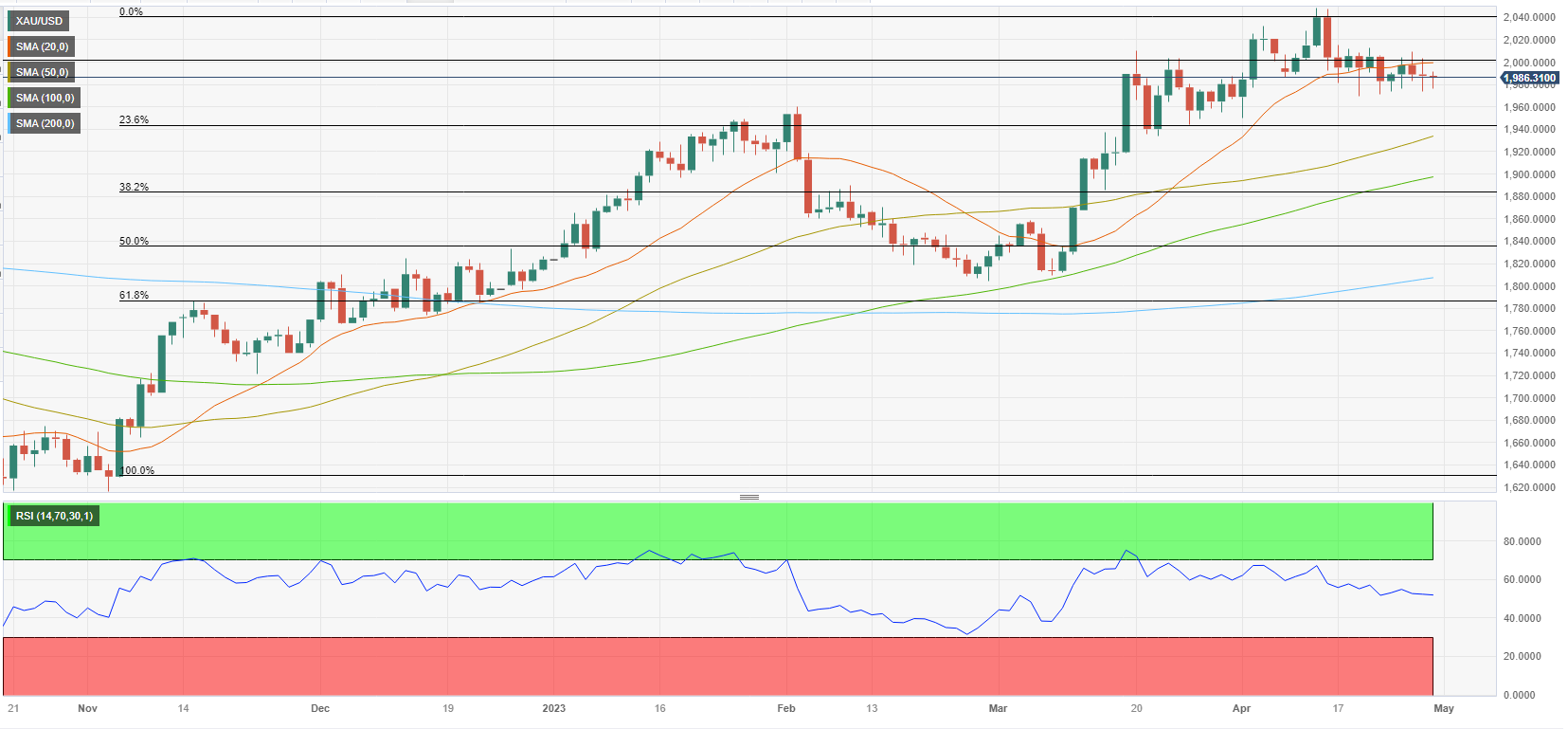
Gold price closed below the 20-day Simple Moving Average (SMA) every day this week and the Relative Strength Index (RSI) indicator on the daily chart declined toward 50, reflecting buyers' hesitancy.
On the downside, interim support seems to have formed at $1,970 ahead of $1,940 (Fibonacci 23.6% retracement of the latest uptrend) and $1,930 (50-day SMA). A daily close below that latest support could trigger an extended slide toward $1,900 (100-day SMA, psychological level).
$2,000 (psychological level, 20-day SMA) aligns as stiff resistance. Once XAU/USD rises above that level and confirms at support, bulls could target $2,020 (static level) and $2,040 (end-point of the latest uptrend) afterward.
Gold price forecast poll
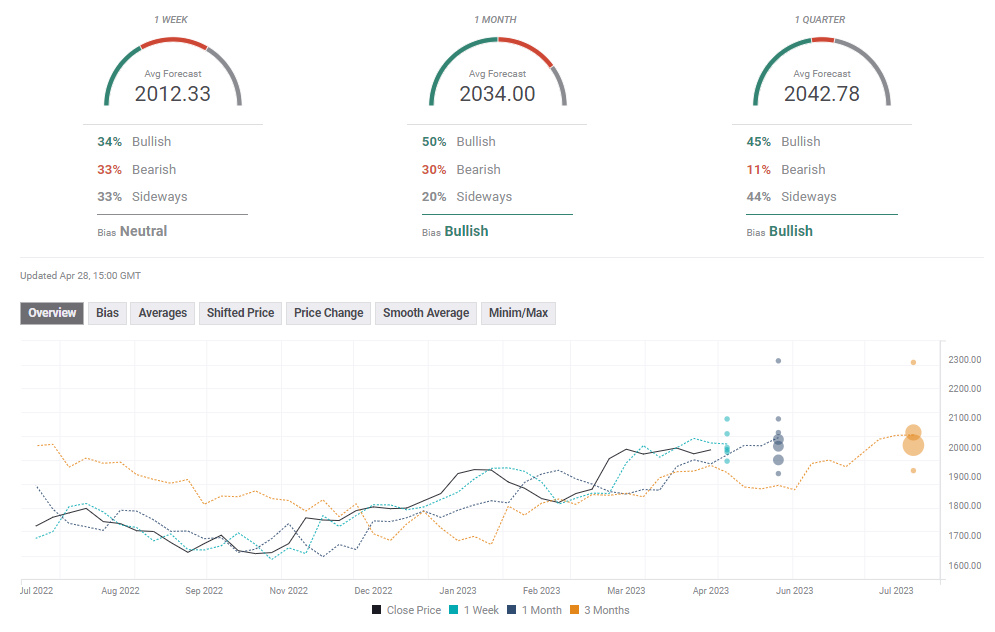
FXStreet Forecast Poll paints a mixed picture in the short term while the one-month outlook remains bullish with an average target of $2,035.
Author

Eren Sengezer
FXStreet
As an economist at heart, Eren Sengezer specializes in the assessment of the short-term and long-term impacts of macroeconomic data, central bank policies and political developments on financial assets.