Gold Price Weekly Forecast: $1,950 stands in the way of an extended uptrend
- Gold price rose for the second consecutive week as a softening US labor market attracted dovish Fed bets.
- XAU/USD could gather bullish momentum once $1,950 is confirmed as support.
- Investors will keep a close eye on China data and global bond yields next week.

Gold price touched its highest level in a month above $1,950, gaining more than 1% for the second straight week. The yellow metal benefited from retreating US yields after disappointing employment-related data releases from the US. In the absence of high-tier data releases, technical positioning and the action in global bond yields could drive XAU/USD’s action next week.
What happened last week?
China's Finance Ministry announced early Monday that the stamp duty on stocks trading would be halved to 0.1% with an aim to "invigorate the capital market and boost investor confidence." This development helped improve the risk mood at the beginning of the week, making it difficult for the US Dollar to build on the previous week’s gains and allowing XAU/USD to post modest daily gains.
Disappointing data releases from the US on Tuesday and Wednesday caused investors to increase their bets over the possibility of the Federal Reserve (Fed) leaving its policy rate unchanged for the rest of 2023. This triggered a steep decline in the US Treasury bond yields.
The number of job openings on the last business day of July declined to 8.82 million from 9.16 million (revised from 9.58 million) in June, the US Bureau of Labor Statistics reported on Tuesday. On Wednesday, the US Bureau of Economic Analysis announced that it revised the annualized second-quarter Gross Domestic Product (GDP) growth down to 2.1% in its second estimate from 2.4% initially estimated. Also on Wednesday, the monthly report released by ADP showed that employment in the private sector rose 177,000 in August, falling short of the market expectation for an increase of 195,000.
The 10-year US T-bond yield fell nearly 3% in the first half of the week and the US Dollar Index dropped to its lowest level in two weeks, highlighting the negative impact on the USD’s valuation. As a result, XAU/USD gathered bullish momentum and climbed above $1,940 for the first time in nearly a month.
Inflation in the US, as measured by the change in the Personal Consumption Expenditures (PCE) Price Index, rose to 3.3% on a yearly basis in July from 3% in June, the US Bureau of Economic Analysis reported on Thursday. The annual Core PCE Price Index, the Federal Reserve's preferred gauge of inflation, rose 4.2% in the same period compared to the 4.1% increase recorded in June. Meanwhile, the number of first-time applications for unemployment benefits declined to 228,000 in the week ending August 26, lower than 232,000 in the previous week.
Although the USD erased a large portion of its weekly losses on Thursday, Gold price held relatively stable. Earlier in the day, investors started to price in a no change in the European Central Bank’s (ECB) key rates in September after Eurostat announced that the Core Harmonized Index of Consumer Prices (HICP) rose 5.3% in August as expected. Consequently, XAU/EUR rose sharply, suggesting that Gold captured some of the capital outflows out of the Euro and managed to stay resilient against the USD.
Another batch of uninspiring employment-related data from the US helped Gold price climb above $1,950 on Friday. Nonfarm Payrolls rose 187,000 in August. Although this reading surpassed the market expectation of 170,000, July increase of 187,000 got revised lower by 30,000 to 157,000. Moreover, the Unemployment Rate climbed to 3.8% amid a 0.2% increase in the Labor Force Participation Rate and the annual wage inflation edged lower to 4.3% from 4.4%. As the 10-year US yield stretched lower with the immediate reaction to the August jobs repot, XAU/USD pushed higher. Profit-taking toward the end of the week caused the pair to retreat later in the American session but XAU/USD ended the second consecutive week in positive territory.
Next week
US markets will be closed on Monday in observance of the Labor Day holiday. On Wednesday, the ISM will release the Services PMI report. The headline PMI is forecast to edge lower to 52.3 in August from 52.7 in July. Unless this data drops below 50 and shows an unexpected contraction in the service sector’s economic activity, it is unlikely to influence Fed wagers. Investors, however, could react to the inflation component – the Prices Paid Index. A significant increase of this indicator could provide a boost to the USD as it would highlight an acceleration in the sector’s input inflation.
In the second half of the week, Trade Balance data from China will be watched closely by market participants. A further deterioration in China’s exports could weigh on Gold price as the country is the world’s biggest gold consumer. Additionally, the Consumer Price Index (CPI) data from China, which will be released on Saturday, could trigger a reaction in XAU/USD at the weekly opening on Monday. On a yearly basis, the CPI declined 0.3% in July. If this data points to ongoing deflation in August as well, investors could see that as a sign of weakening consumer activity and stay away from Gold due to a potentially worsening demand outlook.
The Reserve Bank of Australia and the Bank of Canada will announce interest rate decisions next week. Although these events are unlikely to have an immediate or direct impact on XAU/USD action, changes in global bond yields could influence Gold price. If both of these banks keep their policy rates steady and voice concerns over the economic outlook, a general pullback in global yields could help XAU/USD to keep a firm footing. On that note, the pair could extend its uptrend in case the 10-year US yield falls below 4% level and starts using it as resistance.

Gold technical outlook
The Relative Strength Index (RSI) indicator on the daily chart rose to 60, suggesting that XAU/USD has more room on the upside before it turns technically overbought. Additionally, the pair closed the last three days of the week above the 50-day Simple Moving Average (SMA), confirming the bullish tilt in the short-term outlook.
The $1,950 barrier (100-day SMA, Fibonacci 23.6% retracement of the latest uptrend) aligns as a key pivot level for XAU/USD. If the pair manages to stabilize above that level, $1,980 (static level) could be set as the next bullish target before $2,000 (psychological level).
On the downside, the 50-day SMA acts as dynamic support at around $1,930 ahead of $1,920 (20-day SMA, 200-day SMA). A daily close below the latter could attract technical sellers and trigger another leg lower toward $1,900 (psychological level).

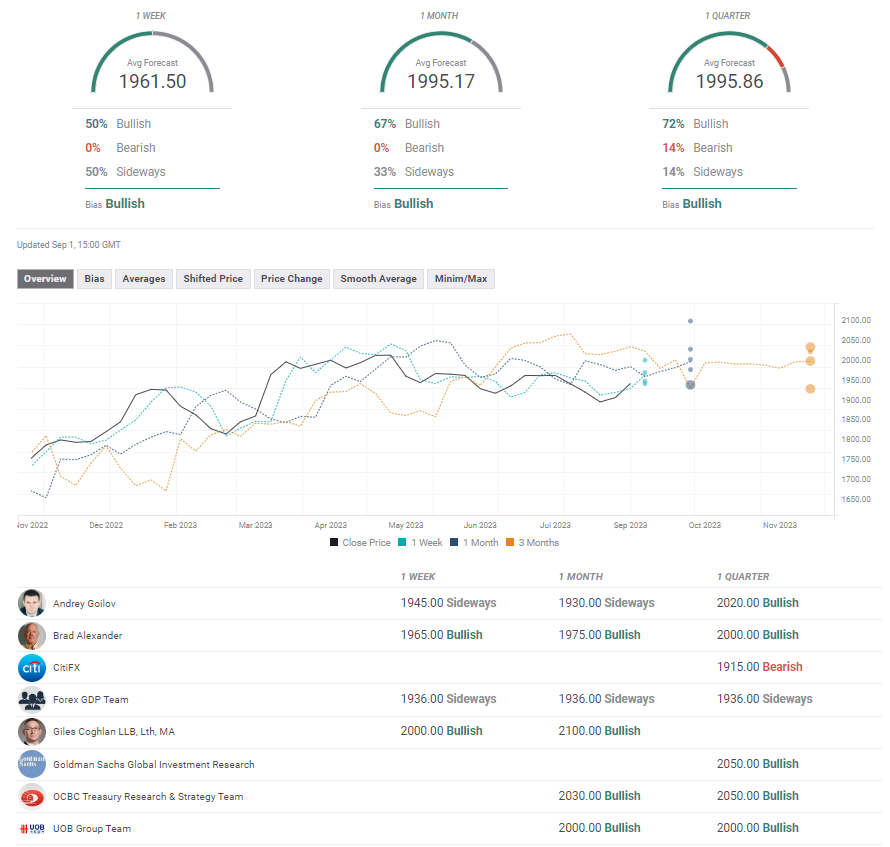
Gold forecast poll
Author

Eren Sengezer
FXStreet
As an economist at heart, Eren Sengezer specializes in the assessment of the short-term and long-term impacts of macroeconomic data, central bank policies and political developments on financial assets.

















