Gold price weakens amid US-China trade truce and Fed signals


Gold (XAUUSD) has faced a notable retreat, breaking below a key psychological level of $3,150. A mix of global macro developments and investor sentiment has contributed to this pullback. Despite some supportive conditions for the US Dollar, gold hasn't found meaningful buying interest. This article examines the fundamental and technical factors influencing the current gold market outlook.
Gold prices fall as US-China trade truce weakens safe-haven demand
Fundamental factors are significantly pressuring gold prices. Optimism over a temporary trade truce between the US and China has dulled gold’s safe-haven appeal. Both countries agreed to pause tariffs for 90 days, which eased fears of a global economic slowdown. This shift in sentiment has dragged gold lower.
US President Donald Trump’s openness to direct negotiations with China’s President Xi further boosted risk appetite. Consequently, investor concerns over a US recession have faded for now. The likelihood of aggressive Federal Reserve rate cuts has also decreased.
Traders now expect only 50 basis points in rate reductions this year, a stark contrast to the full percentage point anticipated earlier. This has driven US Treasury yields to a one-month high, reinforcing bearish pressure on non-yielding assets like gold.
Moreover, recent Fed commentary reflects caution. Vice Chair Jefferson warned that tariffs could disrupt inflation progress. However, he noted that the current policy remains flexible. Similarly, the Chicago Fed President emphasized the lag in inflation data and advised patience before major decisions.
The US Dollar remains mixed, struggling to extend gains despite favorable bond yields. The upcoming US Producer Price Index and Powell’s speech are now pivotal. These events may either validate the hawkish stance or rekindle expectations for rate easing, influencing the dollar and gold's direction.
Gold price struggles to hold support as bearish channel takes shape
The gold chart below shows critical technical developments, including the formation of an ascending broadening wedge, typically a bearish pattern. After a steep rise that lasted for months, prices broke out of the wedge and climbed higher within a rising channel.
However, recent candles indicate a downward channel formation within the broader uptrend. The price is now approaching the lower boundary of this channel. The break of this support will indicate further downside in gold prices.
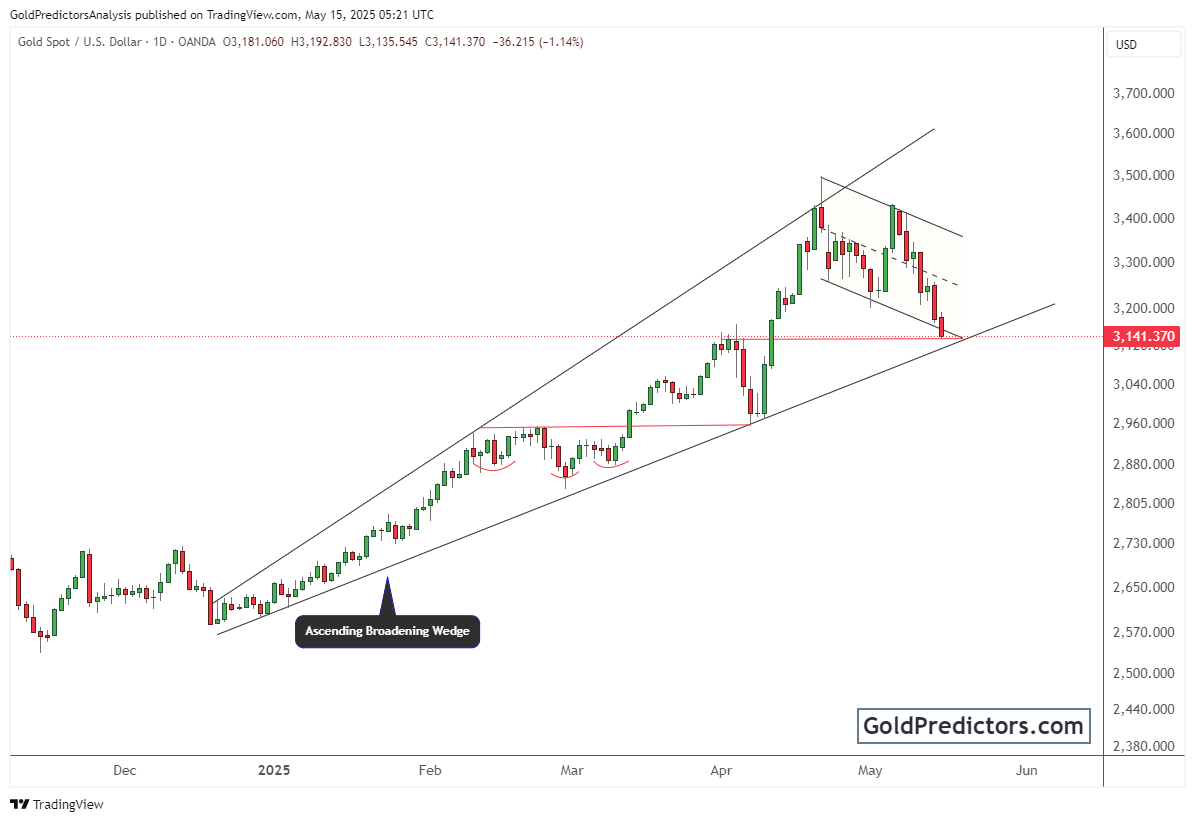
Gold is also testing the bottom trend line of the broader ascending structure. The support zone near $3,140 is crucial. A daily close below this level may trigger more selling, with the next potential support near $3,040.
Additionally, the chart shows prior consolidation levels and minor rounding bottoms, which previously acted as launch pads for upward moves. This time, however, gold has failed to sustain those levels, adding to the bearish bias.
Volume indicators would likely confirm this breakdown if accompanied by rising selling pressure. The failure to defend $3,200 further solidifies the negative outlook.
Conclusion
Gold’s recent breakdown signals a shift in market sentiment, driven by easing geopolitical tensions and weakening technical support. The retreat below $3,150 reflects reduced safe-haven demand, fading rate-cut bets, and strengthening Treasury yields. With key support at $3,140 now under threat, downside risks remain elevated. Unless upcoming data or Fed commentary alters the current trajectory, gold may struggle to regain its bullish footing in the near term.
Unlock exclusive gold and silver trading signals and updates that most investors don’t see. Join our free newsletter now!
Unlock exclusive gold and silver trading signals and updates that most investors don’t see. Join our free newsletter now!
Author
Muhammad Umair, PhD
Gold Predictors
Muhammad Umair is a financial markets analyst and investor who focuses on the forex and precious metals markets.

















