Gold price slides ahead of US jobs report and Fed remarks
Gold (XAU/USD) continues to face headwinds from a stronger US Dollar and expectations of tighter US monetary policy.
Investors are focused on geopolitical developments and key economic events, including the US Nonfarm Payrolls report and comments from Fed Chairman Kevin Warsh. These developments could provide important clues about the future path of interest rates and influence the next move in gold prices.
Gold price falls as stronger US Dollar and rate hike expectations pressure markets
Gold starts the week on a weaker footing as a stronger US Dollar and rising interest rate expectations pressure prices. The US Dollar continues to attract demand and is heading for its strongest monthly performance in almost a year. Investors remain cautious about global developments, increasing demand for the US Dollar. This shift has reduced demand for gold despite its traditional role as a defensive asset.
Geopolitical developments also remain in focus. The United States and Iran exchanged accusations of violating the recent ceasefire before agreeing to restart negotiations in Qatar. Oil prices moved lower as hopes for fresh talks improved. However, investors continue to favor the US Dollar while waiting for more clarity on the situation. This has limited support for gold prices.
Markets also expect the US Federal Reserve to keep monetary policy tight. Expectations for at least two interest rate hikes by the end of the year continue to weigh on the non-yielding metal. Attention now turns to Thursday’s US Nonfarm Payrolls report, which could influence expectations for future Fed decisions. Investors will also monitor the European Central Bank forum in Sintra, where Fed Chairman Kevin Warsh is scheduled to speak. His comments could provide additional direction for financial markets.
Gold holds above major support as bearish channel remains intact
The gold chart below shows that price continues to trade within a well-defined descending channel. It has remained below the falling upper trendline for several months, reflecting sustained selling pressure. Repeated failures to move above this resistance confirm that the broader downtrend remains intact. The channel continues to reflect persistent bearish momentum.
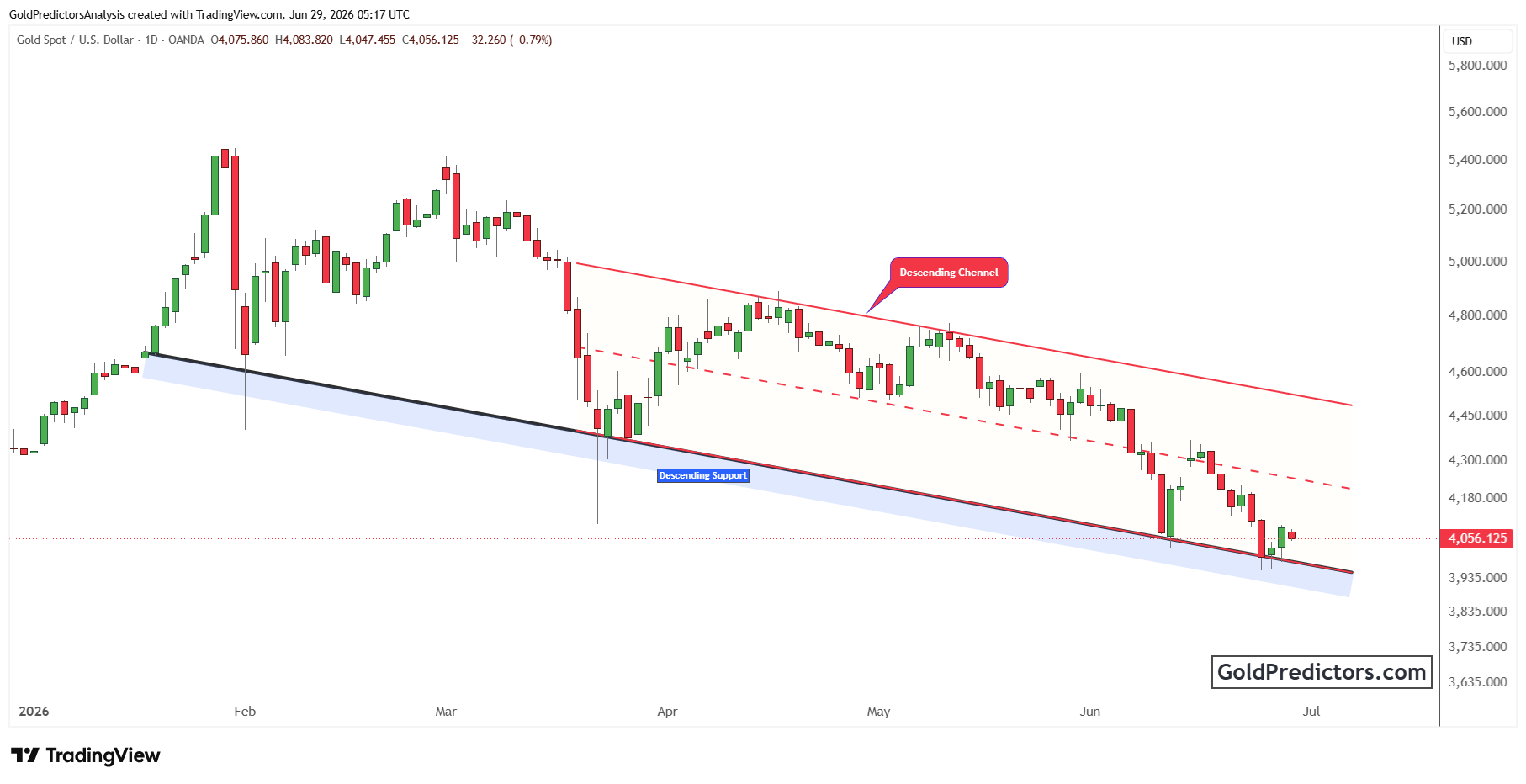
The chart also highlights a long-term descending support trendline that has guided price lower throughout the year. Gold is now trading near this important support region after its recent decline. Recent candlesticks indicate that price is holding above this level, making the current support zone an important area to watch for the next directional move.
Holding above the long-term descending support trendline could help improve the short-term outlook and reduce downside pressure. However, a decisive move below this support would keep the broader downtrend intact. Price action around the current support zone will provide important signals for the next directional move.
Gold forecast: US Payrolls report and Fed comments in focus
Gold stays under downside pressure as markets continue to favor the US Dollar and price in tighter monetary policy. Investors now await the US Nonfarm Payrolls report and comments from Fed Chairman Kevin Warsh for fresh guidance on the interest rate outlook. At the same time, gold remains near an important long-term support trendline within its descending channel. Price action around this support will likely determine whether gold begins a recovery or extends its current decline.
Unlock exclusive gold and silver trading signals and updates that most investors don’t see. Join our free newsletter now!
Author

Muhammad Umair, PhD
Gold Predictors
Muhammad Umair is a financial markets analyst and investor who focuses on the forex and precious metals markets.