Gold Price Forecast: XAU/USD weakens to near $4,110 amid broader strength in oil prices
- Gold price declines to near $4,095 as oil prices remain broadly firm.
- Washington calls non-emergency staff in Saudi Arabia to return home.
- The Fed is expected to hold interest rates steady next week.

Gold is down 1% to near $4,095 in the Asian trading session on Thursday on the back of fears that global inflation expectations could accelerate further due to heightened geopolitical tensions in the Middle East.
Iran’s attacks on Saudi energy facilities prompt energy supply risks
Oil prices continue to attract risk premium as tensions between Yemen’s Iran-backed Houthis and Saudi Arabia has prompted fears of further energy supply concerns.
As of writing, the WTI Oil price is up 0.6% to near $98.00. The oil price is close to its five-week high of $101.05 posted on Tuesday.
Amidst ongoing tensions in Saudi Arabia, the US State Department has ordered non-emergency personnel and family members to leave American embassies in Saudi Arabia, Reuters reported. This raise concerns that tensions in Saudi Arabia could escalate further. Such a scenario would prompt fears of energy supply risks further.
Theoretically, higher inflationary pressures force central banks to consider monetary tightening, a case that bodes poorly for non-yielding assets, such as Gold.
Fed’s policy – the next key trigger
The Federal Reserve’s (Fed) monetary policy announcement next is the key trigger for Gold, which is scheduled next week on Wednesday. According to the CME FedWatch tool, the Fed is almost certain to leave interest rates unchanged in the 3.75%-4.00% range. This underscores the importance of Fed’s monetary guidance as key trigger for Gold’s next move.
So far we know, almost all Fed board members have warned of upside inflation risks and the need of more interest rate hikes. Fed Chairman Kevin Warsh also warned of elevated price pressures in his latest commentary at the annual International Monetary Fund (IMF) meeting.
Warsh flags investment surge and AI risks as Fed keeps options open into year-end
Fed Chair Warsh delivered a moderately constructive but slightly less forceful message, with a 5.6/10 FXS Speechtracker score compared to the established baseline of 6.1/10, signaling a small softening in tone. The admission of being “over-scarred from the Global Financial Crisis” underscores a cautious bias on financial stability even as Warsh highlights a structural growth and investment surge, stressing that upcoming October and December meetings will be the “crystallizing moment” for decisions on output, employment, and inflation. Warsh’s emphasis on AI as a near-term demand shock with uncertain labor-market effects, and on new intellectual capital and field hearings, points to a Fed that is open to innovation but unwilling to pre-commit on the 2026 policy path.
The FXS Fed Sentiment Index was unchanged, moving 0.00 points to a still-elevated 127.51, confirming that the overall stance remains firmly in hawkish territory despite the slightly softer FXS Speechtracker score. This combination suggests that while the rhetoric is marginally less intense relative to the historical average, markets should continue to price a Fed biased toward maintaining restrictive conditions until data clearly validate progress on price stability.
Gold Technical Analysis
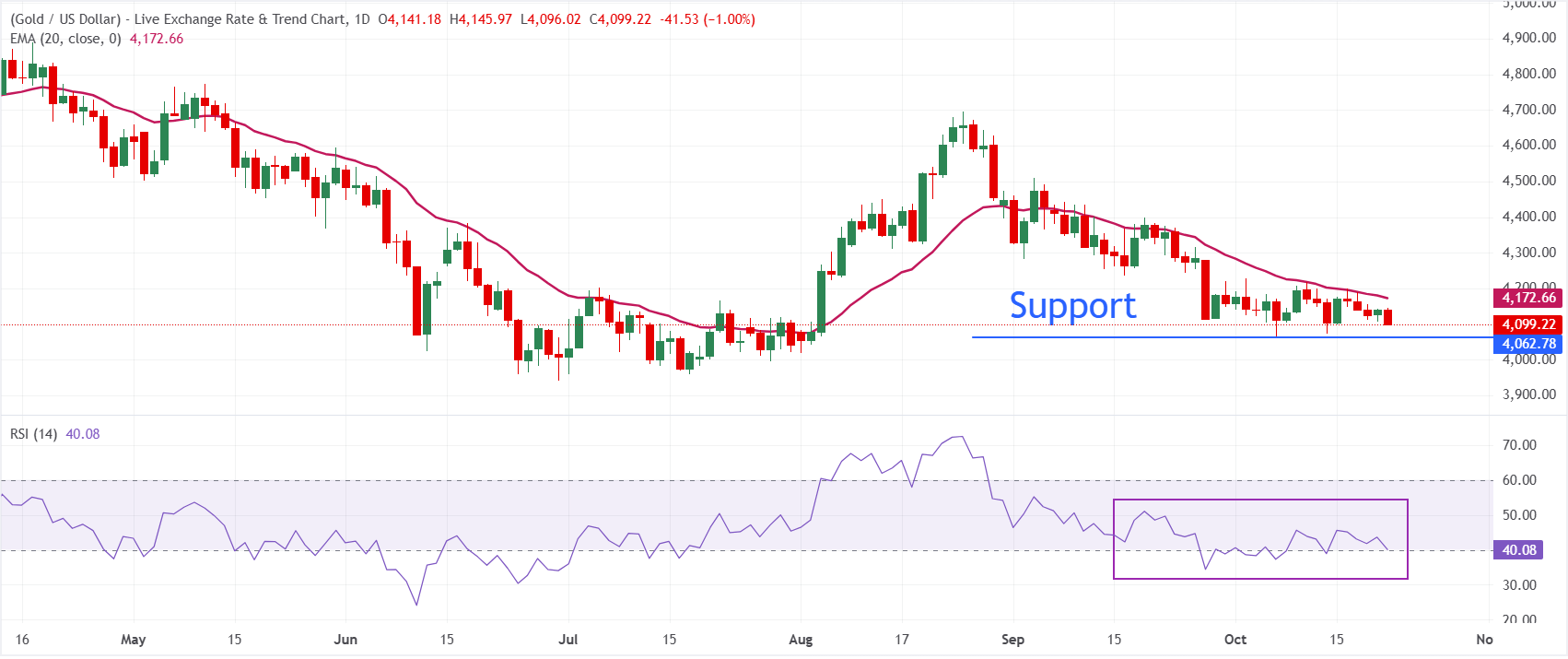
In the daily chart, XAU/USD trades at $4,095, keeping a bearish near-term tone as it holds below the 20-day Exponential Moving Average (EMA) at roughly $4,172. The failure to reclaim this dynamic cap suggests rallies remain vulnerable, while the Relative Strength Index (RSI) around 40 stays in negative territory, hinting at persistent but not extreme downside momentum.
On the topside, immediate resistance is located at the 20-day EMA near $4,172, and a daily close above this level would be needed to ease the current downside bias. On the downside, the absence of nearby measured supports from the provided indicators leaves recent lows and psychological round numbers as the next reference levels for buyers attempting to stem the decline.
(The technical analysis of this story was written with the help of an AI tool. Know more.)
Gold FAQs
Gold has played a key role in human’s history as it has been widely used as a store of value and medium of exchange. Currently, apart from its shine and usage for jewelry, the precious metal is widely seen as a safe-haven asset, meaning that it is considered a good investment during turbulent times. Gold is also widely seen as a hedge against inflation and against depreciating currencies as it doesn’t rely on any specific issuer or government.
Central banks are the biggest Gold holders. In their aim to support their currencies in turbulent times, central banks tend to diversify their reserves and buy Gold to improve the perceived strength of the economy and the currency. High Gold reserves can be a source of trust for a country’s solvency. Central banks added 1,136 tonnes of Gold worth around $70 billion to their reserves in 2022, according to data from the World Gold Council. This is the highest yearly purchase since records began. Central banks from emerging economies such as China, India and Turkey are quickly increasing their Gold reserves.
Gold has an inverse correlation with the US Dollar and US Treasuries, which are both major reserve and safe-haven assets. When the Dollar depreciates, Gold tends to rise, enabling investors and central banks to diversify their assets in turbulent times. Gold is also inversely correlated with risk assets. A rally in the stock market tends to weaken Gold price, while sell-offs in riskier markets tend to favor the precious metal.
The price can move due to a wide range of factors. Geopolitical instability or fears of a deep recession can quickly make Gold price escalate due to its safe-haven status. As a yield-less asset, Gold tends to rise with lower interest rates, while higher cost of money usually weighs down on the yellow metal. Still, most moves depend on how the US Dollar (USD) behaves as the asset is priced in dollars (XAU/USD). A strong Dollar tends to keep the price of Gold controlled, whereas a weaker Dollar is likely to push Gold prices up.
Author

Sagar Dua
FXStreet
Sagar Dua is associated with the financial markets from his college days. Along with pursuing post-graduation in Commerce in 2014, he started his markets training with chart analysis.