Gold investment demand vs. jewelry demand 2025 explained: What it means for the Diwali 2026 buying season
India's festival Gold buying peaks with Dhanteras on November 6 and Diwali on November 8, 2026. Last year's season already showed buyers shifting from jewelry to bullion as prices climbed, and this year's opens with a 15 percent import duty and a weaker rupee.
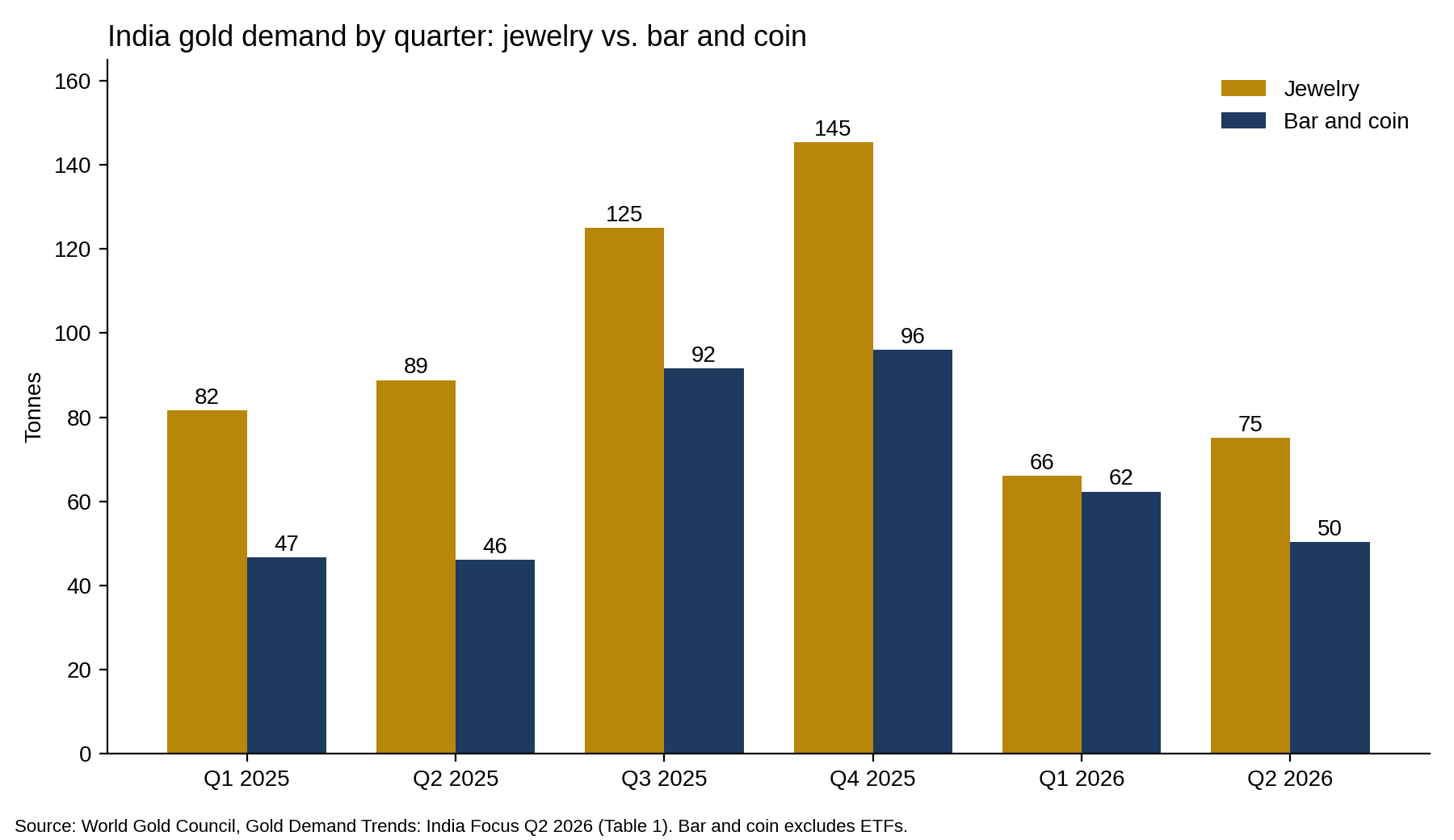
India's jewelry demand fell 24 percent in 2025 to 430.5 tonnes, according to the World Gold Council (WGC), while bar and coin demand climbed 17 percent to 280.4 tonnes. Gold had gained about 73 percent in rupee terms by late December, so the same budget bought far less metal in jewelry form.
The festival quarter widened the gap. Jewelry volumes fell 23 percent to 145.3 tonnes in Q4 even with wedding demand, and bar and coin demand rose 26 percent to 96 tonnes. Jewelry sales still rose 26 percent in rupee terms, so value and volume moved in opposite directions.
Retailers adapted. A bullion dealer cited in Commerzbank's note said jewelers had stocked small coins and bars ahead of Dhanteras and Diwali, and dealer premiums on Gold reached $25 an ounce, up from $15 a week earlier.
What changed in 2026
In mid-May, India raised its import duty on Gold from 6 percent to 15 percent, which one analysis called the largest increase on record, to narrow a trade deficit that was weighing on the rupee. Prime Minister Narendra Modi also urged citizens to pause Gold purchases for a year.
Jewelry demand fell 15 percent year on year to 75.1 tonnes in April to June, while bar and coin demand rose 9 percent to 50.3 tonnes. First-half bar and coin buying reached about 113 tonnes, the highest in 13 years.
Reuters reported that dealers moved from discounts of up to $6 an ounce to premiums of up to $7 in mid-October, the first premium in more than three months, as the price pullback lifted jewelry purchases. A WGC and Kantar survey of 1,963 consumers (May 22 to June 3) found stronger purchase intent for investment Gold than for jewelry, yet one bullion merchant told Reuters that investors were still holding back as prices fall.
Supply data are mixed. India's September Gold imports fell to $1.8 billion from $9.6 billion a year earlier, trade ministry data showed, and a Mumbai dealer told Reuters the shortfall is tightening domestic supply, while the WGC's second-quarter report called supply adequate.
Why it matters for XAU/USD and the Rupee
India accounted for 27 percent of global jewelry demand and 16 percent of global bar and coin demand in the second quarter, according to the WGC, so festival buying is a visible input to the physical market behind XAU/USD. Spot Gold trades near $4,170 an ounce, about a quarter below its January record.
The rupee is the other channel. Importers sell rupees to buy the dollars that pay for Gold, and Gold and silver made up about 11 percent of India's imports against 22 percent for oil, according to Money Metals Exchange analysis. In the second quarter, the LBMA Gold price was 37 percent higher than a year earlier while the domestic price was 59 percent higher, a gap the WGC tied to the duty hike and rupee depreciation.
What to watch through November 8
Dealer premiums are the first reading. Commerzbank expected last year's premium spike to fade after the holidays, so a premium that holds after Diwali would say more than one during the festival.
October import data will show whether restocking came before the festivals or after. Several large Indian mutual funds also suspended bulk subscriptions to Gold ETFs in mid-October at the market regulator's nudge, Reuters reported, so ETF access is worth tracking too.
A weaker rupee lifts domestic prices even when spot Gold is flat, and the WGC noted that both price dips and price stability have supported purchases. Metals Focus has observed that Indian consumers tend to delay purchases after sharp price increases and then adjust, which would make the winter wedding season a second test of this year's demand. No single reading above predicts the festival total.
Author

Shaun Bina
Citadel Gold
UCLA Economics graduate with both academic and business experience, offering a strong understanding of markets, currencies, and asset performance. This background provides clear insight into why gold and silver remain strong stores of value.
















