Gold Price Forecast: XAU/USD tests critical daily support line, will it defend?
- Gold price snaps a two-day uptrend amid a risk-on market profile.
- US Dollar stays afloat on USD/JPY upsurge, despite sluggish US Treasury bond yields.
- Gold price challenges key daily trendline support at $2,325.


Gold price is seeing a negative start to a new week on Monday, having booked a weekly loss. Gold price bears the brunt of resurgent US Dollar (USD) demand and a risk-on market mood amid Japanese holiday-thinned market conditions.
Focus on the Fed and US Nonfarm Payrolls this week
The risk rally in Asia extends early Monday, following a strong close on Wall Street last Friday and a robust Alphabet earnings report, fuelling a fresh decline in the safe-haven Gold price even though the US Treasury bond yields nurse recent losses.
The leg down in the Gold price can be also attributed to a modest uptick in the US Dollar, following Friday’s muted performance. The Greenback draws support from the relentless USD/JPY rally after the Japanese Yen crumbled to a level unseen since 1986 to below 160.00 against the buck on Japan’s political concerns.
Despite the upbeat risk tone, the US Dollar stays afloat, weighing negatively on the USD-denominated Gold price.
On Friday, Gold price rose to a four-day high of $2,353 but failed to resist above the $2,350 threshold, as markets took account of hot US Personal Consumption Expenditures (PCE) Price Index inflation data, betting on delayed policy pivot by the US Federal Reserve (Fed) this year.
The annual Core PCE Price Index, the Fed’s preferred inflation gauge, rose 2.8%, at the same pace as seen in February but came in hotter than the expected 2.6% increase. Markets are pricing in the first Fed rate cut in September, with just over 30 basis points worth of easing expected this year, down from 40 bps projected a week ago.
Risk flows dominated the American trading on Friday, which also curbed the upside in the bright metal.
Looking ahead, Gold traders will remain cautious and refrain from placing big bets on Gold price ahead of the US employment and the Fed interest rate decision due on Wednesday. Although the Fed’s inaction is widely priced in, Chair Jerome Powell’s comments during the press conference will hold the key for gauging the timing of rate cuts.
In the meantime, risk trends and the USD dynamics will continue to influence the Gold price action.
Gold price technical analysis: Daily chart
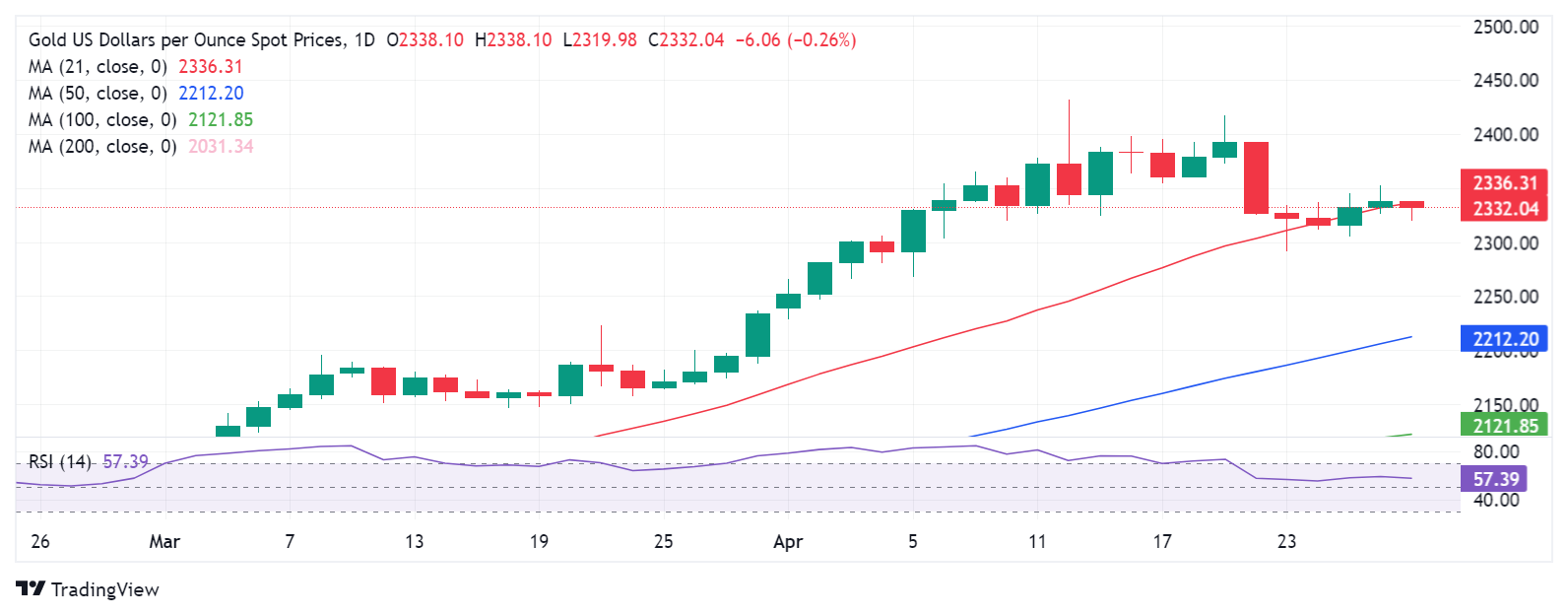
As observed on the daily chart, Gold price continues its struggle around the key 21-day Simple Moving Average (SMA), now at $2,336.
If Gold sellers manage to find a strong foothold below the latter on a daily closing basis, a fresh downtrend could be initiated toward the 50-day SMA at $2,212. Gold sellers, however, will also need to crack the rising trendline support at $2,325 before eyeing the 50-day SMA.
Ahead of that, the previous week’s low of $2,291 and the psychological $2,250 level could lend support to buyers.
The 14-day Relative Strength Index (RSI) has turned south, justifying the latest leg down in Gold price. However, the indicator still hold well above the midline, near 56.00, implying that every dip in Gold price could be a good buying opportunity.
On the upside, the previous week’s high will be the initial contention point on recapturing the 21-day SMA support-turned-resistance. Further up, the $2,370 round level will be challenged en route the April 22 high of $2,392.
Gold FAQs
Gold has played a key role in human’s history as it has been widely used as a store of value and medium of exchange. Currently, apart from its shine and usage for jewelry, the precious metal is widely seen as a safe-haven asset, meaning that it is considered a good investment during turbulent times. Gold is also widely seen as a hedge against inflation and against depreciating currencies as it doesn’t rely on any specific issuer or government.
Central banks are the biggest Gold holders. In their aim to support their currencies in turbulent times, central banks tend to diversify their reserves and buy Gold to improve the perceived strength of the economy and the currency. High Gold reserves can be a source of trust for a country’s solvency. Central banks added 1,136 tonnes of Gold worth around $70 billion to their reserves in 2022, according to data from the World Gold Council. This is the highest yearly purchase since records began. Central banks from emerging economies such as China, India and Turkey are quickly increasing their Gold reserves.
Gold has an inverse correlation with the US Dollar and US Treasuries, which are both major reserve and safe-haven assets. When the Dollar depreciates, Gold tends to rise, enabling investors and central banks to diversify their assets in turbulent times. Gold is also inversely correlated with risk assets. A rally in the stock market tends to weaken Gold price, while sell-offs in riskier markets tend to favor the precious metal.
The price can move due to a wide range of factors. Geopolitical instability or fears of a deep recession can quickly make Gold price escalate due to its safe-haven status. As a yield-less asset, Gold tends to rise with lower interest rates, while higher cost of money usually weighs down on the yellow metal. Still, most moves depend on how the US Dollar (USD) behaves as the asset is priced in dollars (XAU/USD). A strong Dollar tends to keep the price of Gold controlled, whereas a weaker Dollar is likely to push Gold prices up.
Premium
You have reached your limit of 3 free articles for this month.
Start your subscription and get access to all our original articles.
Author
Dhwani Mehta
FXStreet
Residing in Mumbai (India), Dhwani is a Senior Analyst and Manager of the Asian session at FXStreet. She has over 10 years of experience in analyzing and covering the global financial markets, with specialization in Forex and commodities markets.