Gold Price Forecast: XAU/USD tests critical 38.2% Fibo support as Fed meeting looms
- Gold stalls a two-day downtrend as safe-haven demand returns ahead of the Fed meeting.
- US Dollar hits weekly lows on dovish Fed bets, easing US-China trade concerns.
- Gold looks to regain the 21-day SMA at $4,061 as the 38.2% Fibo level at $3,973 holds fort.

Gold is revering a part of the previous decline, challenging the $4,000 mark as safe-haven flows return heading into the two-day US Federal Reserve (Fed) monetary policy meeting.
Gold divided amid US-China trade optimism, Fed event risk
Markets seem to have turned risk-averse, biding time before the Fed policy announcements on Wednesday. Further, nervousness sets in as key US tech titans are due to release their earnings reports later this week.
Meanwhile, the US Dollar (USD) is languishing in weekly lows against its six major currency rivals, as traders look to reposition amid the US-China trade deal optimism and ahead of the Fed event risk.
These factors offer fresh support to Gold, helping the bright metal stage a comeback after having fallen for two trading days in a row.
Gold tumbled over 3% on Monday, as markets ignored the traditional safe haven in search of higher returns on renewed hopes that the US and China will reach a trade deal when US President Donald Trump and his Chinese counterpart Xi Jinping meet on Thursday in South Korea.
All eyes are now on the Fed’s monetary policy verdict and the daily technical setup for fresh trading impetus, as the US government shows no signs of reopening.
Markets are almost fully pricing in two interest rate cuts this year, with a 25 basis points (bps) cut seen on Wednesday. Therefore, the main focus will be on the language in the policy statement and Fed Chairman Jerome Powell’s words for fresh hints on the central bank’s path forward on rates.
Gold price technical analysis: Daily chart
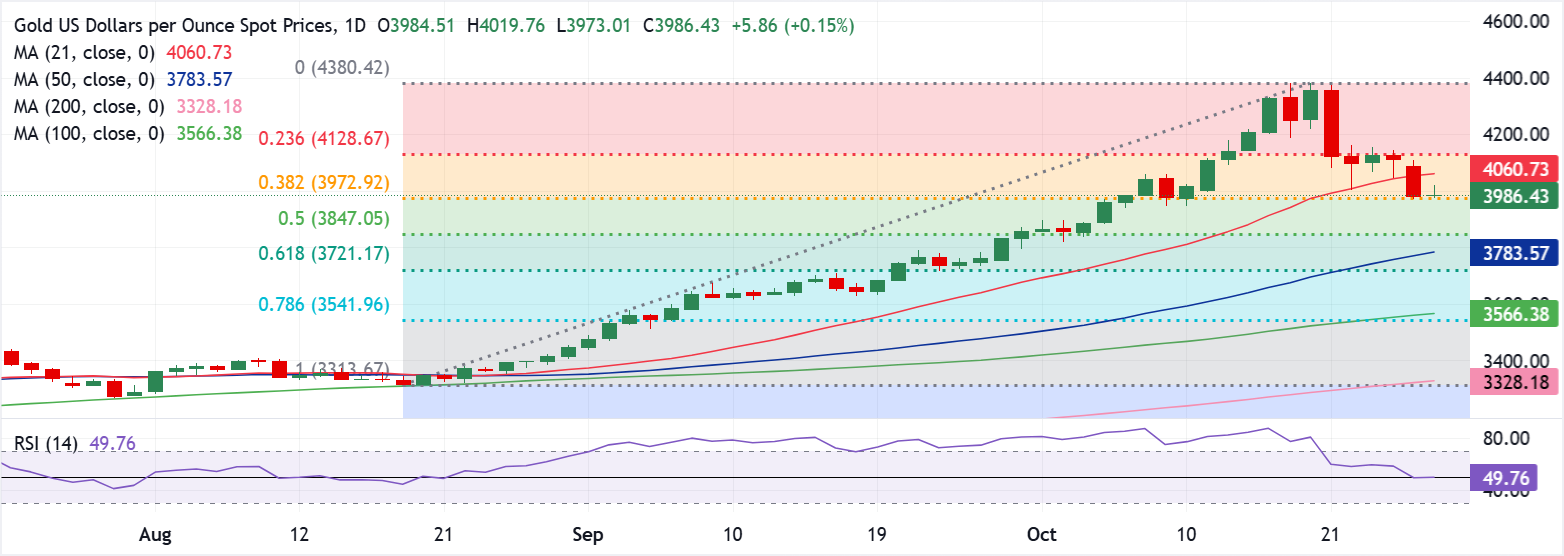
The daily shows that Gold price defends the critical support at $3,973, which is the 38.2% Fibonacci Retracement (Fibo) level of the parabolic rise that kicked off in mid-August.
So long as the abovementioned level is held, Gold buyers will likely remain hopeful.
Meanwhile, the 14-day Relative Strength Index (RSI) flirts with the midline, struggling to find acceptance above it.
If the 50 level is reclaimed on a sustained basis, Gold’s rebound could gather traction toward the 21-day Simple Moving Average (SMA) at $4,061.
Recapturing the latter is critical to stretch the recovery to near the $4,100 hurdle, where a bunch of healthy resistance levels align.
Additional upside will challenge the $4,150 psychological barrier.
Conversely, a daily candlestick closing below the 38.2% Fibo support at $3,973 will initiate a fresh downtrend toward the 50% Fibo level of $3,847.
Further south, the upward-sloping 50-day SMA at $3,784 could rescue buyers.
Gold FAQs
Gold has played a key role in human’s history as it has been widely used as a store of value and medium of exchange. Currently, apart from its shine and usage for jewelry, the precious metal is widely seen as a safe-haven asset, meaning that it is considered a good investment during turbulent times. Gold is also widely seen as a hedge against inflation and against depreciating currencies as it doesn’t rely on any specific issuer or government.
Central banks are the biggest Gold holders. In their aim to support their currencies in turbulent times, central banks tend to diversify their reserves and buy Gold to improve the perceived strength of the economy and the currency. High Gold reserves can be a source of trust for a country’s solvency. Central banks added 1,136 tonnes of Gold worth around $70 billion to their reserves in 2022, according to data from the World Gold Council. This is the highest yearly purchase since records began. Central banks from emerging economies such as China, India and Turkey are quickly increasing their Gold reserves.
Gold has an inverse correlation with the US Dollar and US Treasuries, which are both major reserve and safe-haven assets. When the Dollar depreciates, Gold tends to rise, enabling investors and central banks to diversify their assets in turbulent times. Gold is also inversely correlated with risk assets. A rally in the stock market tends to weaken Gold price, while sell-offs in riskier markets tend to favor the precious metal.
The price can move due to a wide range of factors. Geopolitical instability or fears of a deep recession can quickly make Gold price escalate due to its safe-haven status. As a yield-less asset, Gold tends to rise with lower interest rates, while higher cost of money usually weighs down on the yellow metal. Still, most moves depend on how the US Dollar (USD) behaves as the asset is priced in dollars (XAU/USD). A strong Dollar tends to keep the price of Gold controlled, whereas a weaker Dollar is likely to push Gold prices up.
Author

Dhwani Mehta
FXStreet
Residing in Mumbai (India), Dhwani is a Senior Analyst and Manager of the Asian session at FXStreet. She has over 10 years of experience in analyzing and covering the global financial markets, with specialization in Forex and commodities markets.
















