Gold Price Forecast: XAU/USD set to extend consolidation around the $4,000 mark
- Gold struggles to build on the previous rebound early Thursday, stays below $4,000.
- US Dollar extends the pullback as risk flows return and the government shutdown hits a record.
- Gold’s daily technical setup shows a lack of clear directional bias as the consolidation is set to continue.

Gold is trying hard to hold the previous rebound early Thursday, but sellers continue to lurk near the $4,000 mark, leaving the bright metal in a narrow range.
Gold awaits fresh directional and fundamental impetus
Despite Wednesday’s upswing, Gold remains in a consolidative mode for the eighth trading day in a row, following an 11% correction from record highs of $4,382, reached on October 20.
Gold struggles to capitalize on the recent move higher amid a return of risk appetite in Asian trades this Thursday, as strong US private sector employment data and earnings reports offset the record US government shutdown-induced broad US Dollar retreat.
Furthermore, upbeat US private data justify the US Federal Reserve’s (Fed) recent less dovish stance on future interest rate cuts, boding ill for a non-yielding asset like Gold.
Data published by the ADP showed that US private payrolls increased by 42,000 jobs in October, exceeding expectations of a 25,000 gain, while the ISM Services PMI increased more than expected to 52.4 last month due to a solid jump in New Orders.
Markets now price in roughly 62% odds of the Fed lowering rates next month, the CME Group’s FedWatch Tool shows, down from 69% seen before the data release.
That being said, Gold traders appear to be in search of a clear direction amid persisting bearish catalysts. However, the uncertainty around the government reopening and its potential economic impact, alongside the data drought keeps the downside cushioned in Gold.
Gold price technical analysis: Daily chart
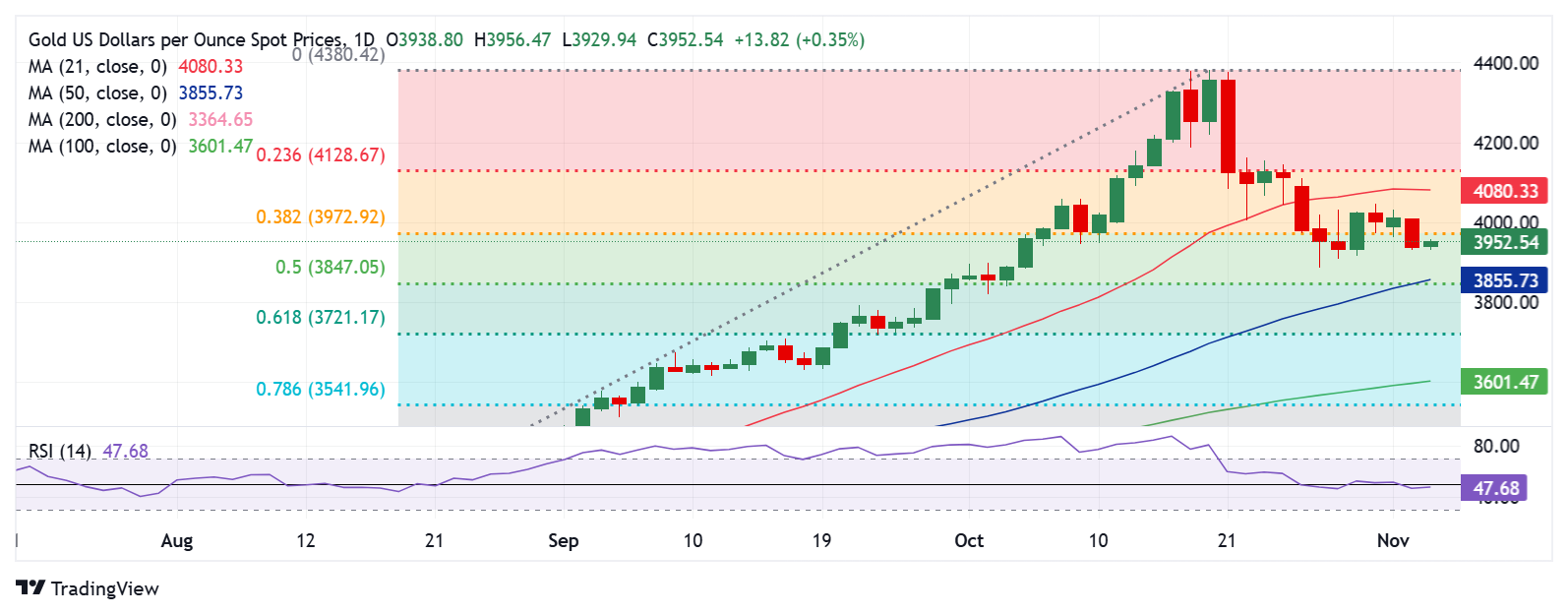
The daily chart suggests that the near-term outlook for Gold appears neutral to bearish as the 14-day Relative Strength Index (RSI) flirts with the midline, while looking to reclaim.
The bullion is currently hovering near the 38.2% Fibonacci Retracement level of the parabolic rise to the record high that began on August 19.
Buyers need to find a daily candlestick closing above the $4,000 mark to attempt another run toward the 21-day Simple Moving Average (SMA) at $4,079.
Ahead of that resistance, strong offers will continue to lurk near the $4,050 psychological level.
On the downside, Gold could find demand once again near $3,930, a break below which would expose the $3,900 figure.
The next relevant supports are seen at the October 28 low of $3,887, followed by the $3,865-$3,850 demand area.
That zone is the confluence of the 50-day SMA and the 50% Fibo level of the same ascent.
Gold FAQs
Gold has played a key role in human’s history as it has been widely used as a store of value and medium of exchange. Currently, apart from its shine and usage for jewelry, the precious metal is widely seen as a safe-haven asset, meaning that it is considered a good investment during turbulent times. Gold is also widely seen as a hedge against inflation and against depreciating currencies as it doesn’t rely on any specific issuer or government.
Central banks are the biggest Gold holders. In their aim to support their currencies in turbulent times, central banks tend to diversify their reserves and buy Gold to improve the perceived strength of the economy and the currency. High Gold reserves can be a source of trust for a country’s solvency. Central banks added 1,136 tonnes of Gold worth around $70 billion to their reserves in 2022, according to data from the World Gold Council. This is the highest yearly purchase since records began. Central banks from emerging economies such as China, India and Turkey are quickly increasing their Gold reserves.
Gold has an inverse correlation with the US Dollar and US Treasuries, which are both major reserve and safe-haven assets. When the Dollar depreciates, Gold tends to rise, enabling investors and central banks to diversify their assets in turbulent times. Gold is also inversely correlated with risk assets. A rally in the stock market tends to weaken Gold price, while sell-offs in riskier markets tend to favor the precious metal.
The price can move due to a wide range of factors. Geopolitical instability or fears of a deep recession can quickly make Gold price escalate due to its safe-haven status. As a yield-less asset, Gold tends to rise with lower interest rates, while higher cost of money usually weighs down on the yellow metal. Still, most moves depend on how the US Dollar (USD) behaves as the asset is priced in dollars (XAU/USD). A strong Dollar tends to keep the price of Gold controlled, whereas a weaker Dollar is likely to push Gold prices up.
Author

Dhwani Mehta
FXStreet
Residing in Mumbai (India), Dhwani is a Senior Analyst and Manager of the Asian session at FXStreet. She has over 10 years of experience in analyzing and covering the global financial markets, with specialization in Forex and commodities markets.














