Gold Price Forecast: XAU/USD sees a profit-taking pullback before the next uptick
- Gold retraces Friday’s uptick, led by Fed Chair Powell’s dovish pivot at the Jackson Hole Symposium.
- US Dollar stages a comeback, but upside appears limited ahead of this week’s preferred inflation gauge of the Fed.
- The daily technical setup flipped in favor of buyers after Powell’s dovish surprise.

Gold is back in the red below $3,370, reversing the sharp turnaround seen on Friday. Buyers take a breather in the aftermath of intense volatility stoked by US Federal Reserve (Fed) Chair Jerome Powell’s surprise dovish pivot at the Jackson Hole Economic Symposium.
Gold appears a ‘buy-the-dip trade
Gold changed its course and rebounded firmly about $50 to test $3,380 after Powell sealed in a September interest rate cut and revived speculations of aggressive rate cuts this year.
"Downside risks to employment are rising, while "GDP growth has slowed notably, reflecting a slowdown in consumer spending," he told an audience of international economists and policymakers.
"And if those risks materialize, they can do so quickly,” Fed may need to cut rates, Powell noted.
Markets are now pricing in an 88% chance that the Fed will lower rates next month, the CME Group’s Fed Watch Tool shows, up from 75% before Powell’s appearance.
At the start of the week on Monday, Gold is witnessing a bout of profit taking following a sharp turnaround on Friday.
However, any downside in the non-yielding Gold is likely to be temporary as markets reprice dovish Fed expectations, which could make it difficult for the US Dollar (USD) to attempt a sustained recovery.
The Greenback struggles to extend its recovery momentum as traders now weigh the comments from St. Louis Federal Reserve President Alberto Musalem.
Musalem said that he will need more data before deciding to support a rate cut at the September meeting, warning inflation remains above the Fed's 2% target, per Reuters.
Looking ahead, the US New Home Sales data and Fedspeak could provide some fresh hints on the Fed’s policy path, eventually impacting the non-interest-bearing Gold.
The main focus this week remains the US core Personal Consumption Expenditures (PCE) Price Index, the Fed’s favorite inflation measure, to affirm aggressive Fed rate cut expectations.
Gold price technical analysis: Daily chart
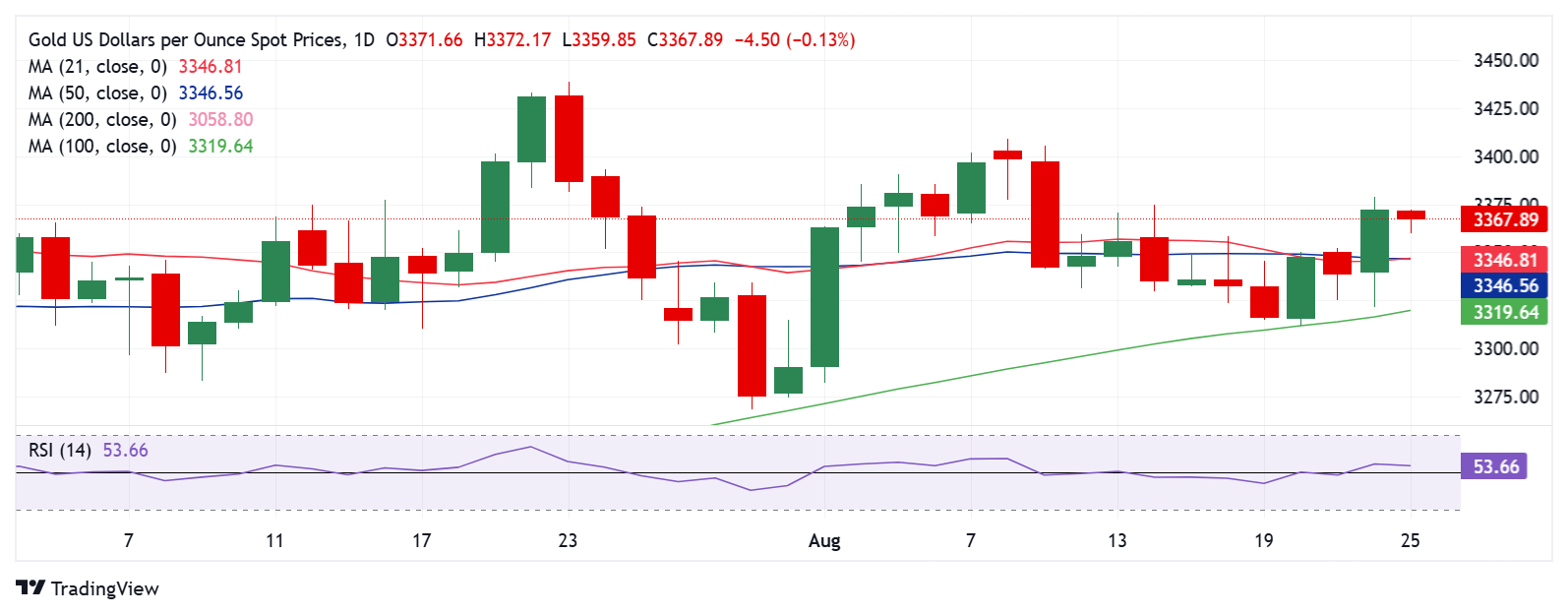
The short-term technical outlook for Gold appears encouraging so long as the 14-day Relative Strength Index (RSI) stays above the 50 level. The leading indicator is currently pointing lower to near 53.50.
Meanwhile, traders will double down on their bullish bets in Gold if the 21-day Simple Moving Average (SMA) closes above the 50-day SMA on Monday, eventually validating a Bull Cross.
If the buying interest re-emerges, the immediate resistance is seen at Friday’s high of $3,379, above which the $3,400 threshold will be challenged.
Further up, the static resistance at around $3,440 will be back in play.
Contrarily, sellers need to crack the 21-day SMA and the 50-day SMA confluence area near $3,346 to stretch the latest leg south.
The next solid support is located at the 100-day SMA at $3,320. Only a sustained move below the latter will negate any positive bias in the medium term.
Note that Gold hasn’t closed below the 100-day SMA since December 31 2024.
Fed FAQs
Monetary policy in the US is shaped by the Federal Reserve (Fed). The Fed has two mandates: to achieve price stability and foster full employment. Its primary tool to achieve these goals is by adjusting interest rates. When prices are rising too quickly and inflation is above the Fed’s 2% target, it raises interest rates, increasing borrowing costs throughout the economy. This results in a stronger US Dollar (USD) as it makes the US a more attractive place for international investors to park their money. When inflation falls below 2% or the Unemployment Rate is too high, the Fed may lower interest rates to encourage borrowing, which weighs on the Greenback.
The Federal Reserve (Fed) holds eight policy meetings a year, where the Federal Open Market Committee (FOMC) assesses economic conditions and makes monetary policy decisions. The FOMC is attended by twelve Fed officials – the seven members of the Board of Governors, the president of the Federal Reserve Bank of New York, and four of the remaining eleven regional Reserve Bank presidents, who serve one-year terms on a rotating basis.
In extreme situations, the Federal Reserve may resort to a policy named Quantitative Easing (QE). QE is the process by which the Fed substantially increases the flow of credit in a stuck financial system. It is a non-standard policy measure used during crises or when inflation is extremely low. It was the Fed’s weapon of choice during the Great Financial Crisis in 2008. It involves the Fed printing more Dollars and using them to buy high grade bonds from financial institutions. QE usually weakens the US Dollar.
Quantitative tightening (QT) is the reverse process of QE, whereby the Federal Reserve stops buying bonds from financial institutions and does not reinvest the principal from the bonds it holds maturing, to purchase new bonds. It is usually positive for the value of the US Dollar.
Author

Dhwani Mehta
FXStreet
Residing in Mumbai (India), Dhwani is a Senior Analyst and Manager of the Asian session at FXStreet. She has over 10 years of experience in analyzing and covering the global financial markets, with specialization in Forex and commodities markets.














