|premium|

Gold Price Forecast: XAU/USD retreats below $1,830 after CPI-inspired fluctuations

  • XAU/USD fluctuated wildly after April inflation data from US.
  • 10-year US T-bond yield is up more than 2% on Wednesday.
  • Additional losses are likely with a daily close below $1,820.

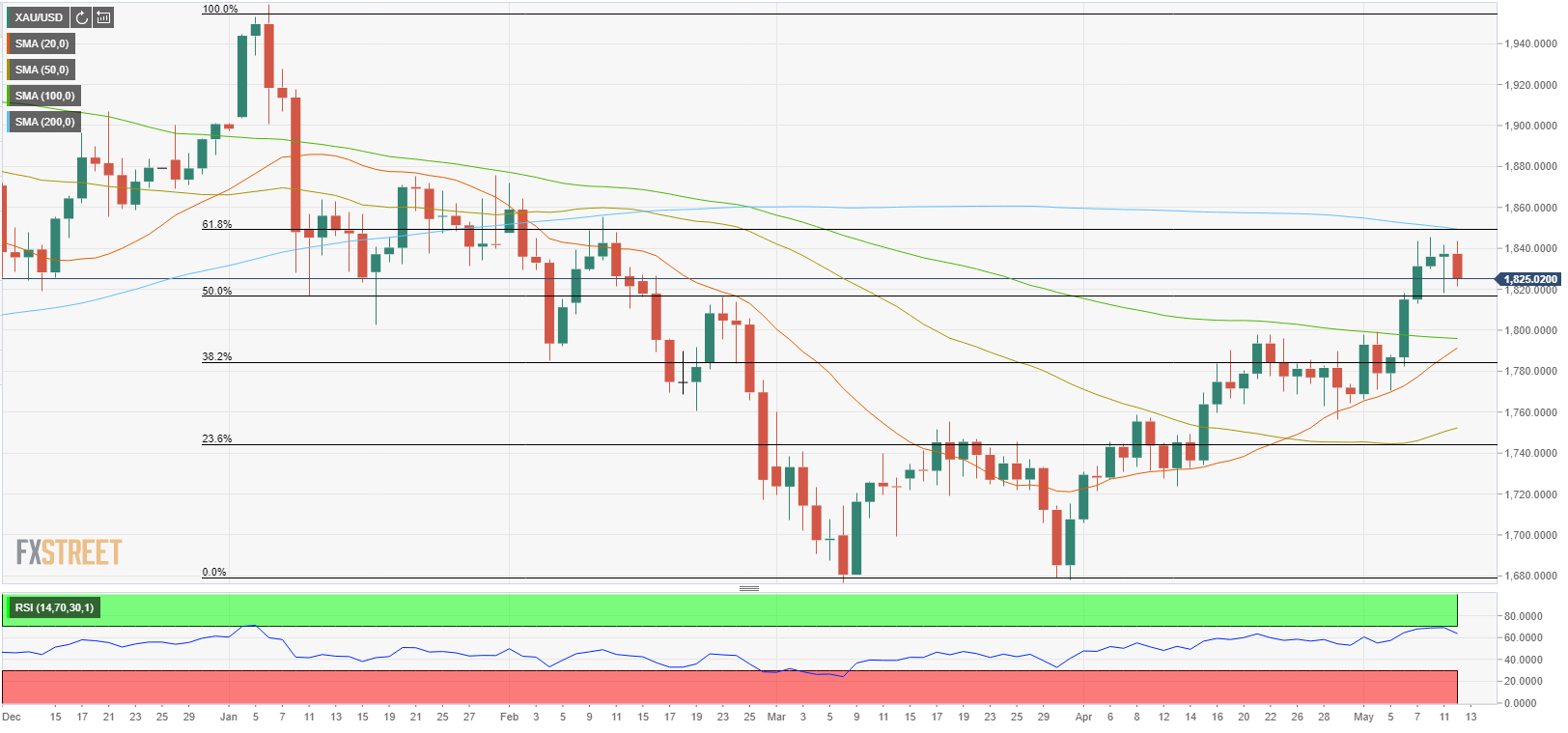
The XAU/USD pair struggled to make a decisive move in either direction and closed unchanged on Tuesday. After staying relatively quiet during the first half of the day on Wednesday, the pair fluctuated sharply as investors assessed the latest inflation data from the US. Following a sharp upsurge to $1,843, gold reversed its direction and was last seen losing 0.5% at $1,828.

The US Bureau of Labor Statistics reported that the Consumer Price Index (CPI) jumped to 4.2% on a yearly basis in April from 2.6% in March. This reading came in much higher than the market expectation of 3.6% and provided a boost to the US Treasury bond yields. At the moment, the benchmark 10-year US T-bond yield is up 2.3% at 1.663%. Moreover, the US Dollar Index is up 0.4% at 90.55, making it difficult for XAU/USD to climb into the positive territory. 

Commenting on the data, "apart from well-known base effects – CPI tumbled this time last year due to covid – bottlenecks such as the global chip shortage and the quick reopening could be behind the move," said FXStreet analyst Yohay Elam. "That could cool down as supply meets demand. Overall, there is room for the trend to switch – an upswing in shares and a fresh fall for the dollar."

Gold technical outlook

On the downside, $1,820 (Fibonacci 50% retracement of the January-March downtrend) aligns as the first support. A daily close below that level could open the door for additional losses toward the key support at $1,800 (psychological level, 100-day SMA) and $1,790 (20-day SMA).

Resistances, on the other hand, are located at  $1,850 (Fibonacci 61.8% retracement level, 200-day SMA) and $1,860 (static level). On the daily chart, the Relative Strength Index (RSI) indicator is edging lower toward 50, suggesting that buyers are struggling to remain in control of gold's action.
Premium

You have reached your limit of 3 free articles for this month.

Start your subscription and get access to all our original articles.

Subscribe to PremiumSign In

Author

Eren Sengezer

As an economist at heart, Eren Sengezer specializes in the assessment of the short-term and long-term impacts of macroeconomic data, central bank policies and political developments on financial assets.


More from Eren Sengezer
Share:

Editor's Picks

GBP/USD holds losses below 1.3250 on UK politics,  PMIs eyed

GBP/USD loses ground below 1.3250 in the European session on Tuesday. Political uncertainty in the United Kingdom continues to weigh on the British Pound, while the US Dollar capitalizes on the risk-off mood and hawkish Fed bets. The UK and US S&P Global preliminary PMI data are next of note for the major.


EUR/USD stays weak below 1.1450 after German, EU PMI data

EUR/USD struggles to stage a rebound and trades below 1.1450 in the European session on Tuesday, after the data from Germany showed that the Composite PMI declined to 48 in June from 48.8 May, while that from the Eurozone rose to 49.5. Meanwhile, the US Dollar holds the upper hand against the Euro amid risk-off sentiment and a hawkish Fed outlook, leaving the pair on the defensive. Traders now await the US PMI data.

Gold drops to nearly two-week low, seems vulnerable amid Fed hike bets, bullish USD

Gold adds to its Asian session losses, and drops to a nearly two-week low, around the $4,115 region in the last hour amid a bullish US Dollar. Despite positive signals from US-Iran peace talks, widespread skepticism remains toward a final deal. This helps the USD in preserving its recent strong gains to the highest level since May 2025.

Bears cap Solana below $75 as ETF, retail demand wanes

Solana edges below $72 risking a third consecutive day of losses that could erase the 5% gains from Friday. SOL-focused Exchange Traded Funds reflect muted demand from institutional investors following a minor recovery last week. Meanwhile, retail trading activity hints at a bearish positional buildup.

Big day of PMIs ahead

In the euro area, June flash PMIs are released. Most respondents will likely have answered after the US-Iran deal, yet the impact of lower oil prices is unlikely to already show up in activity data. We expect manufacturing to edge down to 50.9 (May: 51.6), while we expect services to see a modest improvement to 48.8 (May: 47.7).

Regime change: Inside Kevin Warsh's first move to make the Fed unreadable on purpose

The rate did not move. That was the least interesting thing about Kevin Warsh's first meeting in charge of the Fed. The FOMC held its benchmark at 3.50%-3.75% for the fourth straight meeting, exactly as priced, and then the new chair used his first press conference to dismantle the machinery the market has leaned on for a decade.