Gold Price Forecast: XAU/USD resumes bullish run, flirts with $3,100
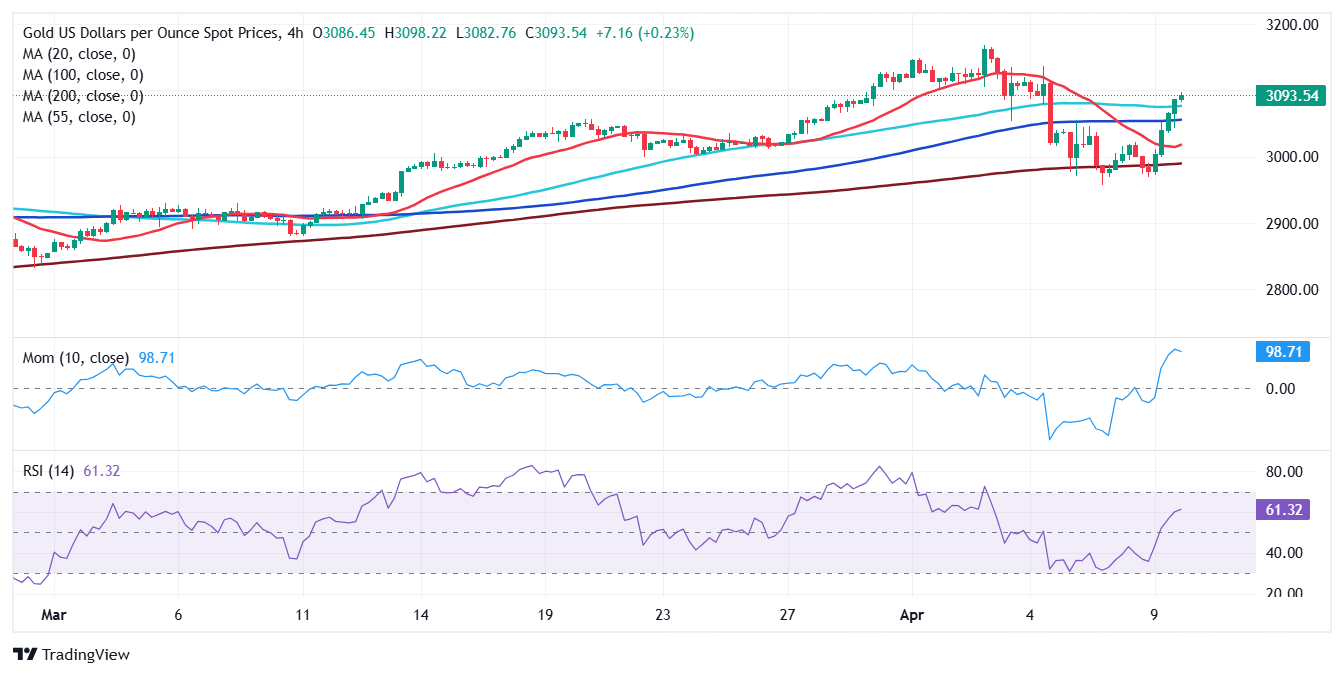
XAU/USD Current price: $3,094.10
- The FOMC Minutes could have a limited impact on markets given recent tariffs' turmoil.
- The trade war escalation brought back risk-off trading, underpinning gold.
- XAU/USD approaches the $3,100 mark and could extend gains to fresh record highs.
Spot Gold resumed its bullish run after a brief consolidating phase, trading a handful of bucks below the $3,100 mark in the American session, up roughly $100 on the day amid returning risk-aversion. The escalation of the trade war, particularly between the United States (US) and China. Following US President Trump’s decision to double levies on the Asian giant to a whopping 104%, Beijing announced retaliatory tariffs of 84%.
Back-and-forth announcements finally took their toll on financial markets, and fears returned. Investors are concerned about a potential US recession alongside economic setbacks among major economies. Market participants are also worried about upward inflationary pressures coming with widespread import taxes, and how those could affect central banks’ upcoming monetary policy decisions.
Meanwhile, the Federal Open Market Committee is about to release the Minutes from the March meeting. Given the latest tariffs’ developments, the document could be considered old news and have a limited impact on the US Dollar (USD). Nevertheless, the document may shed additional light on policymakers’ thinking.
Back in March, the Summary of Economic Projections (SEP) showed Chair Jerome Powell and co are in no rush to move interest rates amid increased fiscal and political uncertainty. The Federal Reserve (Fed) is expected to trim rates by modest 50 basis points (bps) this year, with increased doubts about such moves given mounting trading tensions.
XAU/USD short-term technical outlook
From a technical point of view, XAU/USD is poised to retest record highs in the $3,160 region. The daily chart for the pair shows technical indicators advancing within positive levels, with sharp bullish slopes. At the same time, the pair recovered above a bullish 20 Simple Moving Average (SMA) currently at around $3,044. Finally, the 100 and 200 SMAs keep heading firmly higher, far below the shorter one, in line with the dominant bullish trend.
The near-term picture also favors another leg higher, although given the intraday advance, Gold may consolidate or even correct lower before resuming gains. Still, the 4-hour chart shows XAU/USD stands above all its moving averages, which, anyway, lack directional strength. At the same time, technical indicators have turned flat near their intraday highs, and well above their midlines, suggesting absent selling interest.
Support levels: 3,078.30 3,062.90 3,051.10
Resistance levels: 3,105.00 3,122.85 3,136.50
US-China Trade War FAQs
Generally speaking, a trade war is an economic conflict between two or more countries due to extreme protectionism on one end. It implies the creation of trade barriers, such as tariffs, which result in counter-barriers, escalating import costs, and hence the cost of living.
An economic conflict between the United States (US) and China began early in 2018, when President Donald Trump set trade barriers on China, claiming unfair commercial practices and intellectual property theft from the Asian giant. China took retaliatory action, imposing tariffs on multiple US goods, such as automobiles and soybeans. Tensions escalated until the two countries signed the US-China Phase One trade deal in January 2020. The agreement required structural reforms and other changes to China’s economic and trade regime and pretended to restore stability and trust between the two nations. However, the Coronavirus pandemic took the focus out of the conflict. Yet, it is worth mentioning that President Joe Biden, who took office after Trump, kept tariffs in place and even added some additional levies.
The return of Donald Trump to the White House as the 47th US President has sparked a fresh wave of tensions between the two countries. During the 2024 election campaign, Trump pledged to impose 60% tariffs on China once he returned to office, which he did on January 20, 2025. With Trump back, the US-China trade war is meant to resume where it was left, with tit-for-tat policies affecting the global economic landscape amid disruptions in global supply chains, resulting in a reduction in spending, particularly investment, and directly feeding into the Consumer Price Index inflation.
tariff
Author

Valeria Bednarik
FXStreet
Valeria Bednarik was born and lives in Buenos Aires, Argentina. Her passion for math and numbers pushed her into studying economics in her younger years.