Gold Price Forecast: XAU/USD remains stuck between two key barriers amid thin trading
- Gold price reverses the previous decline but remains in a familiar range early Tuesday.
- The US Dollar holds the latest upswing alongside the US Treasury bond yields amid thin trading.
- Gold price remains a ‘sell-on-bounce’ trade amid bearish daily RSI, stuck between two key SMAs.

Gold price is attempting another run higher while defending the $2,600 threshold early Tuesday. In doing so, Gold price replicates the recovery moves seen in Monday’s trading, which eventually fizzled out on a broad US Dollar (USD) comeback in tandem with US Treasury bond yields.
Gold price looks to extend range play amid light trading
The further upside in Gold price could remain limited as the Greenback stays supported by the US Federal Reserve’s (Fed) hawkish tilt at its December policy meeting. Expectations of higher-for-longer US interest rates continue to underpin the US Treasury bond yields and the USD, rendering negative for the non-interest-bearing Gold price.
The US central bank lowered policy rate by 25 basis points (bps) to 4.25%-4.50% range last week, as widely expected. However, the Fed’s Statement of Economic Projections (SEP), the so-called Dot Plot, predicted two quarter-percentage-point rate reductions by the end of 2025. That is half a percentage point less in policy easing next year than officials anticipated as of September. Rising inflation expectations on the back of US President-elect Donald Trump’s protectionist policies call for higher interest rates.
Additionally, markets prefer to hold the US currency in a Christmas holiday-curtailed week, where trading volumes will likely thin out heading into the New Year festive season. Thin market conditions could exaggerate moves across the financial markets, with investors seeking safety in the Greenback.
Therefore, the Gold price remains a good selling opportunity on recovery attempts going forward, barring the unexpected flaring up of any conflicts in the Middle East or between Russia and Ukraine. Gold traders will remain at the mercy of the market sentiment and the US Dollar dynamics, refraining from placing any fresh directional bets on the bright metal.
Gold price technical analysis: Daily chart
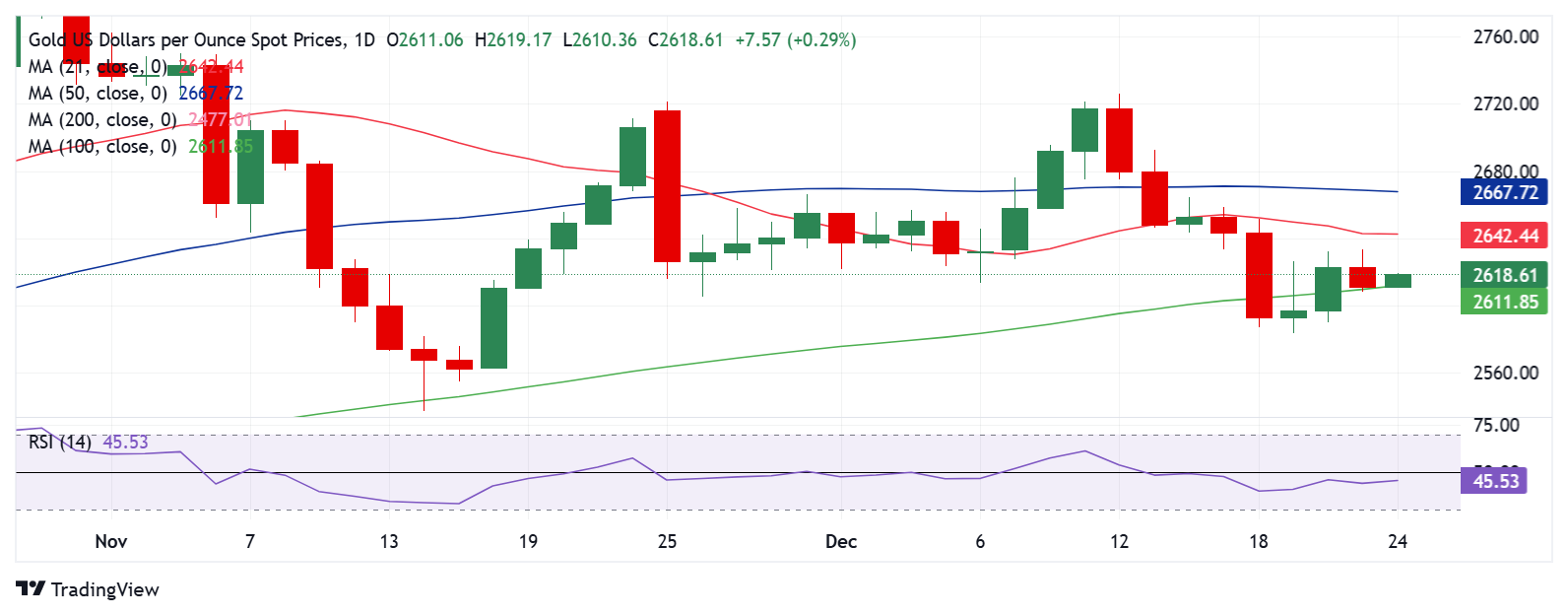
Technically, Gold price remains more or less the same from a short-term perspective so long as the 14-day Relative Strength Index (RSI) holds below the 50 level.
Currently, Gold's price defends the 100-day Simple Moving Average (SMA) of $2,611 while it continues to face sellers at the 21-day SMA of $2,642.
Acceptance above the 21-day SMA is needed to negate the bearish momentum, which will call for a test of the 50-day SMA at $2,668.
Further up, the $2,700 mark will come into play.
If Gold buyers give up, a sustained break below the 100-day SMA resistance-turned-support at $2,611 will put the monthly low of $2,583 to the test.
The next relevant supports are November 15 and 14 lows at $2,555 and $2,537, respectively, could come into play.
Gold FAQs
Gold has played a key role in human’s history as it has been widely used as a store of value and medium of exchange. Currently, apart from its shine and usage for jewelry, the precious metal is widely seen as a safe-haven asset, meaning that it is considered a good investment during turbulent times. Gold is also widely seen as a hedge against inflation and against depreciating currencies as it doesn’t rely on any specific issuer or government.
Central banks are the biggest Gold holders. In their aim to support their currencies in turbulent times, central banks tend to diversify their reserves and buy Gold to improve the perceived strength of the economy and the currency. High Gold reserves can be a source of trust for a country’s solvency. Central banks added 1,136 tonnes of Gold worth around $70 billion to their reserves in 2022, according to data from the World Gold Council. This is the highest yearly purchase since records began. Central banks from emerging economies such as China, India and Turkey are quickly increasing their Gold reserves.
Gold has an inverse correlation with the US Dollar and US Treasuries, which are both major reserve and safe-haven assets. When the Dollar depreciates, Gold tends to rise, enabling investors and central banks to diversify their assets in turbulent times. Gold is also inversely correlated with risk assets. A rally in the stock market tends to weaken Gold price, while sell-offs in riskier markets tend to favor the precious metal.
The price can move due to a wide range of factors. Geopolitical instability or fears of a deep recession can quickly make Gold price escalate due to its safe-haven status. As a yield-less asset, Gold tends to rise with lower interest rates, while higher cost of money usually weighs down on the yellow metal. Still, most moves depend on how the US Dollar (USD) behaves as the asset is priced in dollars (XAU/USD). A strong Dollar tends to keep the price of Gold controlled, whereas a weaker Dollar is likely to push Gold prices up.
Author

Dhwani Mehta
FXStreet
Residing in Mumbai (India), Dhwani is a Senior Analyst and Manager of the Asian session at FXStreet. She has over 10 years of experience in analyzing and covering the global financial markets, with specialization in Forex and commodities markets.