Gold Price Forecast: XAU/USD needs a weekly close above 21 DMA to confirm a bullish reversal
- Gold price is back in the green zone early Friday after failing to sustain above 21 DMA at $1,878.
- US Dollar retreats with bond yields as traders weigh renewed hawkish Federal Reserve expectations.
- Will Gold price yield a weekly closing above the 21 DMA resistance? US data, Fedspeak eyed.

Gold price is making a tepid recovery attempt near $1,870 early Friday, reverting toward a fresh two-week high of $1,885 set on Thursday. Gold price has resumed the upside, as the United States Dollar (USD) buyers take a breather amid retreating US Treasury bond yields.
Top-tier US sentiment data and Fedspeak in focus
Investors reassess renewed hawkish US Federal Reserve (Fed) expectations, spurred by the unexpectedly hot Consumer Price Index (CPI) data from the United States. The US CPI increased 0.4% last month after a 0.3% gain in August, the Labor Department said on Thursday. On an annual basis, the CPI inflation steadied at 3.7% in September, at the same pace as seen in August while beating estimates of a 3.6% rise.
The US inflation data reinforced the Fed’s “higher rates for longer” narrative, lifting the US Dollar and the US Treasury bond yields from their recent two-week troughs. Gold price, thereafter, reversed sharply from a two-week high above $1,880 and tested bids below the $1,870 mark, as the revival of hawkish Fed bets dented risk sentiment, aiding the US Dollar rebound.
Commenting on the latest inflation report, Boston Fed President Susan Collins said that it underscores uneven progress toward restoring price stability, reiterating her view that the central bank might have to raise rates again to combat inflation.
The probability of a rate hike in December from the Fed spiked up to 38%, according to the CME Fedwatch tool, compared with about a 28% chance seen before the report. Currently, markets price a 30% chance of a final Fed rate hike in December.
The reaction to the US CPI report was short-lived, as the US Dollar sellers have returned on Friday, even though risk sentiment remains sour after softer-than-expected Chinese CPI and Producer Price Index (PPI) data.
China’s Consumer Price Index (CPI) stagnated at 0% YoY in September after accelerating by 0.1% in August. The market expected an increase of 0.2%. China’s Producer Price Index (PPI) dropped 2.5% YoY in September, compared with a 3.0% decline registered previously. The market forecast was for a 2.4% decline.
Attention now turns toward the US Preliminary UoM Consumer Sentiment and Inflation Expectations data for fresh cues on the Fed’s interest rate outlook. Speeches from Fed policymakers will also play a pivotal role in influencing the US Dollar valuations alongside the end-of-the-week flows.
Gold price technical analysis: Daily chart
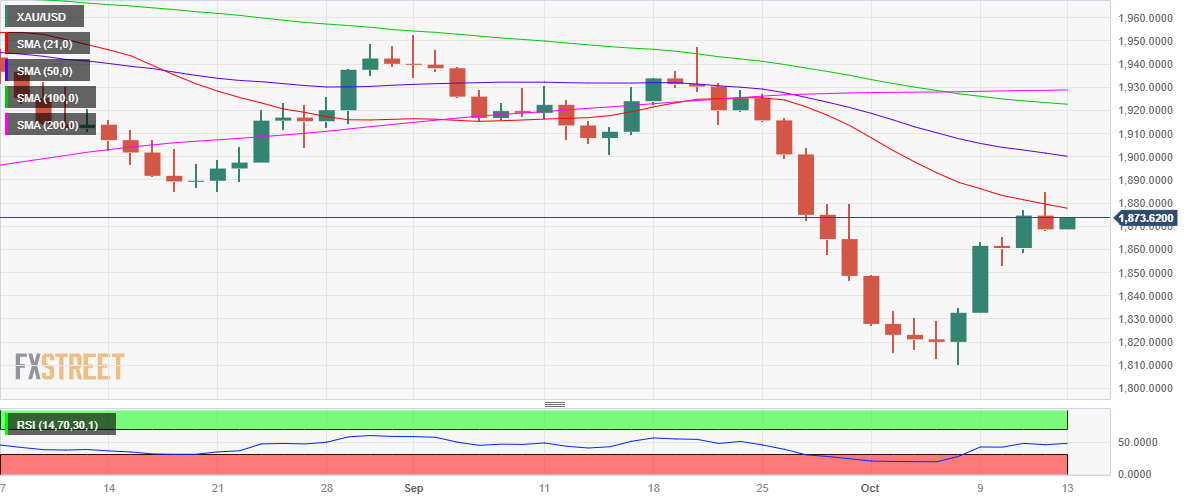
The Gold price brief recaptured the key short-term descending 21-Daily Moving Average (DMA) at $1,878 but failed to yield a daily closing above the latter.
The 14-day Relative Strength Index (RSI) indicator is lying just below the midline, suggesting that the upside attempts appear temporary in Gold price.
Failure to seek a weekly close above the 21 DMA at $1,878 could reinforce bearish interest, fuelling a fresh downswing toward Wednesday’s low of $1,859.
The next relevant support is seen at the $1,850 psychological level.
On the upside, recapturing the 21 DMA barrier on a sustained basis will confirm a bullish reversal from multi-month troughs. Gold buyers will then target the $1,900 threshold. At that level, the mildly bearish 50 DMA coincides.
Further up, powerful resistance around the $1,925 level could be challenged, where the 100 and 200 DMAs hang around.
Author

Dhwani Mehta
FXStreet
Residing in Mumbai (India), Dhwani is a Senior Analyst and Manager of the Asian session at FXStreet. She has over 10 years of experience in analyzing and covering the global financial markets, with specialization in Forex and commodities markets.

















