Gold Price Forecast: XAU/USD finds temporary support at 100-day SMA amid bearish technicals
- Gold price is attempting a tepid recovery from monthly lows near $3,270 early Thursday.
- The US Dollar gives up a part of the hawkish Fed verdict-inspired rally as US-China trade woes resurface.
- Gold price bounces off the 100-day SMA support at $3,267, but the daily technical setup stays bearish.

Gold price is reversing a part of the US Federal Reserve (Fed) monetary policy announcements-led sell-off to monthly lows of $3,268 early Thursday.
Gold price recovers as focus shifts to US Nonfarm Payrolls
Gold sellers are taking a breather after the steep 1.5% downfall witnessed on Wednesday, after the US Dollar (USD) shot through the roof against its major currency rivals in reaction to the hawkish no-rate change decision by the Fed.
Following the July monetary policy meeting, the Fed policymakers voted 9-2 to keep the federal funds rate in a range between 4.25%-4.5%, with the accompanying statement underscoring ‘elevated uncertainty’ in the economy due to US President Donald Trump’s tariffs.
Meanwhile, Fed Chair Jerome Powell stuck to the central bank’s cautious stance even though two Fed governors dissented at the meeting, favoring a 25 basis points (bps) interest rate cut.
In the post-policy meeting press conference, Powell said: “We have made no decisions about September.”
“We don’t do that in advance. We’ll be taking that information into consideration and all the other information we get as we make our decision, he added, shrugging off Trump’s push to lower rates.
Therefore, the decision and Powell’s words were perceived as hawkish, with markets now pricing in a 58% chance that the Fed could hold rates again in September, according to the CME Group’s FedWatch Tool, against the odds of about 35% pre-Fed outcome.
However, in Thursday’s trading so far, the Fed-inspired USD rally appears to face headwinds from renewed tensions surrounding the extension of the US-China trade truce, even as the US announced trade deals with Thailand and Cambodia.
Xinhua News Agency, a Chinese state media outlet, carried a story early Thursday stating that “some deep-seated and structural problems in China-US economic and trade relations cannot be solved overnight.”
The commentary raised concerns over the potential extension of the August 12 tariff deadline by the US on China.
Further, traders resort to profit-taking on their USD longs, repositioning ahead of Friday’s all-important US labor data, with the Nonfarm Payrolls set to take center stage after a solid ADP and Gross Domestic Product (GDP) prints on Wednesday.
The ADP report showed that the US private sector employment increased by 104,000 jobs in July, recovering from -23,000 in June and against the expectations of +78,000.
Meanwhile, US annualized GDP jumped 3% for the second quarter, better than the 2.4% estimate and reversing a 0.5% decline in the prior period.
Looking ahead, pre-NFP position adjustments and trade headlines will continue to play a pivotal role in driving the Gold price action, with the downside potential still in place amid a bearish technical setup on the daily chart.
Gold price technical analysis: Daily chart
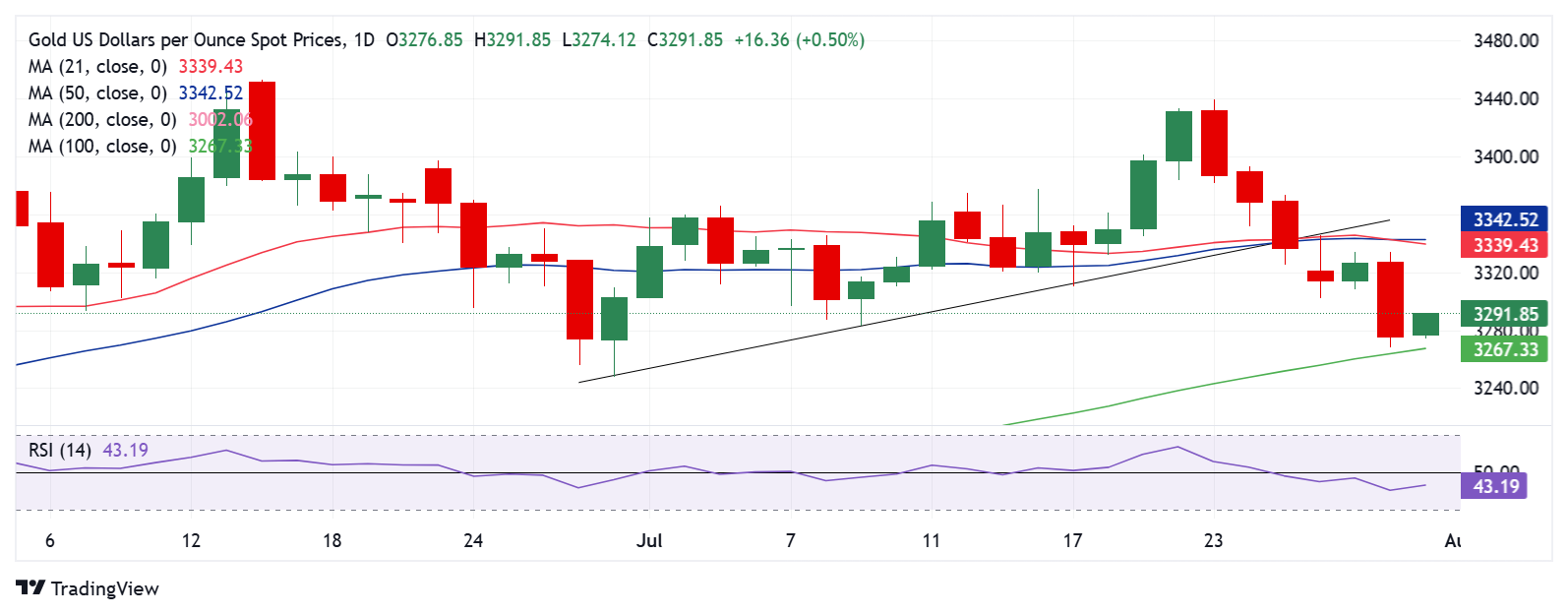
Despite the latest upswing, bearish bias prevails for the Gold price in the near term amid a Bear Cross in play.
The 21-day Simple Moving Average (SMA) pierced through the 50-day SMA from above on a daily closing basis on Wednesday, validating a Bear Cross.
Meanwhile, the 14-day Relative Strength Index (RSI) portrays a modest uptick but stays below the midline, currently near 43, suggesting that Gold price remains a ‘sell the bounce’ trade.
If selling pressure re-emerges, Gold price could crack the 100-day SMA barrier at $3,267 on a sustained basis, below which the June 30 low of $3,248 will be threatened.
The last line of defense for Gold buyers is seen at the May 20 low of $3,205.
Alternatively, any recovery attempts will need acceptance above the 21-day SMA and 50-day SMA supply zone near $3,340.
Ahead of that, the $3,300 psychological level must be scaled. The next topside hurdle is seen at the $3,380 static resistance.
Gold FAQs
Gold has played a key role in human’s history as it has been widely used as a store of value and medium of exchange. Currently, apart from its shine and usage for jewelry, the precious metal is widely seen as a safe-haven asset, meaning that it is considered a good investment during turbulent times. Gold is also widely seen as a hedge against inflation and against depreciating currencies as it doesn’t rely on any specific issuer or government.
Central banks are the biggest Gold holders. In their aim to support their currencies in turbulent times, central banks tend to diversify their reserves and buy Gold to improve the perceived strength of the economy and the currency. High Gold reserves can be a source of trust for a country’s solvency. Central banks added 1,136 tonnes of Gold worth around $70 billion to their reserves in 2022, according to data from the World Gold Council. This is the highest yearly purchase since records began. Central banks from emerging economies such as China, India and Turkey are quickly increasing their Gold reserves.
Gold has an inverse correlation with the US Dollar and US Treasuries, which are both major reserve and safe-haven assets. When the Dollar depreciates, Gold tends to rise, enabling investors and central banks to diversify their assets in turbulent times. Gold is also inversely correlated with risk assets. A rally in the stock market tends to weaken Gold price, while sell-offs in riskier markets tend to favor the precious metal.
The price can move due to a wide range of factors. Geopolitical instability or fears of a deep recession can quickly make Gold price escalate due to its safe-haven status. As a yield-less asset, Gold tends to rise with lower interest rates, while higher cost of money usually weighs down on the yellow metal. Still, most moves depend on how the US Dollar (USD) behaves as the asset is priced in dollars (XAU/USD). A strong Dollar tends to keep the price of Gold controlled, whereas a weaker Dollar is likely to push Gold prices up.
Author

Dhwani Mehta
FXStreet
Residing in Mumbai (India), Dhwani is a Senior Analyst and Manager of the Asian session at FXStreet. She has over 10 years of experience in analyzing and covering the global financial markets, with specialization in Forex and commodities markets.