Gold Price Forecast: XAU/USD eyes acceptance above $2,200 amid bullish technicals
- Gold price rebounds early Monday, snapping two-day corrective declines.
- US Dollar retreats with US Treasury yields, tracking USD/JPY lower.
- Upside risks intact for Gold price amid bullish daily technical setup.

Gold price is rebounding firmly toward the $2,200 threshold in Monday’s Asian trading so far, as the US Dollar recovery takes a breather amid sluggish US Treasury bond yields and a mixed market mood.
Gold price capitalizes on US Dollar pullback
The US Dollar is retreating from a five-week high of 104.50 against its major rivals, in the wake of a renewed selling in the USD/JPY pair and a stronger-than-expected Chinese Yuan fix. The latest leg down in the Greenback is helping Gold price regain its lost footing.
USD/JPY corrects further from year-to-date (YTD) highs of 151.86 set on Friday, as the Japanese Yen draws support from mounting risks over a potential forex market intervention by Japan’s authorities.
Meanwhile, the People’s Bank of China (PBOC) set the USD/CNY reference rate at 7.0996, as against the Reuters estimate of 7.2267. Additionally, reports that Chinese authorities have intervened by selling USD/CNY to support the Yuan seem to contribute to the renewed US Dollar weakness.
Gold price, thus, snaps its two-day corrective decline from the fresh all-time high of $2,223, awaiting fresh catalysts for the resumption of the uptrend.
The US Dollar staged a solid comeback in the latter part of the previous week after falling hard alongside the US Treasury bond yields on the dovish US Federal Reserve (Fed) interest rate outlook.
The Fed's economic projections, the so-called Dot Plot chart, still predicted three rate cuts this year as seen in January. Markets had begun pricing two Fed rate cuts this year after two consecutive months of higher inflation readings. The Fed kept the key rates unchanged between the 5.25% to 5.50% target range, following the March policy meeting.
Markets are now pricing in a 75% probability that the Fed will begin easing in June, up from 59% pre-Fed decision, according to the CME Group's FedWatch Tool.
The central focus this week remains on the speeches from the Fed policymakers and the Core PCE Price Index data, as the US economic docket remains relatively light in terms of high-impact releases.
In the meantime, the broader market sentiment and the US Dollar dynamics will continue to play their part in the Gold price action.
Gold price technical analysis: Daily chart
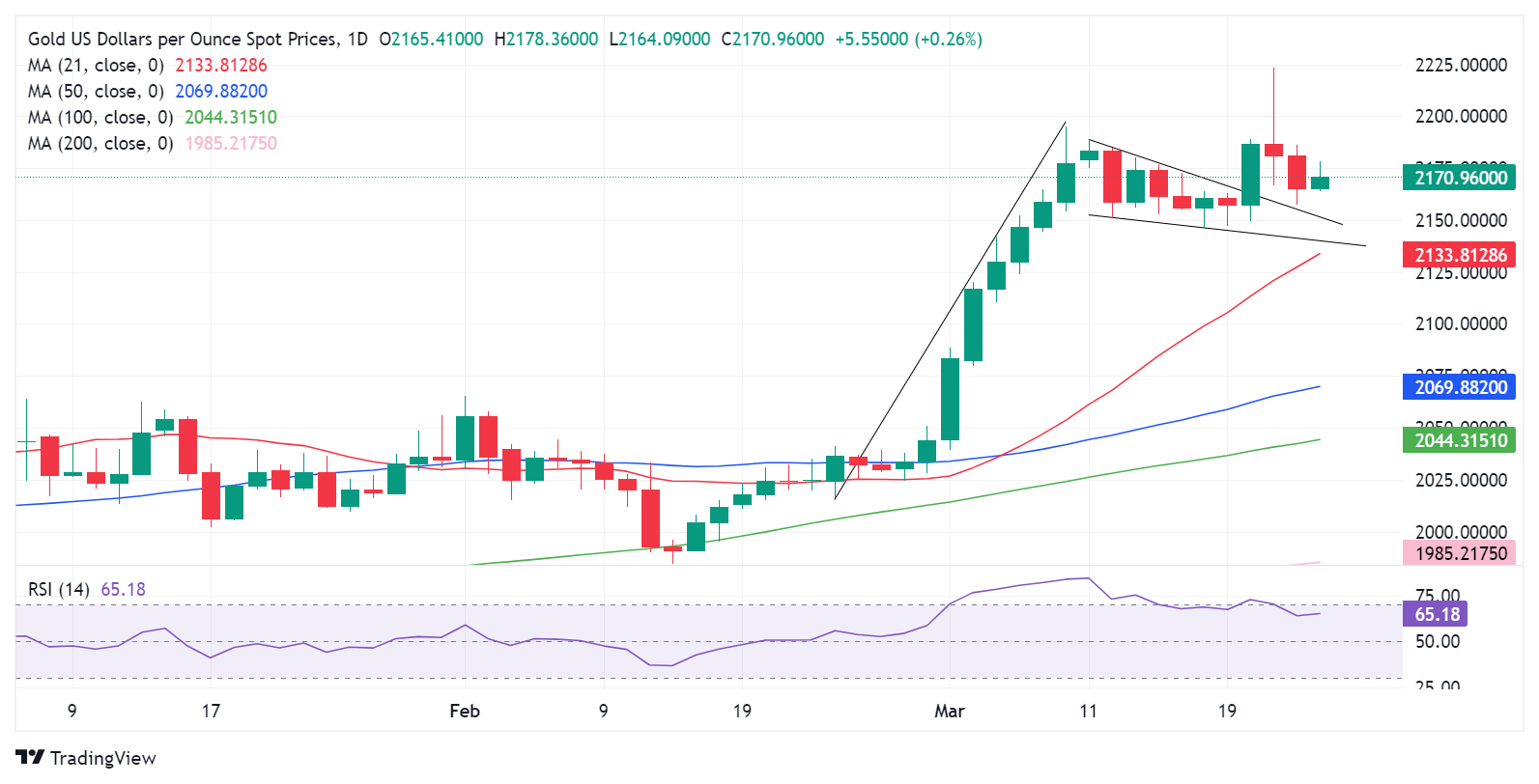
With a Bull Flag in play, Gold price remains on track to test the measured target at $2,251 should buyers regain control.
At first, Gold price needs to recapture the $2,200 threshold, following the record high at $2,223.
The 14-day Relative Strength Index (RSI), is seeing a fresh uptick while within the positive territory, indicating more upside on the cards.
On the flip side, immediate support is seen at the previous day’s low of $2,157, below which the Bull Flag resistance at $2,150 will be challenged.
A sustained move below the latter will put the Bull Flag support of $2,140 at risk.
Gold FAQs
Gold has played a key role in human’s history as it has been widely used as a store of value and medium of exchange. Currently, apart from its shine and usage for jewelry, the precious metal is widely seen as a safe-haven asset, meaning that it is considered a good investment during turbulent times. Gold is also widely seen as a hedge against inflation and against depreciating currencies as it doesn’t rely on any specific issuer or government.
Central banks are the biggest Gold holders. In their aim to support their currencies in turbulent times, central banks tend to diversify their reserves and buy Gold to improve the perceived strength of the economy and the currency. High Gold reserves can be a source of trust for a country’s solvency. Central banks added 1,136 tonnes of Gold worth around $70 billion to their reserves in 2022, according to data from the World Gold Council. This is the highest yearly purchase since records began. Central banks from emerging economies such as China, India and Turkey are quickly increasing their Gold reserves.
Gold has an inverse correlation with the US Dollar and US Treasuries, which are both major reserve and safe-haven assets. When the Dollar depreciates, Gold tends to rise, enabling investors and central banks to diversify their assets in turbulent times. Gold is also inversely correlated with risk assets. A rally in the stock market tends to weaken Gold price, while sell-offs in riskier markets tend to favor the precious metal.
The price can move due to a wide range of factors. Geopolitical instability or fears of a deep recession can quickly make Gold price escalate due to its safe-haven status. As a yield-less asset, Gold tends to rise with lower interest rates, while higher cost of money usually weighs down on the yellow metal. Still, most moves depend on how the US Dollar (USD) behaves as the asset is priced in dollars (XAU/USD). A strong Dollar tends to keep the price of Gold controlled, whereas a weaker Dollar is likely to push Gold prices up.
Author

Dhwani Mehta
FXStreet
Residing in Mumbai (India), Dhwani is a Senior Analyst and Manager of the Asian session at FXStreet. She has over 10 years of experience in analyzing and covering the global financial markets, with specialization in Forex and commodities markets.