Gold Price Forecast: XAU/USD downside appears capped whilst above $2,410
- Gold price is under pressure amid intense risk aversion-led ‘sell-everything mode’.
- US jobs data fuelled recession fears and aggressive Fed rate cut bets and, hurting the US Dollar and Treasury bond yields.
- Expectations of an imminent Israel-Iran war keep Gold price downside checked.
- Gold price remains poised to retest lifetime highs at $2,484, US ISM Services PMI awaited.

Gold price remains on the defensive for the third day in a row, kicking off the week cautiously early Monday. Gold traders are now looking for more US economic data, including the ISM Services PMI due later Monday for fresh trading impetus.
Gold struggles despite Middle East escalation, dovish Fed bets
Despite risk-off sentiment in full swing in Asian trading on Monday, Gold price struggles to benefit, as markets resort to ‘sell everything’ mode. Risk-aversion is mainly triggered by growing concerns that the US economy is headed for recession, in the aftermath of a weak jobs report on Friday.
Nonfarm payrolls increased by 114,000 jobs last month after rising by a downwardly revised 179,000 in June, the US Bureau of Labor Statistics (BLS) said on Friday. The Unemployment Rate climbed to 4.3% from 4.1% in June while the Labor Force Participation Rate advanced slightly to 62.7% from 62.6%.
Mounting US recession fears prompted markets wager aggressive US Federal Reserve (Fed) easing in September. Markets are predicting 115 bps of cuts this year, with traders pricing in a 74% chance of the Fed lowering rates by 50 bps in September, compared to an 11.5% chance a week earlier, according to the CME FedWatch tool.
Risk-aversion heightened in Asia also after US Secretary of State Tony Blinken during the G7 meeting on Sunday that an attack by Iran and Hezbollah against Israel could start as early as Monday, Axios reported, citing three sources.
The US S&P 500 futures, a risk barometer, are down 0.55% on the day, as of writing. Asian markets are on a downward spiral, led by a 6% slump in the Japanese Nikkei 225 index.
Dovish Fed expectations are offsetting the risk-off mood, not allowing the US Dollar to attract some haven buying. The US Treasury bond yields also extend the previous week’s downtrend, weighing further on Greenback.
In light of a broad US Dollar weakness and negative US Treasury bond yields, the Gold price downside appears capped. Dovish Fed expectations will continue to underpin the non-interest-rate-bearing Gold price in the near term.
However, traders turn cautious and refrain from placing fresh bets on the bright metal in the lead-up to the ISM Services PMI data release while closely monitoring the developments on the Middle East geopolitical tensions. The headline ISM Services PMI is set to rise to 51.0 in July from June’s 48.8.
Meanwhile, US President Joe Biden will convene the National Security Council on Monday to discuss developments in the Middle East.
Gold price technical analysis: Daily chart
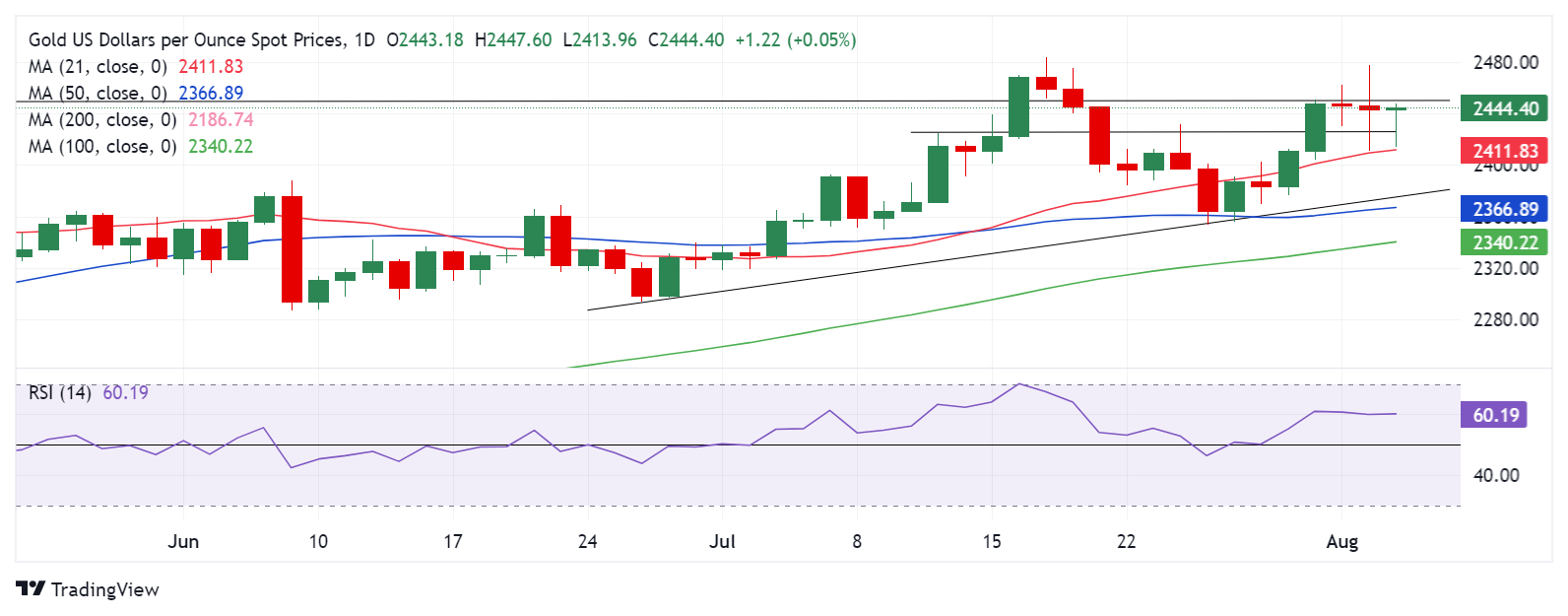
As observed on the daily chart, Gold price needs a daily candlestick close above the previous record highs of $2,450 to successfully resume the uptrend toward the lifetime highs of $2,484, reached on July 17.
Ahead of that, Friday’s high of $2,478 could be challenged, if buyers regain poise.
The 14-day Relative Strength Index (RSI) is holding steady while above the 50 level, currently near 60, suggesting that the bullish potential remains in place for Gold price.
Conversely, Gold sellers need to crack the 21-day Simple Moving Average (SMA) at $2,411 to carve a sustained downside. Additional declines could challenge the confluence support near $2,370, where rising trendline support meets with the 50-day SMA.
Gold FAQs
Gold has played a key role in human’s history as it has been widely used as a store of value and medium of exchange. Currently, apart from its shine and usage for jewelry, the precious metal is widely seen as a safe-haven asset, meaning that it is considered a good investment during turbulent times. Gold is also widely seen as a hedge against inflation and against depreciating currencies as it doesn’t rely on any specific issuer or government.
Central banks are the biggest Gold holders. In their aim to support their currencies in turbulent times, central banks tend to diversify their reserves and buy Gold to improve the perceived strength of the economy and the currency. High Gold reserves can be a source of trust for a country’s solvency. Central banks added 1,136 tonnes of Gold worth around $70 billion to their reserves in 2022, according to data from the World Gold Council. This is the highest yearly purchase since records began. Central banks from emerging economies such as China, India and Turkey are quickly increasing their Gold reserves.
Gold has an inverse correlation with the US Dollar and US Treasuries, which are both major reserve and safe-haven assets. When the Dollar depreciates, Gold tends to rise, enabling investors and central banks to diversify their assets in turbulent times. Gold is also inversely correlated with risk assets. A rally in the stock market tends to weaken Gold price, while sell-offs in riskier markets tend to favor the precious metal.
The price can move due to a wide range of factors. Geopolitical instability or fears of a deep recession can quickly make Gold price escalate due to its safe-haven status. As a yield-less asset, Gold tends to rise with lower interest rates, while higher cost of money usually weighs down on the yellow metal. Still, most moves depend on how the US Dollar (USD) behaves as the asset is priced in dollars (XAU/USD). A strong Dollar tends to keep the price of Gold controlled, whereas a weaker Dollar is likely to push Gold prices up.
Author

Dhwani Mehta
FXStreet
Residing in Mumbai (India), Dhwani is a Senior Analyst and Manager of the Asian session at FXStreet. She has over 10 years of experience in analyzing and covering the global financial markets, with specialization in Forex and commodities markets.