Gold Price Forecast: XAU/USD down but not out in the Fed’s aftermath
- Gold holds the pullback early Thursday, having renewed record highs at $3,708 in a knee-jerk reaction to the Fed announcement.
- US Dollar recovers on Fed Chair Powell’s cautious stance on further policy easing.
- Gold retreats from extreme overbought conditions on the daily chart, keeping buying interest alive.

Gold is licking its wounds near $3,650 in Thursday’s Asian trades, having stalled its pullback from fresh record highs of $3,707 reached in an initial reaction to the US Federal Reserve (Fed) policy announcements.
Gold assesses Fed’s interest rate outlook ahead of data
Gold witnessed intense volatility during the Fed event on Wednesday, initially spiking to a new lifetime high before falling as low as $3,646 to settle the day just above $3,650.
Fed delivered on the expected 25 basis points (bps) interest rate cut but the Summary of Economic Projections (SEP), the so-called Dot Plot chart, showed that the Fed policymakers project two additional rate cuts this year.
Markets read this as dovish and smashed the US Dollar (USD) across the board, spiking up Gold to new record highs.
However, the Greenback staged an impressive comeback alongside US Treasury bond yields after Fed Chairman Jerome Powell, in his post-policy meeting press conference, adopted a measured rhetoric on further policy easing.
Powell signaled caution on future rate cut outlook by saying that “the policy action as a risk-management cut in response to the weakening labour market and the central bank is in a ‘meeting-by-meeting’ situation,” per Reuters.
The resurgent USD demand and the Fed’s restraint triggered a pullback in the non-yielding Gold.
Traders are now pricing in a 87.7% chance of another 25 bps cut at the Fed's October meeting, compared to a 74.3% probability a day earlier, according to the CME Group's FedWatch tool.
With the dovish expectations surrounding the Fed still intact, any downside in Gold is likely to be seen as a good bargain-buying opportunity, keeping the uptrend alive.
Markets now look forward to the mid-tier US Jobless Claims data for fresh trading impetus.
Additionally, geopolitical headlines and US President Donald Trump’s commentary could also play their part in driving Gold price action in the sessions ahead.
Gold price technical analysis: Daily chart
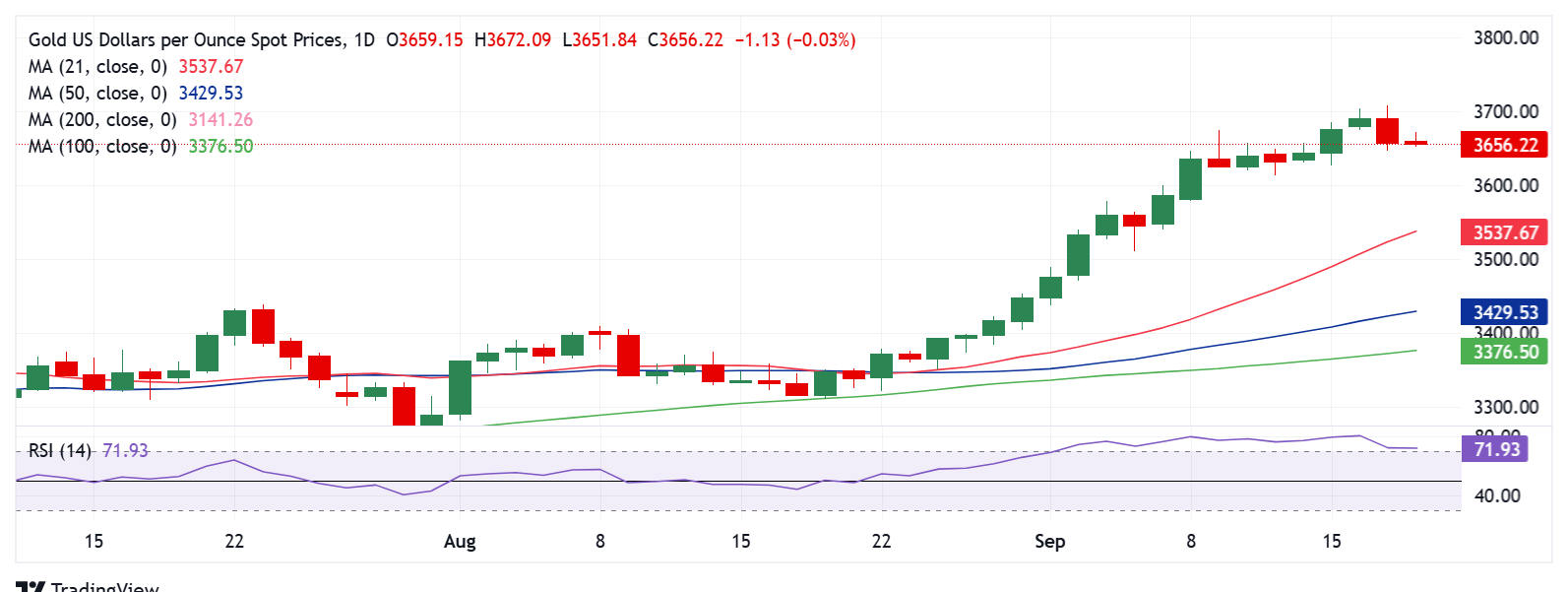
The daily chart shows that Gold buyers seem to be given another chance for a sustained uptrend as the 14-day Relative Strength Index (RSI) has finally eased considerably from the extreme overbought zone, from 80 to 72 levels, as of writing.
If dip-buying emerges and gathers strength, Gold could retest the record high at $3,708. A daily candlestick closing above that level will open doors toward the $3,750 region.
However, Gold could challenge this week’s low at $3,627 if the corrective decline extends.
Further down, the $3,600 round figure will be tested, below which the previous week’s low of $3,578 will be next on sellers’ radars.
Gold FAQs
Gold has played a key role in human’s history as it has been widely used as a store of value and medium of exchange. Currently, apart from its shine and usage for jewelry, the precious metal is widely seen as a safe-haven asset, meaning that it is considered a good investment during turbulent times. Gold is also widely seen as a hedge against inflation and against depreciating currencies as it doesn’t rely on any specific issuer or government.
Central banks are the biggest Gold holders. In their aim to support their currencies in turbulent times, central banks tend to diversify their reserves and buy Gold to improve the perceived strength of the economy and the currency. High Gold reserves can be a source of trust for a country’s solvency. Central banks added 1,136 tonnes of Gold worth around $70 billion to their reserves in 2022, according to data from the World Gold Council. This is the highest yearly purchase since records began. Central banks from emerging economies such as China, India and Turkey are quickly increasing their Gold reserves.
Gold has an inverse correlation with the US Dollar and US Treasuries, which are both major reserve and safe-haven assets. When the Dollar depreciates, Gold tends to rise, enabling investors and central banks to diversify their assets in turbulent times. Gold is also inversely correlated with risk assets. A rally in the stock market tends to weaken Gold price, while sell-offs in riskier markets tend to favor the precious metal.
The price can move due to a wide range of factors. Geopolitical instability or fears of a deep recession can quickly make Gold price escalate due to its safe-haven status. As a yield-less asset, Gold tends to rise with lower interest rates, while higher cost of money usually weighs down on the yellow metal. Still, most moves depend on how the US Dollar (USD) behaves as the asset is priced in dollars (XAU/USD). A strong Dollar tends to keep the price of Gold controlled, whereas a weaker Dollar is likely to push Gold prices up.
Author

Dhwani Mehta
FXStreet
Residing in Mumbai (India), Dhwani is a Senior Analyst and Manager of the Asian session at FXStreet. She has over 10 years of experience in analyzing and covering the global financial markets, with specialization in Forex and commodities markets.