Gold Price Forecast: XAU/USD defends $2,400, more upside looks likely
- Gold price bounces off $2,400 amid a positive start to a Big week.
- Despite risk aversion, the US Dollar stays softer with US Treasury bond yields.
- Gold price looks to $2,425, as the daily RSI turns north above 50.

Gold price is attempting a bounce from $2,400, having snapped a three-day corrective decline from record highs of $2,484. Gold price capitalizes on a broad-based US Dollar softness alongside sluggish US Treasury bond yields even as markets stay risk averse.
Gold price keenly awaits top-tier US economic data
As investors digest the recent US political developments, the US Dollar maintains a weaker undertone so far this Monday. On Sunday, US President Biden dropped out of the election race and endorsed Vice President Kamala Harris for the Democratic ticket. Online betting site PredictIT showed pricing for a victory by Donald Trump had fallen 4 cents to 60 cents, while Harris climbed 12 cents to 39 cents, per Reuters.
A Democratic win would imply higher taxes and the need for lower borrowing costs, suggesting that policy easing for the US Federal Reserve (Fed). This, in turn, would be bearish for the US Dollar in the long term. Therefore, the Greenback is unable to take advantage of the market’s anxiety amid renewed China growth worries while gearing up for key US event risks later this week.
The US equity and Treasury futures rise, exerting negative pressure on the US Treasury bond yields across the curve, lending additional support to the non-yielding Gold price. Markets also seem to ignore the People’s Bank of China’s (PBOC) interest-rate cuts to its one-year and five-year mortgage lending rates, as it raises concerns that the government recognizes the downward pressure on China’s economy.
Markets also stay unnerved as a packed week of corporate earnings unfolds, with Tesla and Google-parent Alphabet due on the cards. Additionally, traders resort to repositioning ahead of Thursday’s advance US second-quarter Gross Domestic Product (GDP) and the Fed favored inflation gauge out on Friday.
Markets are currently pricing in a September rate cut, as futures show a 97% chance, according to the CME Group’s FedWatch Tool.
Ahead of these key events, Gold price could maintain a buoyant tone amid dovish Fed expectations and the US political uncertainty. However, the fading Asian physical demand for Gold price could act as a headwind for the bright metal. Asian customers, especially the Indians, refrained from making new purchases despite deep discounts, as they preferred to book profits on record-high bullion prices.
China, dealers were offering discounts of up to $6 an ounce on international spot prices, the lowest in more than two years as per Reuters records.
Gold price technical analysis: Daily chart
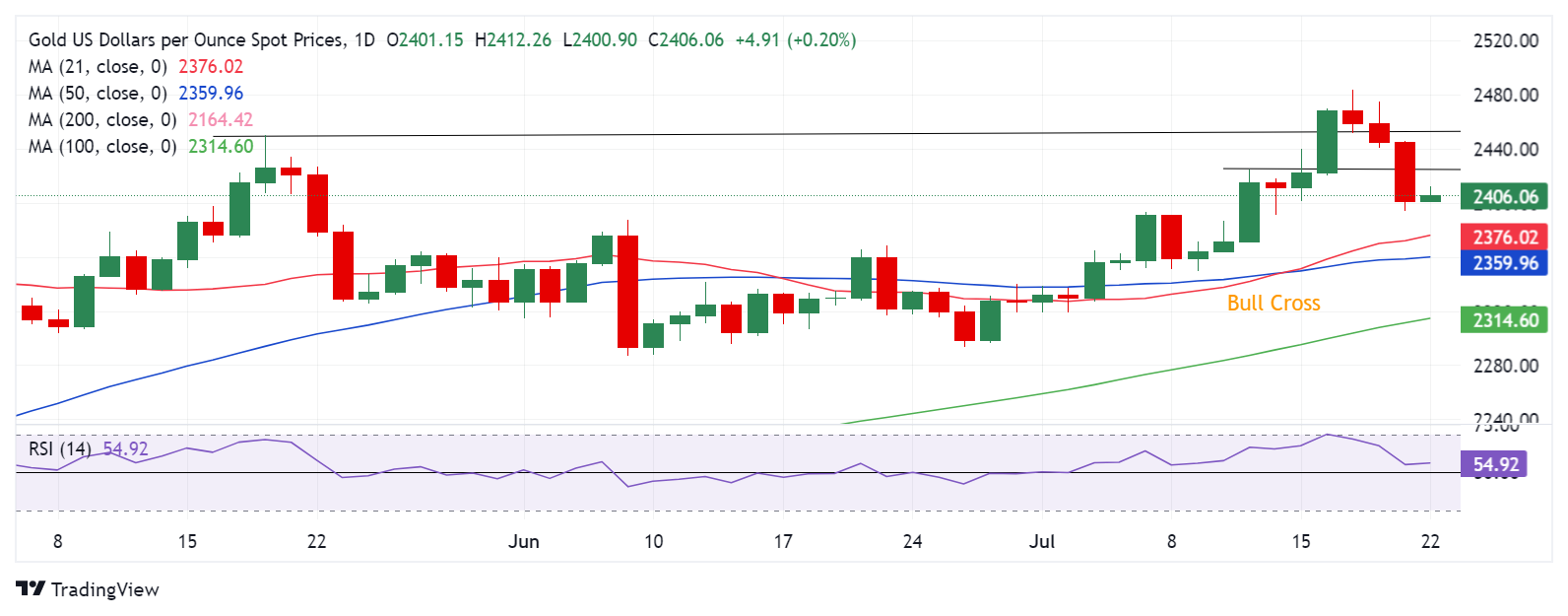
Gold price has found fresh buyers, as the 14-day Relative Strength Index (RSI) stalls its descent and turns north again while holding above the 50 level. The indicator is currently at 55.
The 21-day and 50-day Simple Moving Averages (SMA) Bull Cross also remains in play, adding credence to the renewed upside in Gold price.
if Gold price rebound picks up strength, the $2,425 static resistance will be tested. The next topside barrier is seen at the previous lifetime high of $2,450, above which buyers will target the new all-time high of $2,484 reached last week.
Conversely, should sellers fight back control, Gold price could challenge the $2,400 threshold once again. Acceptance below that level could accentuate the downside toward the 21-day SMA at $2,376.
Additional weakness could expose the 50-day SMA support at $2,360.
Gold FAQs
Gold has played a key role in human’s history as it has been widely used as a store of value and medium of exchange. Currently, apart from its shine and usage for jewelry, the precious metal is widely seen as a safe-haven asset, meaning that it is considered a good investment during turbulent times. Gold is also widely seen as a hedge against inflation and against depreciating currencies as it doesn’t rely on any specific issuer or government.
Central banks are the biggest Gold holders. In their aim to support their currencies in turbulent times, central banks tend to diversify their reserves and buy Gold to improve the perceived strength of the economy and the currency. High Gold reserves can be a source of trust for a country’s solvency. Central banks added 1,136 tonnes of Gold worth around $70 billion to their reserves in 2022, according to data from the World Gold Council. This is the highest yearly purchase since records began. Central banks from emerging economies such as China, India and Turkey are quickly increasing their Gold reserves.
Gold has an inverse correlation with the US Dollar and US Treasuries, which are both major reserve and safe-haven assets. When the Dollar depreciates, Gold tends to rise, enabling investors and central banks to diversify their assets in turbulent times. Gold is also inversely correlated with risk assets. A rally in the stock market tends to weaken Gold price, while sell-offs in riskier markets tend to favor the precious metal.
The price can move due to a wide range of factors. Geopolitical instability or fears of a deep recession can quickly make Gold price escalate due to its safe-haven status. As a yield-less asset, Gold tends to rise with lower interest rates, while higher cost of money usually weighs down on the yellow metal. Still, most moves depend on how the US Dollar (USD) behaves as the asset is priced in dollars (XAU/USD). A strong Dollar tends to keep the price of Gold controlled, whereas a weaker Dollar is likely to push Gold prices up.
Author

Dhwani Mehta
FXStreet
Residing in Mumbai (India), Dhwani is a Senior Analyst and Manager of the Asian session at FXStreet. She has over 10 years of experience in analyzing and covering the global financial markets, with specialization in Forex and commodities markets.