Gold Price Forecast: XAU/USD corrects to near $4,060 amid caution ahead of US NFP data
- Gold price retreats from $4,147 to near $4,047 ahead of US NFP data for October.
- The US Dollar bounces back as investors turn cautious ahead of US labor market report.
- OCBC expects the divided government may constrain fiscal expansion and weigh on US growth.
Gold corrects to near $4,047 after failing to extend the United States (US) midterm elections outcome-driven advance above $4,147 on Friday. A strong recovery move in the Gold price from its recent lows of $3,870.25 has been halted as the US Dollar (USD) regains ground, with financial markets turning cautious ahead of the Nonfarm Payrolls (NFP) data for October, which will be published at 13:30 GMT.
As of writing, the US Dollar Index (DXY), which gauges the Greenback’s value against six major currencies, trades 0.13% higher to near 101.70. Technically, a higher US Dollar makes the Gold price an unfavorable risk-reward bet for investors.
What to expect from US NFP report?
According to estimates, the US economy is expected to have created 65K new jobs, higher than 29K in September. The Unemployment Rate is seen as steady at 4.2%.
Average Hourly Earnings, a key measure of wage growth, is expected to have grown at a moderate pace of 2.9% Year-on-year (YoY) against 3% in September. On a monthly basis, the wage growth measure is seen rising 0.3% against the previous reading of 0.1%.
The data is expected to have a limited impact on Federal Reserve’s (Fed) interest rate expectations as remarks from Federal Open Market Committee (FOMC) members in last several months have signaled that they are more concerned about prolonged elevated inflation. About employment conditions, members have indicated that the labor demand has remained steady.
Logan’s call for more rate hikes reinforces hawkish Fed tone
Fed’s Logan delivers a distinctly hawkish message on October 30, with an FXS Speechtracker score of 8/10, slightly above the 7.7/10 historical average and signaling stronger-than-usual tightening bias relative to the established baseline. The insistence that the Fed “needs at least two more quarter-point rate hikes,” combined with the view that skipping a meeting does not alter the policy destination and that it is “unacceptable” that inflation is not headed back to 2%, underscores a clear commitment to making policy modestly restrictive while using gradual adjustments to limit economic damage and help households, businesses, and investors adapt to higher rates. Logan’s emphasis on strong economic growth, solid consumer spending, balanced-to-tightening labor markets, and supportive financial conditions further validates the case for additional tightening rather than an imminent pivot.
The FXS Fed Sentiment Index rose by 0.95 points to 143.62, firmly in hawkish territory and consistent with the above-baseline tone captured by the FXS Speechtracker. This elevated level signals that markets should expect the Dollar to remain supported as investors price in further policy tightening and a prolonged period of restrictive Fed stance.
Why Gold gained after US midterm elections?
Gold witnessed a strong buying interest after US Republicans face a setback in midterm elections on Wednesday. Democrats win majority seats in both Houses of Federal law. The victory of Democrats and a likely outcome of divided government prompted fears of tougher regulations on spending in Artificial Intelligence (AI) infrastructure and prolonged shutdown next year.
Strategists at OCBC highlight those precious metals “rebounded sharply following the US midterm elections, supported by a softer USD, lower US Treasury yields and oil prices as markets reassessed the implications of political gridlock for US fiscal policy and growth.” In their view, the shift in the political landscape has helped ease concerns over aggressive fiscal expansion, with “expectations that political gridlock may constrain fiscal expansion and weigh on US growth” offering “some relief to yields,” while “slippage in oil prices also lent support.” Against this backdrop, OCBC notes that “Gold rallied around 3%, reclaiming the 4000 level,” underscoring how the metal has responded to the more favourable macro mix of a weaker Dollar, lower yields and softer energy prices.
Gold Technical Analysis
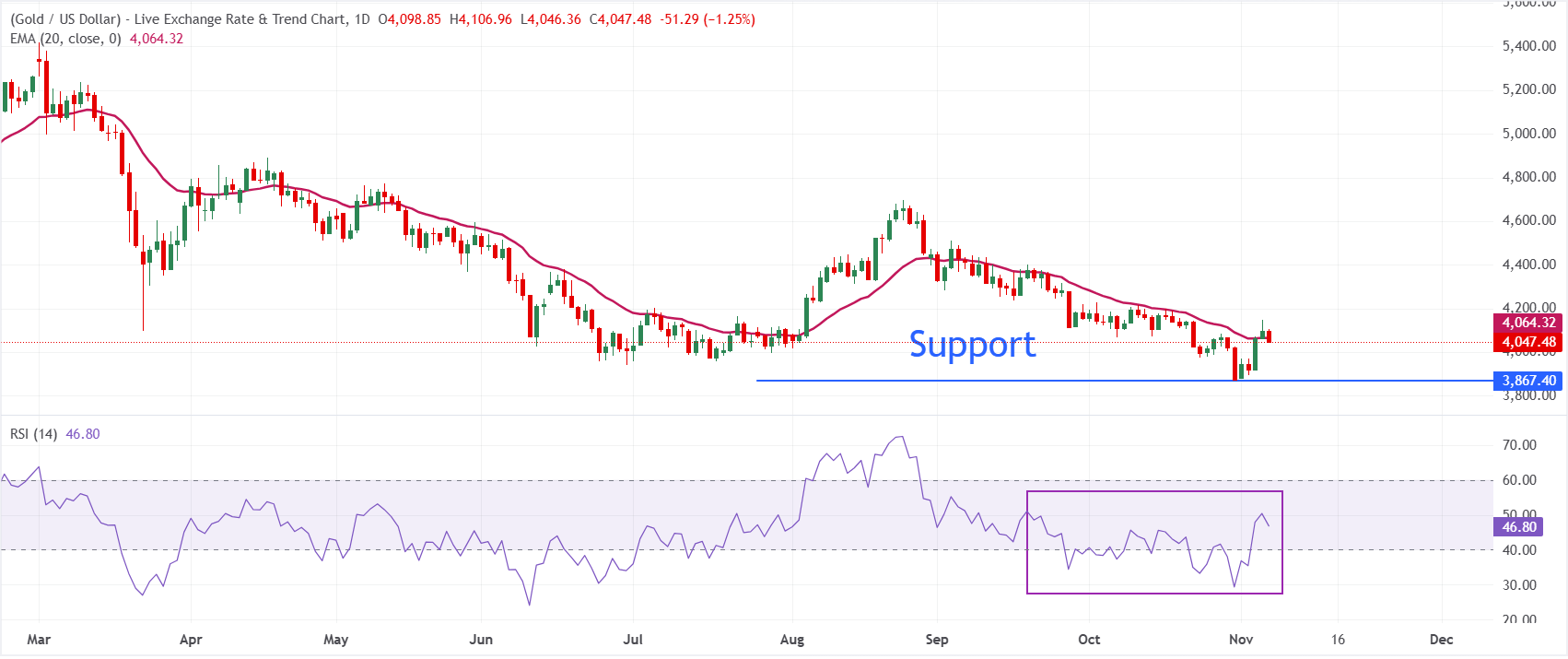
In the daily chart, XAU/USD trades at $4,047.83, keeping a mildly bearish near-term bias as it remains capped by the 20-day exponential moving average (EMA) at $4,064.36. Price action holds just under this dynamic barrier, suggesting topside attempts are still vulnerable, while the Relative Strength Index (14) at 46.82 stays below the midline and hints at lacking bullish conviction rather than outright selling pressure.
On the topside, immediate resistance is the November 5 high at $4,147, followed by $4,200. Looking down, the recent low of $3,870.25 will be the key support level.
(The technical analysis of this story was written with the help of an AI tool. Know more.)
Gold FAQs
Gold has played a key role in human’s history as it has been widely used as a store of value and medium of exchange. Currently, apart from its shine and usage for jewelry, the precious metal is widely seen as a safe-haven asset, meaning that it is considered a good investment during turbulent times. Gold is also widely seen as a hedge against inflation and against depreciating currencies as it doesn’t rely on any specific issuer or government.
Central banks are the biggest Gold holders. In their aim to support their currencies in turbulent times, central banks tend to diversify their reserves and buy Gold to improve the perceived strength of the economy and the currency. High Gold reserves can be a source of trust for a country’s solvency. Central banks added 1,136 tonnes of Gold worth around $70 billion to their reserves in 2022, according to data from the World Gold Council. This is the highest yearly purchase since records began. Central banks from emerging economies such as China, India and Turkey are quickly increasing their Gold reserves.
Gold has an inverse correlation with the US Dollar and US Treasuries, which are both major reserve and safe-haven assets. When the Dollar depreciates, Gold tends to rise, enabling investors and central banks to diversify their assets in turbulent times. Gold is also inversely correlated with risk assets. A rally in the stock market tends to weaken Gold price, while sell-offs in riskier markets tend to favor the precious metal.
The price can move due to a wide range of factors. Geopolitical instability or fears of a deep recession can quickly make Gold price escalate due to its safe-haven status. As a yield-less asset, Gold tends to rise with lower interest rates, while higher cost of money usually weighs down on the yellow metal. Still, most moves depend on how the US Dollar (USD) behaves as the asset is priced in dollars (XAU/USD). A strong Dollar tends to keep the price of Gold controlled, whereas a weaker Dollar is likely to push Gold prices up.
Author

Sagar Dua
FXStreet
Sagar Dua is associated with the financial markets from his college days. Along with pursuing post-graduation in Commerce in 2014, he started his markets training with chart analysis.