Neither the election nor the US Dollar: Why Friday's payrolls hold the key to Gold's next move
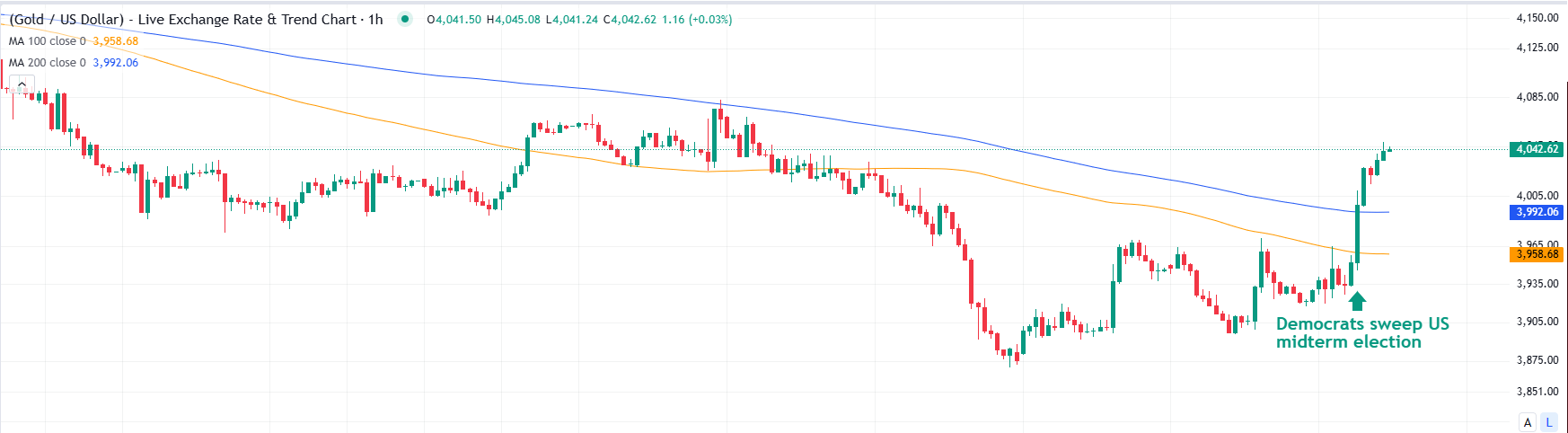
Gold (XAU/USD) has climbed back above $4,000 as the US Dollar (USD) weakened following a Democratic sweep in the US midterm elections. However, with every Gold rally facing heavy selling throughout the year, investors are looking to Friday's Nonfarm Payrolls (NFP) report to determine whether this move marks a sustainable breakout or just another temporary rebound.

Election fallout and the market reaction
American voters went to the polls on Tuesday night, delivering a clean sweep for the Democrats. Markets responded immediately: the US Dollar sold off sharply, pushing the yellow metal back above the $4,000 mark.
A divided government shifts the policy outlook, as a Democrat-controlled Congress can block, delay, or reshape the White House agenda across spending, trade, and foreign policy. Foreign policy proved to be a decisive issue on the ballot, particularly US President Donald Trump’s military campaign in the Middle East. Oil traders interpreted the election outcome as reducing the risk of further escalation and supply disruptions, driving WTI lower to near $88 a barrel on Wednesday.
In a single session, markets priced in a weaker US Dollar, cheaper Oil, and Gold above $4,000 — a strong structural setup for Gold bulls on paper.
Macro dynamics: US Dollar and Oil pressure easing
To assess whether this rally can endure, it helps to examine Gold’s relationship with Oil and the US Dollar. The link to the Greenback is straightforward: because Gold is priced in US Dollars, a weaker Greenback makes the metal cheaper for international buyers.
The link to Oil is equally critical. Higher Oil prices fuel inflation, prompting the Federal Reserve (Fed) to maintain a tighter monetary policy. Higher interest rates create headwinds for non-yielding assets like Gold. Earlier this year, elevated Oil prices weighed heavily on Gold. Now, both headwinds — a strong US Dollar and expensive Oil — are easing at the same time, raising the key question of whether Gold's broader downtrend is ending.
Labor market cooling and the Fed's dual mandate
The political shift alone will not dictate the yellow metal’s trajectory; the Federal Reserve’s policy path will. Friday's employment report provides the market with its first major opportunity to reprice Fed expectations under the updated political landscape.
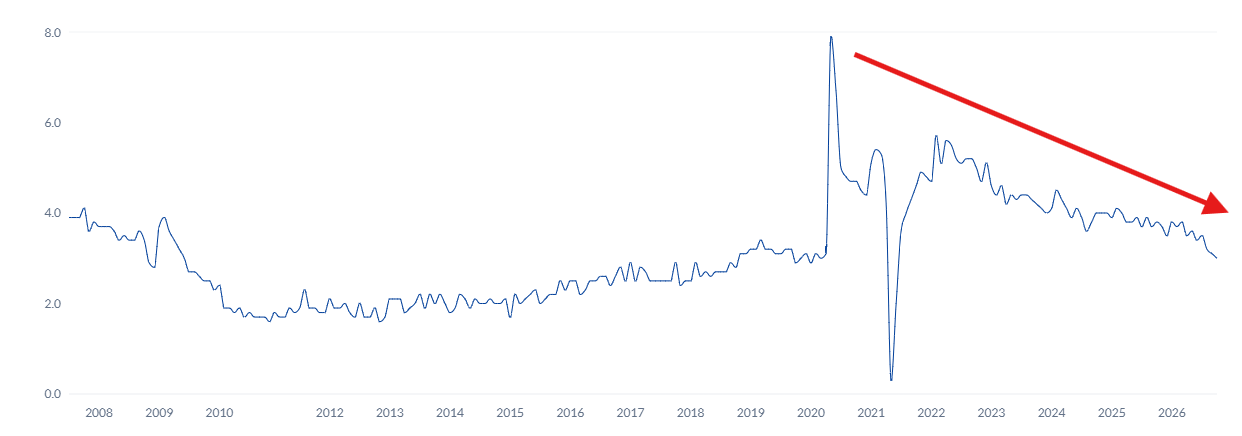
US job creation has slowed significantly. Over the past year, Nonfarm Payrolls have averaged 41,000 new jobs per month, compared to the five-year average of 187,000. Two primary structural forces are driving this trend:
- Supply side: Immigration policy changes under President Trump have constrained the available labor pool.
- Demand side: The expansion of AI technology has shifted corporate hiring strategies, allowing companies to maintain productivity with fewer workers.
Wage growth reflects this deceleration, with Average Hourly Earnings rising at an annual rate of 3% in September, down from over 5% in 2022. For Gold investors, a cooling labor market and slowing wage inflation provide the Fed with reason to pause monetary tightening. Each soft economic release allows markets to price out future interest rate hikes, offering support to Gold.
Interest rate expectations and current pricing
While recent political developments impacted currency and commodity markets, interest rate expectations remain largely unchanged. According to the CME FedWatch tool, traders still price in roughly an 80% chance of a rate hike in December, rendering that decision mostly priced into current valuations. Further out, expectations for March remain split 50-50.
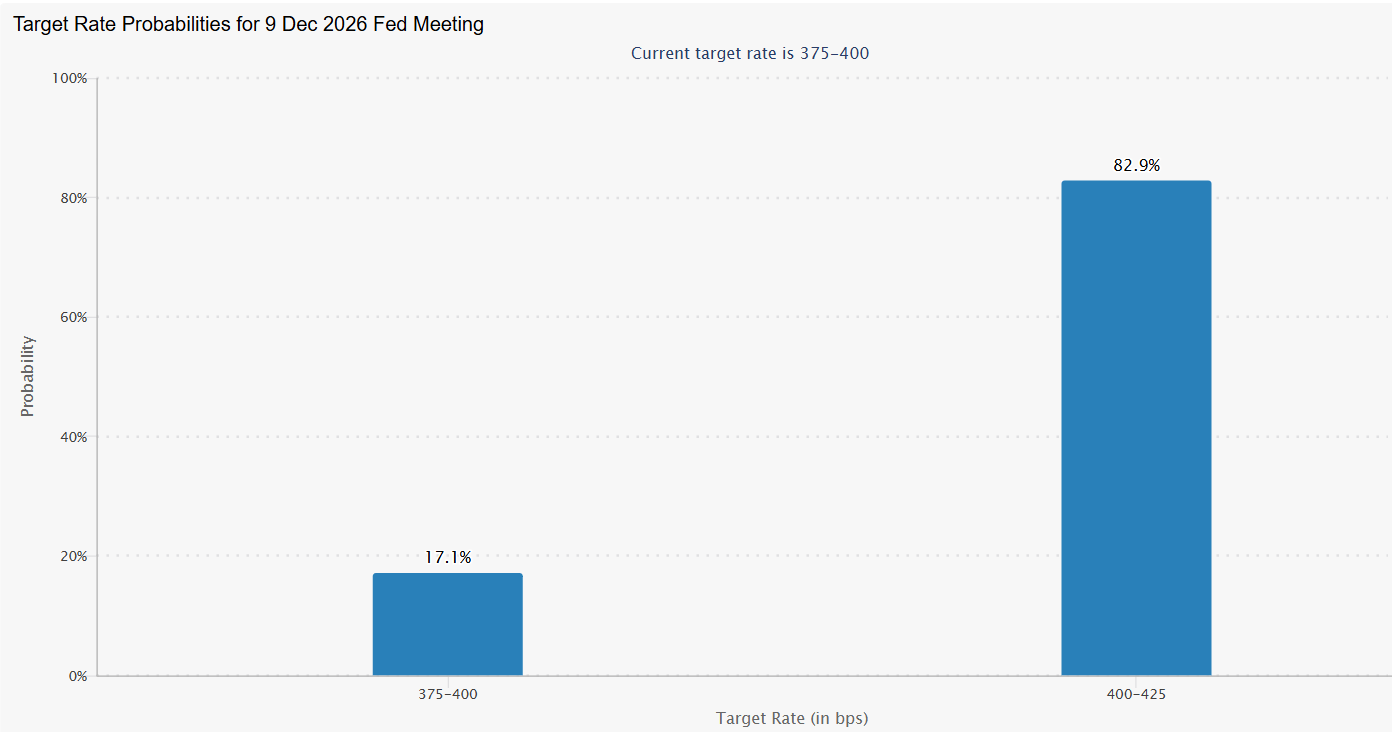
While the Fed's primary focus has been controlling inflation, maximum employment represents the second component of its dual mandate. With December largely anticipated, whether the Fed continues hiking into 2027 remains an open question that Friday’s data could help answer.
Scenarios for Friday's NFP report
Consensus expectations point to 65,000 jobs added in October. While above the recent monthly average, this figure remains modest relative to historical standards. Revisions to the prior two months will also play a key role in shaping market sentiment.
Two primary scenarios present themselves for Friday's release:
- Scenario one (A miss): If the headline figure and revisions fall below expectations, markets will likely reduce the probability of additional rate hikes next year. Lower interest rate expectations combined with a weaker US Dollar would support further upside in Gold.
- Scenario two (A beat): If the data comes in stronger than expected, market reaction to the headline number may remain muted given the Fed’s focus on inflation. In this scenario, market attention will shift to Average Hourly Earnings, which are expected to slow to 2.9% in October from 3.0%. If wage growth continues to moderate, potential downside pressure on the yellow metal should remain limited. Conversely, a reacceleration in wage growth would challenge Gold bulls.
Leading indicators suggest potential for a modest beat. JOLTS Job Openings for September rose to 7.52 million (above the 7.13 million expected), while ADP private sector employment expanded by 86,000 (exceeding the 69,000 forecast). However, the ISM Manufacturing employment index contracted slightly to 52.4 in October from 52.7 in September.
Technical levels to watch
The sell-off in the US Dollar triggered a strong upside move in Gold, achieving key technical milestones:
- Target achieved: The Ending Wedge pattern target of $4,082 was reached.
- Resistance zones: The rally encountered resistance near the 261.8% extension level at $4,135. While Elliott wave structure suggests a potential downside correction, broader correlation metrics indicate mild ongoing upside pressure. The next major resistance barrier sits at $4,196, with the $4,196–$4,200 area expected to attract selling interest.
- Key support: Time cycle support is positioned at $3,946.
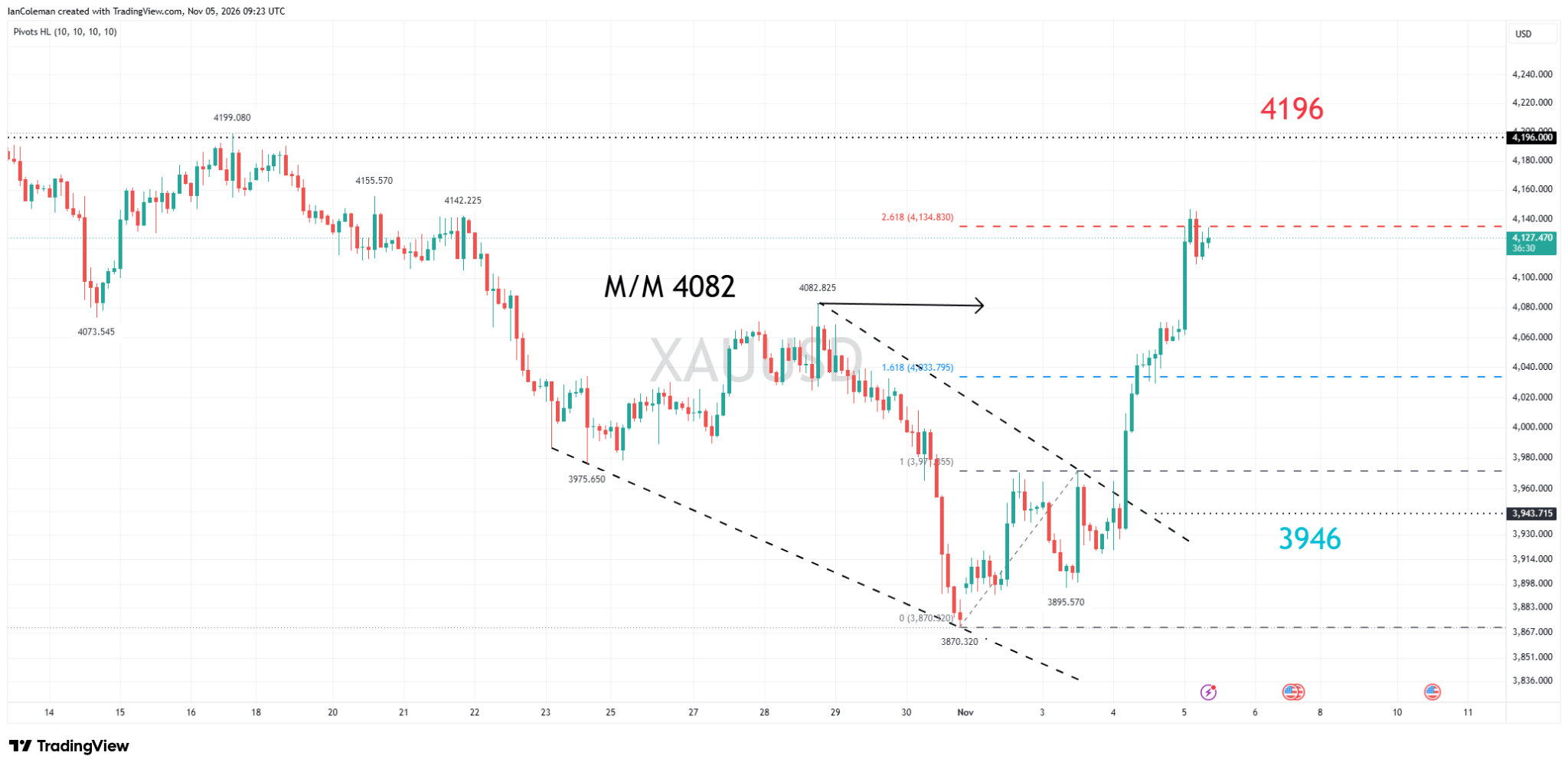
Gold has reclaimed the $4,000 level, but interest rate expectations have not yet fully adjusted. Friday's employment report will clarify whether this price action represents a broader structural breakout or a temporary rally within a wider range.
(This article was created with the help of an Artificial Intelligence tool and reviewed by an editor. Know more.)
Author

Ian Coleman
FXStreet
Ian started his financial career at the age of 18 working as a Junior Swiss Broker at Godsell Astley and Pearce (London). He quickly moved through the ranks and was Desk Manager at RP Martins at the age of 29.