Gold Price Forecast: XAU/USD buyers take breather before the next run to $4,000
- Gold holds the previous retracement from record highs of $3,895 early Thursday.
- US Dollar struggles with its overnight rebound amid US government shutdown concerns.
- Technically, Gold remains a ‘buy-the-dips’ trade, with the four-hourly RSI within the bullish zone.

Gold is modestly in the red for the first time in six trading days early Thursday, holding its retreat from record highs of $3,895 reached mid-Wednesday.
Gold stays supported amid US fiscal and data woes
Concerns over the United States (US) government shutdown-induced delay in critical employment and inflation data weighed on investors as they flocked to safety in the traditional safe haven Gold.
The delay in the US statistics could probably raise doubts on the scope and timing of further US Federal Reserve (Fed) interest rate cuts beyond the October 28-29 meeting, This narrative dented the sentiment around the US Dollar (USD), further helping Gold stretch its record raly.
However, the USD changed course in the mid-American session and staged a decent comeback following the news that the Supreme Court allowed Fed Governor Lisa Cook to remain in her post pending oral arguments in January on whether President Donald Trump has legal cause to fire her., per CNBC News.
Gold paused its record run and pulled back sharply from fresh lifetime highs on the USD turnaround to settle Wednesday near $3,865.
In Thursday’s trading so far, Gold is consolidating the previous retracement moves, supported above the $3,850 barrier.
The bright metal is drawing support from lingering geopolitical tensions surrounding Russia and Ukraine.
The Group of Seven (G7) nations vowed to tighten sanctions enforcement against Russia, pledging to phase out remaining imports and warning of penalties for countries and firms helping to finance Moscow’s war effort.
Following this announcement late Wednesday, the Wall Street Journal (WSJ) reported, quoting US President Trump that he will provide Ukraine with intelligence to support long-range missile strikes on Russian energy infrastructure.
Additionally, impending worries over the effects of the US shutdown and increased October Fed rate cut expectations will likely keep any pullback in Gold price short-lived as markets take account of weakening US labor market conditions.
The Automatic Data Processing (ADP) showed on Wednesday, private companies shed a seasonally adjusted 32,000 jobs during the month, the biggest slide since March 2023. Markets expected an increase of 50,000 in the reported month.
The US ADP data outweighed the uptick in the ISM Manufacturing PMI to 49.1 in September.
Looking ahead, traders will continue to pay close attention to whether the lawmakers will reach an interim deal to pause the shutdown, enabling the release of the US weekly Jobless Claims and August Factory Orders, originally scheduled later in the day.
Gold price technical analysis: Four-hourly chart
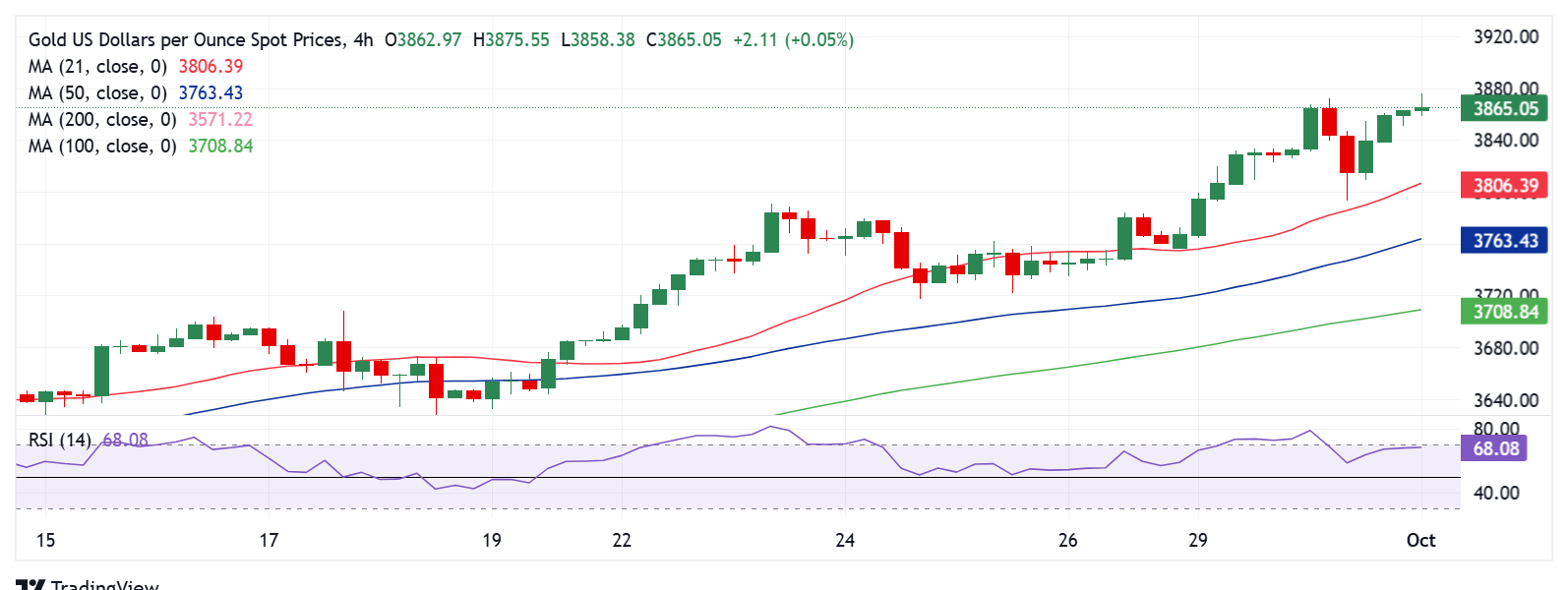
As observed on the four-hour chart, the 14-day Relative Strength Index (RSI) remains within the bullish territory, currently near 64.
Therefore, the leading indicator suggests that the Gold uptrend remains well in place in the near term, and that any dip could be quickly bought in.
Buyers must find acceptance above the $3,900 level on a daily closing basis to resume the bullish momentum.
The next topside hurdle is located at the $3,950 barrier on the way to the $4,000 mark.
Conversely, any retracement pullback could test the initial support at $3,839, the 21-Simple Moving Average (SMA), below which the 50-SMA at $3,787 would be tested.
Deeper correction could target the September 24 low near $3,720, where the 100-SMA coincides.
Gold FAQs
Gold has played a key role in human’s history as it has been widely used as a store of value and medium of exchange. Currently, apart from its shine and usage for jewelry, the precious metal is widely seen as a safe-haven asset, meaning that it is considered a good investment during turbulent times. Gold is also widely seen as a hedge against inflation and against depreciating currencies as it doesn’t rely on any specific issuer or government.
Central banks are the biggest Gold holders. In their aim to support their currencies in turbulent times, central banks tend to diversify their reserves and buy Gold to improve the perceived strength of the economy and the currency. High Gold reserves can be a source of trust for a country’s solvency. Central banks added 1,136 tonnes of Gold worth around $70 billion to their reserves in 2022, according to data from the World Gold Council. This is the highest yearly purchase since records began. Central banks from emerging economies such as China, India and Turkey are quickly increasing their Gold reserves.
Gold has an inverse correlation with the US Dollar and US Treasuries, which are both major reserve and safe-haven assets. When the Dollar depreciates, Gold tends to rise, enabling investors and central banks to diversify their assets in turbulent times. Gold is also inversely correlated with risk assets. A rally in the stock market tends to weaken Gold price, while sell-offs in riskier markets tend to favor the precious metal.
The price can move due to a wide range of factors. Geopolitical instability or fears of a deep recession can quickly make Gold price escalate due to its safe-haven status. As a yield-less asset, Gold tends to rise with lower interest rates, while higher cost of money usually weighs down on the yellow metal. Still, most moves depend on how the US Dollar (USD) behaves as the asset is priced in dollars (XAU/USD). A strong Dollar tends to keep the price of Gold controlled, whereas a weaker Dollar is likely to push Gold prices up.
Author

Dhwani Mehta
FXStreet
Residing in Mumbai (India), Dhwani is a Senior Analyst and Manager of the Asian session at FXStreet. She has over 10 years of experience in analyzing and covering the global financial markets, with specialization in Forex and commodities markets.