Gold Price Forecast: XAU/USD buyers take a breather after testing static resistance at $3,440
- Gold price turns south after hitting the key $3,440 hurdle early Wednesday.
- The US Dollar finds its feet amid US trade deals optimism with Japan and Canada.
- Technically, the path of least resistance appears to the upside for Gold price.

Gold price is replicating the reversal moves seen in Tuesday’s Asian trading, as buyers catch a breather early Wednesday, following two back-to-back days of solid gains.
Gold price pauses but buyers stay hopeful
Gold price refreshed five-week highs at $3,439 this Wednesday before turning south on a bout of profit-taking and a rebound in the US Dollar (USD).
Optimism surrounding US trade deals with Japan and Canada boosts risk flows back into the Asian markets, dampening the safe-haven status of Gold price while lifting the USD, considering easing US economic growth concerns.
Trump stated early Wednesday that he just completed a massive deal with Japan, perhaps the largest deal ever made. Japan's top trade negotiator Ryosei Akazawa confirmed on X, saying, “Mission Complete.”
On Tuesday, Canadian Prime Minister Mark Carney said that “We're working positively for a trade deal with Trump.”
Despite the positive shift in risk sentiment, investors remain wary amid a lack of substantial details on the US-Japan trade deal and ahead of the earnings report from the American tech giant Alphabet Inc, after the markets close on Wednesday.
Furthermore, Japanese political instability and uncertainty over a US-EU trade deal remain a drag on the sentiment, which could limit the Gold price downside.
A Japanese media outlet, Mainichi, reported on Wednesday that Prime Minister Shigeru Ishiba is set to resign by the end of August, following the defeat of his ruling Liberal Democratic Party (LDP) in the Upper House in Sunday's election.
Looking ahead, trade and political developments will continue playing a pivotal role in the Gold price action, while traders will also pay close attention to the feud between Trump and US Federal Reserve (Fed) Chairman Jerome Powell.
Gold price technical analysis: Daily chart
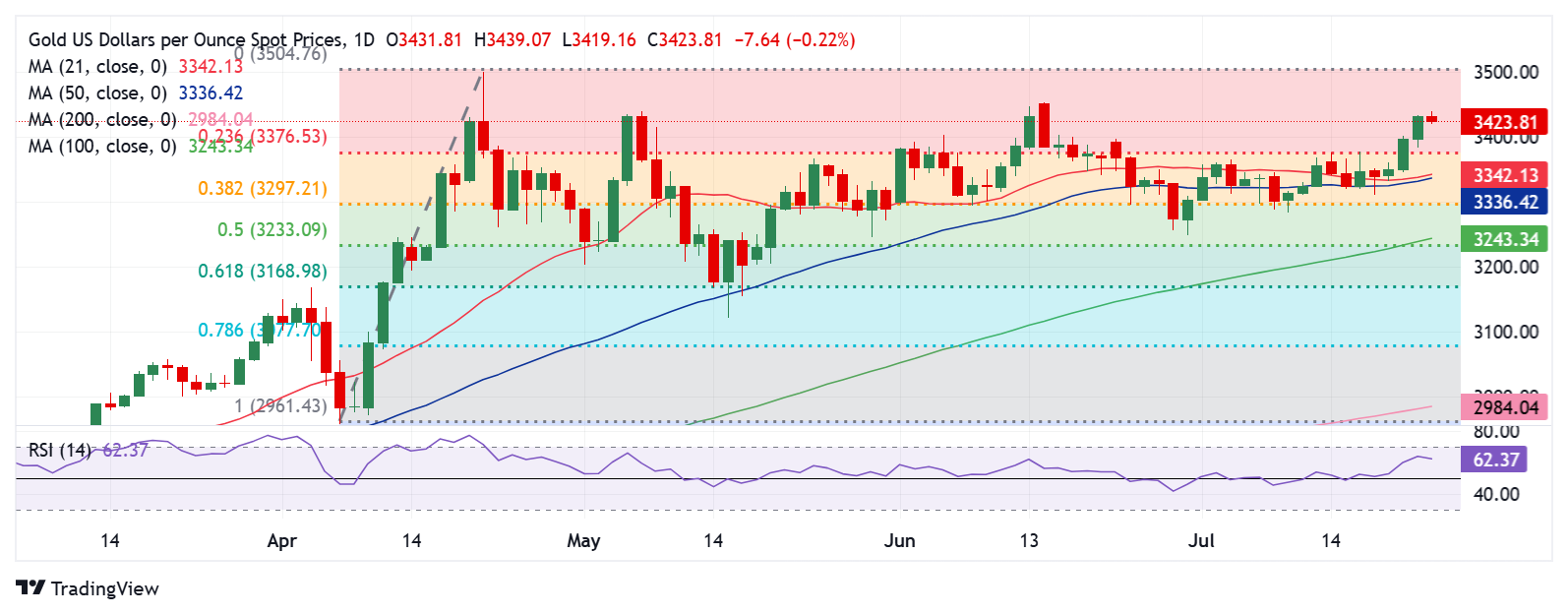
As observed on the daily chart, Gold price extended the break above the 23.6% Fibonacci Retracement (Fibo) level of the April record rally at $3,377.
The yellow metal holds its position well above all major Simple Moving Averages (SMA) as the 14-day Relative Strength Index (RSI) stays comfortably above the midline, despite the latest downtick.
The path of least resistance, therefore, appears to the upside, with acceptance above the $3,440 static resistance needed to take on the June 16 high of $3,453.
A sustained move above that level will fuel a fresh uptrend toward the record high of $3,500.
Alternatively, if the correction gathers pace, Gold price could test the previous resistance-turned-support at $3,377, below which the $3,340 area could lend some support. That zone is the confluence of the 21-day SMA and the 50-day SMA.
Sellers must find a strong foothold below that demand area to test the 38.2% Fibo level of the same rally at $3,297 before targeting the July low of $3,283.
Tariffs FAQs
Tariffs are customs duties levied on certain merchandise imports or a category of products. Tariffs are designed to help local producers and manufacturers be more competitive in the market by providing a price advantage over similar goods that can be imported. Tariffs are widely used as tools of protectionism, along with trade barriers and import quotas.
Although tariffs and taxes both generate government revenue to fund public goods and services, they have several distinctions. Tariffs are prepaid at the port of entry, while taxes are paid at the time of purchase. Taxes are imposed on individual taxpayers and businesses, while tariffs are paid by importers.
There are two schools of thought among economists regarding the usage of tariffs. While some argue that tariffs are necessary to protect domestic industries and address trade imbalances, others see them as a harmful tool that could potentially drive prices higher over the long term and lead to a damaging trade war by encouraging tit-for-tat tariffs.
During the run-up to the presidential election in November 2024, Donald Trump made it clear that he intends to use tariffs to support the US economy and American producers. In 2024, Mexico, China and Canada accounted for 42% of total US imports. In this period, Mexico stood out as the top exporter with $466.6 billion, according to the US Census Bureau. Hence, Trump wants to focus on these three nations when imposing tariffs. He also plans to use the revenue generated through tariffs to lower personal income taxes.
Author

Dhwani Mehta
FXStreet
Residing in Mumbai (India), Dhwani is a Senior Analyst and Manager of the Asian session at FXStreet. She has over 10 years of experience in analyzing and covering the global financial markets, with specialization in Forex and commodities markets.